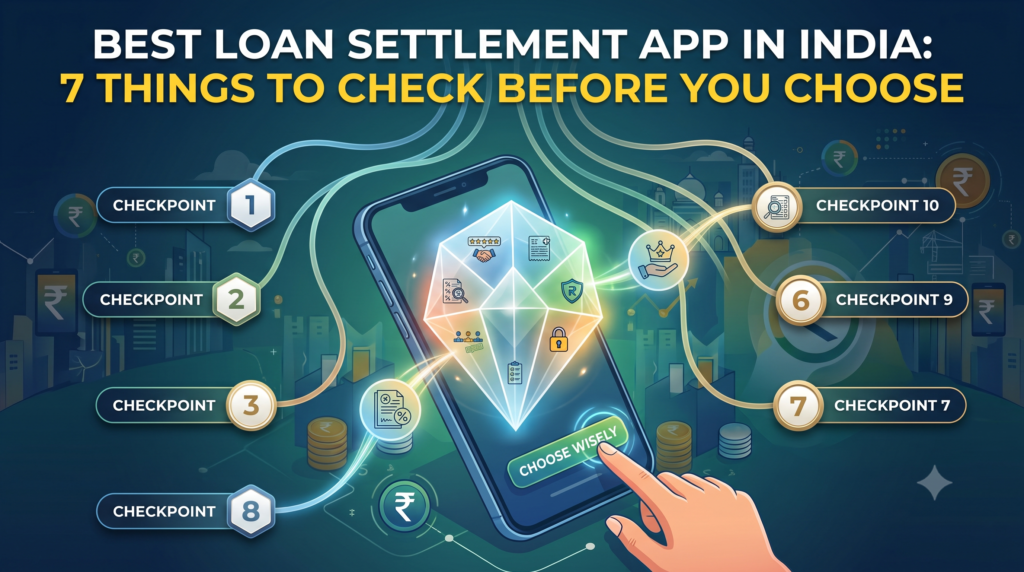
Navigating loan settlement apps in India can be confusing, but making the wrong choice could cost you. Before you commit, here are the 7 non-negotiable points you must review.
If you’re searching for the best loan settlement app in India right now, you’ve probably already noticed the problem: every single app claims to be the best one. That’s not helpful when you’re trying to make a real decision with your actual money on the line. Missing a few EMIs is stressful enough without having to sort marketing copy from genuine information.
Instead of ranking apps by their own claims, here’s a practical framework for evaluating any loan settlement app before you hand over your financial details so you can decide for yourself which one actually deserves to be called the best loan settlement app for your situation.
What Loan Settlement Actually Means
Loan settlement is a legitimate, RBI-recognized process where you negotiate with your lender to close an outstanding loan by paying a lump sum that’s less than the full amount owed. It’s officially called a One-Time Settlement (OTS). Banks agree to it because recovering a partial payment from someone who genuinely can’t repay in full is still better than recovering nothing at all.
It’s meant for genuine hardship job loss, medical emergencies, income disruption not as a way to dodge debt you can actually afford to pay. Keeping that distinction in mind matters before you even start comparing apps.
1. Does It Connect You Directly to Your Lender?
The best loan settlement apps put you in direct contact with the actual bank or NBFC specifically the team authorized to approve settlements, not general customer care. Extra layers of middlemen usually mean extra fees and slower resolution.
2. Are There Upfront Fees?
This is one of the biggest red flags when evaluating a loan settlement app. Legitimate platforms typically charge only after your case is successfully resolved. If an app or agent asks for payment before anything is settled, treat that as a serious warning sign it’s one of the most common scam patterns reported around loan settlement in India.
3. Is There a Verifiable Track Record?
Look past the homepage claims. Check app store ratings, read recent reviews (not just the featured ones), and see if the platform publishes any data you can actually cross-reference. Treat any published success rate as a starting point to verify, not a guarantee, when deciding which is genuinely the best loan settlement app for you.
4. Does It Cover Your Type of Debt?
Some platforms only handle personal loans. Others cover credit cards, NBFC loans, and business loans under one process. Confirm the app actually handles your specific debt type before signing up.
5. How Transparent Is the Process?
You should be able to see every settlement offer and every document before agreeing to anything. If a platform asks you to “just trust the process” without showing you the actual terms, that’s a problem transparency is one of the clearest markers separating a trustworthy app from a risky one.
6. Does It Help With Recovery Agent Harassment?
A genuinely useful loan settlement app should help ease collection pressure while your case is active, not leave you to deal with aggressive recovery calls on your own during the negotiation period.
7. Is There Support After Settlement?
Settlement affects your credit report your account shows as “Settled” rather than “Closed,” and that stays visible for a while. A good app should help you understand what comes next for rebuilding your CIBIL score, not just disappear once the loan is closed.
Three Ways to Actually Settle a Loan in India
Direct negotiation with your bank. Free, but you’re negotiating against people who do this professionally every day. Most individuals end up with weaker terms than they’d get with guidance.
A third-party settlement agent. Common, but risky many charge 5–15% of the settled amount, sometimes upfront. Fraud is a real problem in this space; never pay cash before a settlement is confirmed in writing.
A dedicated settlement app. This is where platforms built specifically for this purpose, like Zavo, aim to combine direct lender access with structured guidance, so you get bank-level negotiating leverage without doing it blind. Zavo states it charges nothing until a case is resolved and reports a 97% success rate across roughly 10 lakh users as with any self-reported figure, it’s worth verifying against current app reviews before deciding it’s the best loan settlement app for your case.
Settlement Isn’t Your Only Option
If you can still manage EMI payments with some breathing room, EMI relief (reduced payments, a moratorium, or restructured tenure) might be the better first step your total debt stays the same, but you buy time. Settlement makes more sense once repayment in full is genuinely off the table.
Red Flags to Never Ignore
- Anyone asking for cash upfront before a settlement is confirmed
- WhatsApp groups promising blanket loan waivers
- Messages claiming to be an “official RBI settlement scheme”
- Any request for your net banking login or OTP no legitimate platform will ever ask for this
Bottom Line
There’s no single objectively best loan settlement app what matters is whether a platform is transparent about fees, gives you direct lender access, and stays with you through credit recovery afterward, not just during negotiation. Run any app you’re considering through this 7-point checklist, verify their claims independently, and read recent reviews before committing.
Frequently Asked Questions
What makes an app the best loan settlement app in India?
Direct lender access, no upfront fees, a verifiable track record, transparent documentation, and post-settlement credit support not just marketing claims.
Is using a loan settlement app safe?
Yes, as long as the platform doesn’t ask for upfront payment or your banking credentials. Verify reviews and check that fees are charged only after resolution.
Does loan settlement hurt my credit score?
Yes, in the short term the account shows as “Settled” rather than “Closed.” Most people see meaningful score recovery within 12 to 24 months.