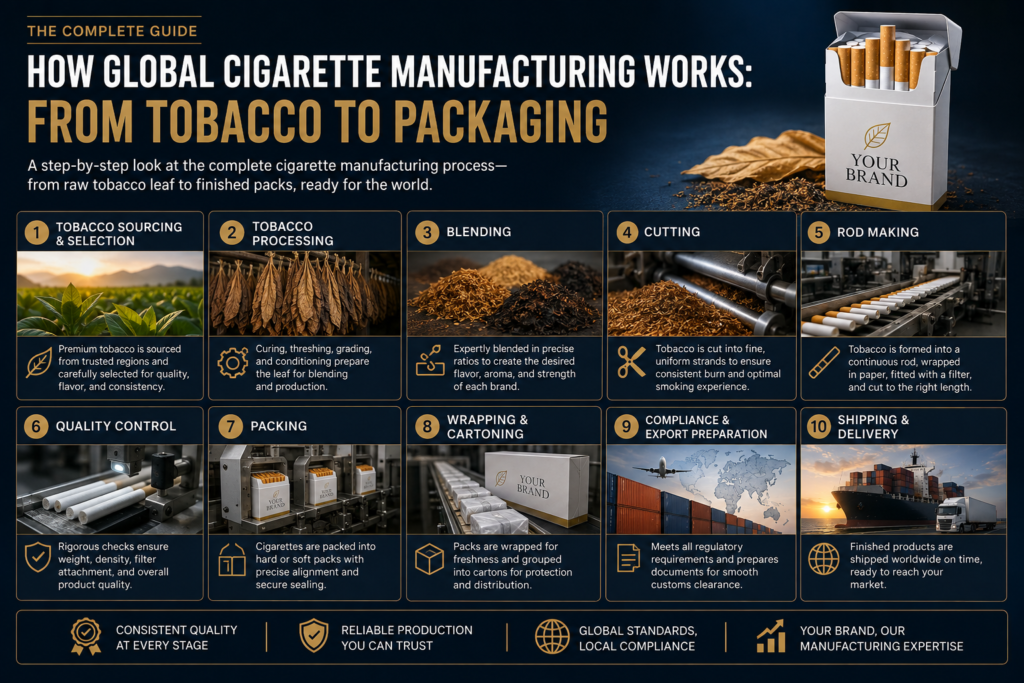
Global Cigarette Manufacturing: Step-by-Step Production Guide
Most brand owners and distributors interact with global cigarette manufacturing only at the final stage, a finished product arriving in cartons ready for their target market. But understanding what actually happens before that point, from raw tobacco leaf to sealed pack, gives brand owners a much clearer picture of what drives quality, cost, and production timelines. This guide walks through the full manufacturing process stage by stage.
Stage One: Tobacco Sourcing and Selection
Every cigarette starts with raw tobacco leaf, and the sourcing stage is where much of the final product’s character gets decided. Tobacco is grown across different regions globally, and each origin produces leaf with distinct characteristics in flavor, strength, and burn quality. Virginia tobacco, American blend combinations, Burley, and various specialty leaf types each bring something different to a finished blend.
Manufacturers with established sourcing relationships select leaf based on grade, moisture content, and characteristics suited to the specific blend they are producing. This stage happens well before any brand specific production begins, since tobacco is typically sourced, graded, and stored in advance of being allocated to a particular blend or order.
Stage Two: Tobacco Processing
Raw leaf is not ready for cigarette production straight from the field. Tobacco processing includes several steps that prepare the leaf for blending and production.
Curing. Depending on the tobacco type, leaf undergoes air curing, flue curing, or other curing methods that develop its final color, flavor, and chemical characteristics before it ever reaches a factory.
Threshing and grading. Cured leaf is separated from stems, sorted by grade and quality, and prepared for storage or immediate use in blending.
Conditioning. Tobacco moisture content is carefully controlled during processing, since leaf that is too dry becomes brittle and difficult to work with on production equipment, while leaf that is too moist can affect burn quality in the finished product.
Stage Three: Blending
Blending is where individual tobacco types are combined according to a specific recipe to create the flavor profile and strength characteristic of a particular brand. This is one of the most skill dependent stages in the entire manufacturing process, since the same base tobacco types can produce very different finished products depending on ratios, additional flavoring, and blending technique.
An experienced manufacturer maintains blend consistency across production runs, which matters enormously for brand owners since consumers expect the same product experience every time they purchase, regardless of which production batch their pack came from.
Stage Four: Cutting
Once blended, tobacco moves through a cutting stage where leaf is cut into the fine strands used in the finished cigarette rod. Cut width and consistency affect burn rate and smoking characteristics, so this stage is calibrated carefully to match the intended product specification rather than run at a single generic setting across every blend.
Stage Five: Rod Making
This is where the cigarette production line actually forms the recognizable cigarette shape. Cut tobacco is fed continuously into a cigarette making machine, which forms it into a continuous rod, wraps it in cigarette paper, and cuts it to length at high speed. Modern production lines run this stage automatically at significant volume, producing thousands of cigarettes per minute.
Filters are attached during this stage as well, either sourced from a separate filter production process or produced in house depending on the manufacturer’s setup. The filter material, length, and design all form part of the product specification agreed with the brand owner before production begins.
Stage Six: Quality Control
Throughout rod making and immediately after, finished cigarettes pass through quality checks covering weight consistency, filter attachment, paper sealing, and overall rod integrity. Manufacturers with strong quality control systems catch inconsistencies during production rather than after a full batch has already been packed, which protects both product consistency and production efficiency.
Stage Seven: Packing
Finished cigarettes move from the making stage into packing, where they are formed into packs according to the brand’s chosen format, hard pack or soft pack, and specific pack style. This stage involves folding foil liners, applying pack structure, and printing or applying the brand’s packaging artwork, including mandatory health warnings and regulatory markings required in the target market.
Pack format choice, decided earlier between the brand owner and manufacturer, directly determines which packing equipment and tooling is used at this stage.
Stage Eight: Wrapping and Cartoning
Once packs are formed and sealed, they move through wrapping, where an outer film is applied for freshness and protection, before being grouped into cartons for distribution. This stage prepares the product for the handling and transport it will go through on its way to the target market, whether that is domestic distribution or international export.
Stage Nine: Compliance and Export Preparation
For brands shipping internationally, finished product needs to meet the specific regulatory and documentation requirements of the destination market before it can be exported. This includes confirming health warning formats, labeling language, and any market specific compliance requirements, along with preparing the shipping documentation required for customs clearance.
A manufacturer with genuine export experience in your target market has typically already solved these requirements across many previous shipments, which reduces risk significantly compared to a manufacturer unfamiliar with international compliance for that specific destination.
Stage Ten: Shipping and Delivery
The final stage moves finished product from the factory to the brand owner or distributor, whether through domestic delivery or international freight. Lead time at this stage depends on production scheduling, order volume, and shipping method, and an experienced manufacturer will typically give brand owners a realistic timeline early in the order process rather than an optimistic estimate that shifts once production actually begins.
Why Understanding This Process Matters for Brand Owners
Brand owners do not need to manage any of these stages directly when working with an experienced manufacturing partner, but understanding what happens at each point helps in a few practical ways. It clarifies why blend, format, and specification decisions need to be finalized early, since changes become far more costly once production is already underway. It also helps brand owners ask better questions when evaluating a manufacturer, since knowing what a strong tobacco processing and production line setup actually looks like makes it easier to spot a manufacturer who cuts corners at any given stage.
At General Tobacco, the full manufacturing process, from tobacco sourcing through blending, production, packing, and export, runs under one roof with decades of production expertise behind it. Brand owners working with an established manufacturing process at every stage get a more consistent, reliable finished product, and a much clearer picture of what is actually happening behind their order from the moment it is placed to the moment it ships.