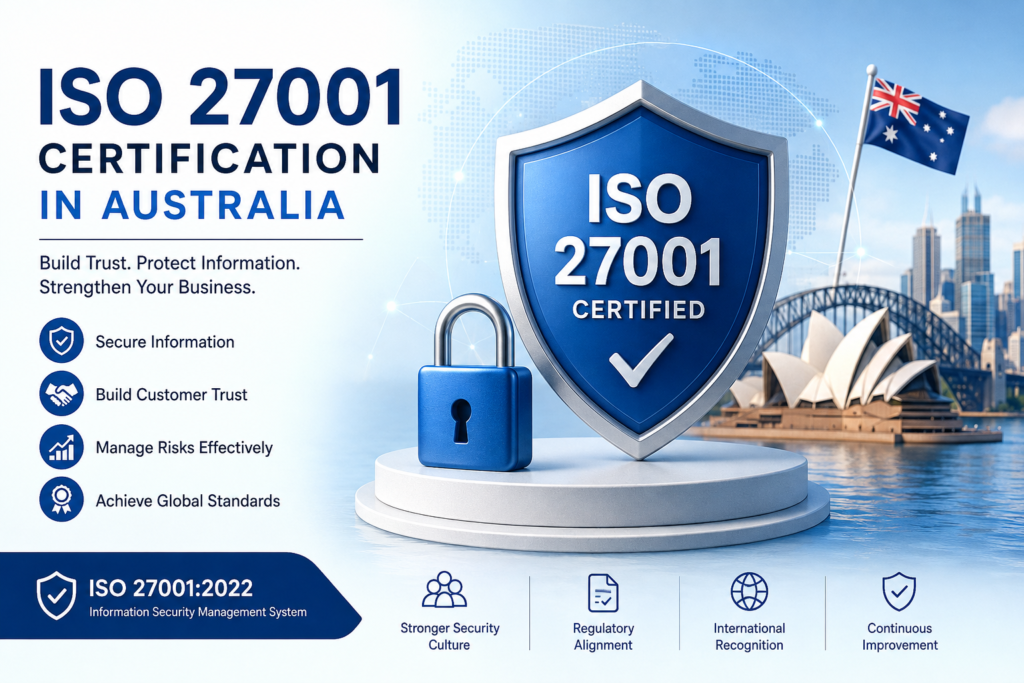
ISO 27001 certification in Australia is becoming increasingly important for organisations that need to demonstrate strong information security practices, protect sensitive data, and build trust with customers, partners, and regulators. ISO/IEC 27001:2022 provides a structured framework for establishing, implementing, maintaining, and continually improving an Information Security Management System (ISMS).
For Australian businesses, certification can also support broader security and compliance objectives involving the Privacy Act, customer security requirements, ASD Essential Eight, APRA CPS 234, and other industry-specific expectations. However, ISO 27001 certification is not simply about creating security policies. It requires an organisation to identify information-security risks, implement appropriate controls, maintain evidence, conduct internal audits, and successfully complete an independent certification audit.
What Is ISO 27001 Certification?
ISO 27001 is an internationally recognised standard for information security management. Certification demonstrates that an organisation has established a systematic approach to managing information-security risks.
Rather than focusing only on technology, ISO 27001 considers people, processes, governance, physical security, suppliers, information assets, and technical safeguards.
The 2022 edition includes a risk-based management approach and 93 controls in Annex A. Organisations determine which controls are applicable based on their risk assessment, business environment, and ISMS scope.
Certification can help businesses demonstrate that information security is actively managed rather than treated as a one-time technical project.
Why Is ISO 27001 Important for Australian Businesses?
Australian businesses increasingly operate in environments where customers expect evidence of strong security controls. SaaS companies, technology providers, financial service organisations, healthcare businesses, government suppliers, and professional service providers may encounter ISO 27001 requirements during procurement or vendor assessments.
Key benefits include:
- Improved information security: A formal ISMS helps identify and manage security risks systematically.
- Customer confidence: Certification provides independent evidence of an organisation’s security commitment.
- Competitive advantage: ISO 27001 can strengthen proposals and supplier assessments.
- Better risk management: Businesses establish processes for identifying, evaluating, treating, and monitoring information-security risks.
- Regulatory alignment: The framework can complement Australian security and privacy obligations.
- International recognition: ISO 27001 is widely recognised by organisations and customers worldwide.
- Continuous improvement: Certification requires ongoing monitoring, review, and improvement of the ISMS.
CyberSapiens notes that ISO 27001 can also complement frameworks such as ASD Essential Eight and SOC 2, allowing organisations with existing security controls to reuse relevant evidence and processes.
ISO 27001 Certification Process in Australia
Although the exact project structure depends on the organisation, the certification journey generally includes several important stages.
1. Define the ISMS Scope
The first step is deciding what the certification will cover. The scope may include particular products, services, locations, departments, systems, or business processes.
A clearly defined scope prevents unnecessary complexity while ensuring important information assets and processes are included.
2. Conduct a Gap Assessment
A gap assessment compares current security practices with ISO 27001 requirements. It identifies missing policies, technical controls, governance processes, documentation, evidence, and other areas requiring improvement.
The resulting roadmap helps establish priorities before implementation begins.
3. Perform Risk Assessment
Risk assessment is a core component of ISO 27001. Organisations identify information-security risks, assess their likelihood and potential impact, and determine appropriate treatment options.
The organisation then develops a Risk Treatment Plan and documents how significant risks will be addressed.
4. Develop the ISMS
The ISMS brings security governance, policies, procedures, responsibilities, risk management, monitoring, and continual improvement together into a structured system.
Typical documentation may include information-security policies, risk-management procedures, access-control requirements, incident-management processes, supplier-security procedures, business continuity requirements, and other supporting documentation.
5. Implement Applicable Controls
Organisations implement controls according to their identified risks and applicable requirements. Annex A provides a catalogue of controls covering areas such as organisational, people, physical, and technological security.
A Statement of Applicability (SoA) records which controls are applicable and explains their implementation status and justification.
6. Security Awareness and Training
Employees play an important role in information security. Organisations should provide appropriate awareness and training so employees understand their responsibilities regarding passwords, phishing, information handling, incident reporting, access control, and other relevant security practices.
7. Internal Audit
Before the external certification audit, an internal audit evaluates whether the ISMS is implemented effectively and meets applicable ISO 27001 requirements.
Any identified nonconformities or weaknesses should be addressed before the certification audit.
8. Management Review
Management reviews the ISMS to evaluate its effectiveness, performance, risks, objectives, audit findings, incidents, and opportunities for improvement.
This demonstrates that information security is supported at the leadership level.
9. Stage 1 and Stage 2 Certification Audits
An independent certification body conducts the certification process.
Stage 1 primarily reviews the organisation’s ISMS documentation, scope, readiness, and overall approach.
Stage 2 assesses whether the ISMS has been effectively implemented and is operating as required. Auditors may review records, interview employees, inspect evidence, and evaluate implemented controls.
If significant nonconformities are identified, corrective action may be required before certification can be issued.
How Long Does ISO 27001 Certification Take?
The timeline depends on organisation size, ISMS scope, existing security maturity, available resources, and the complexity of the systems being assessed.
CyberSapiens states that many organisations can complete its structured certification engagement in approximately 60–90 days, while larger or more complex scopes may require longer. Its broader implementation guidance indicates that many Australian SMEs and mid-sized organisations may take around three to six months depending on their starting point.
Businesses that already maintain SOC 2, Essential Eight, or mature security controls may be able to reuse documentation and evidence, potentially reducing implementation effort.
How Much Does ISO 27001 Certification Cost in Australia?
There is no single fixed cost because certification expenses depend on the scope, organisation size, complexity, existing controls, consulting requirements, and certification-body fees.
CyberSapiens’ current Australian market guidance gives indicative end-to-end investment ranges of approximately AUD $15,000–$35,000 for organisations with fewer than 50 employees, $30,000–$60,000 for mid-sized organisations, and $60,000+ for larger enterprises. These are indicative ranges rather than universal certification prices.
A business should request a detailed scope-based quotation rather than selecting a provider solely on the lowest price.
Choosing an ISO 27001 Certification Partner
When selecting an ISO 27001 consultant or certification partner, consider:
- Experience with ISO/IEC 27001:2022
- Qualified ISO 27001 Lead Auditors or Lead Implementers
- Australian business and regulatory experience
- Clear certification methodology
- Gap assessment and risk-management expertise
- Internal audit support
- Stage 1 and Stage 2 audit readiness
- Post-certification support
- Transparent pricing and deliverables
- Appropriate certification-body arrangements
It is also important to distinguish between an ISO 27001 consultant and an independent certification body. A consultant can help prepare and implement the ISMS, while the certification audit must be performed independently.
Why Choose CyberSapiens for ISO 27001 Certification in Australia?
CyberSapiens provides end-to-end ISO 27001 certification support for Australian organisations, covering gap assessment, ISMS development, risk assessment, documentation, control implementation, staff awareness, internal audit, management review, and certification audit preparation. Its website states that CyberSapiens is itself ISO 27001:2022 certified and provides remote services across Australia.
CyberSapiens supports organisations across sectors including SaaS and technology, financial services, healthcare, government contractors, managed service providers, professional services, education, and e-commerce.
For businesses pursuing ISO 27001 while also addressing penetration testing, SOC 2, or broader cybersecurity requirements, CyberSapiens offers complementary security and compliance services that can help create a more integrated security programme.
Frequently Asked Questions
1. Is ISO 27001 certification mandatory in Australia?
ISO 27001 certification is not universally mandatory for Australian businesses. However, customers, procurement teams, regulators, contracts, or industry requirements may make certification highly valuable or effectively necessary for certain organisations.
2. How long is an ISO 27001 certificate valid?
ISO 27001 certification generally operates on a three-year certification cycle, with surveillance audits during the cycle and a recertification audit afterward.
3. Can a small business get ISO 27001 certified?
Yes. Small businesses can achieve ISO 27001 certification by defining an appropriate ISMS scope and implementing controls proportionate to their risks, operations, and information-security requirements.
4. Does ISO 27001 replace the Essential Eight?
No. ISO 27001 and the ASD Essential Eight serve different purposes. ISO 27001 establishes a broader information-security management framework, while Essential Eight focuses on prioritised cybersecurity mitigation strategies. They can complement each other.
5. Can ISO 27001 help with customer security questionnaires?
Yes. Certification can provide independent evidence that an organisation operates a structured information-security management system, which may simplify customer due diligence and vendor security assessments.
6. Can CyberSapiens provide ISO 27001 certification support remotely?
Yes. CyberSapiens states that its ISO 27001 engagement is delivered remotely across Australia, including support for the certification audit stages.
7. What is the first step toward ISO 27001 certification?
The best starting point is usually an ISMS scope discussion and gap assessment. This establishes your current maturity, identifies gaps, and creates a practical roadmap toward certification.
Conclusion
ISO 27001 certification in Australia can help organisations establish a structured, risk-based approach to information security while strengthening customer trust and supporting business growth. The certification journey involves more than documentation: organisations must implement appropriate controls, maintain evidence, conduct internal audits, involve management, and demonstrate that the ISMS operates effectively.
With the right preparation and experienced guidance, Australian businesses can turn ISO 27001 from a compliance exercise into a practical framework for stronger security, better governance, and long-term resilience. CyberSapiens can support organisations through the journey from initial gap assessment to certification readiness and ongoing ISMS improvement.