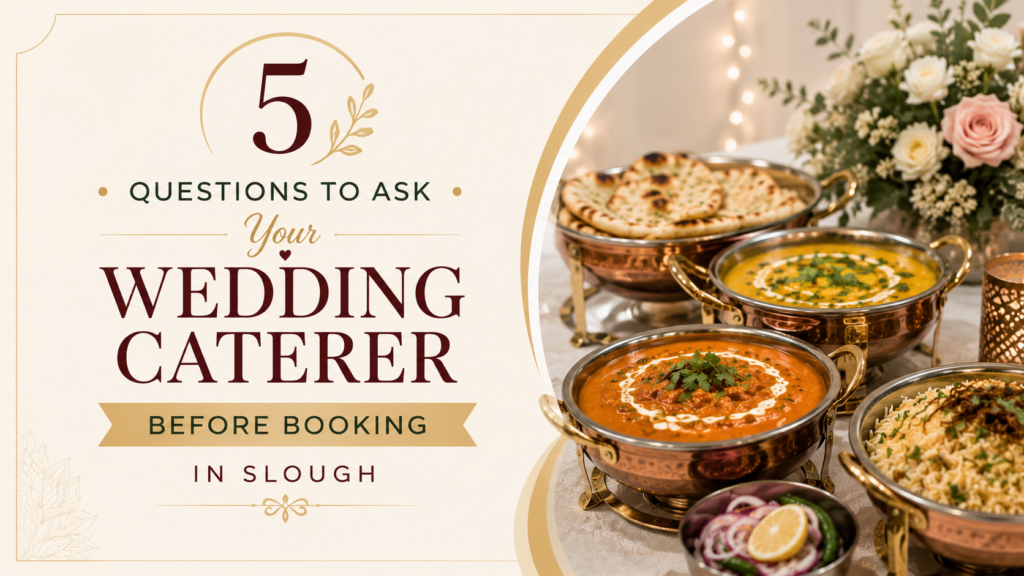
5 Questions to Ask Your Wedding Caterer Before Booking in Slough
Booking a wedding caterer feels like it should be simple. You taste some food, you like it, you sign a contract. In practice, the couples who end up happiest with their catering on the day are the ones who asked a handful of pointed questions before signing anything, not just at the tasting session, but during that first proper conversation.
Slough has plenty of strong catering options, from traditional British menus through to full South Asian feasts and everything fused in between. That range is a good problem to have, but it also means a bit more due diligence before committing. Here are five questions worth asking every caterer on your shortlist, and why each one matters more than it might first seem.
1. What’s Actually Included in the Quoted Price?
This is the question that saves the most money, and the most stress, later on. A quote that looks reasonable on the surface can hide extras that only appear once you’re deep into planning: VAT, staffing costs, crockery and linen hire, cake cutting fees, corkage if you’re bringing your own drinks. Ask directly whether the number you’re being given is the final figure or a starting point.
It’s also worth asking about minimum guest counts. Some caterers set a floor, say 80 guests, and charge that minimum regardless of your actual headcount. If your wedding is smaller and more intimate, this detail alone can rule certain caterers out before you go any further.
Payment structure matters too. Ask when the deposit is due, what percentage it represents, and the deadline for the final balance. Most caterers offering wedding catering services in slough will have a fairly standard structure here, but the details vary enough between providers that it’s worth getting in writing rather than assuming.
2. Have You Handled a Wedding Like Mine Before?
This sounds like a soft question, but the answer tells you a great deal. A caterer who’s mostly done corporate lunches and small private dinners might struggle with the logistics of a 250 guest wedding reception, even if their food is genuinely excellent. Scale changes everything, from kitchen timing to how quickly buffet stations need replenishing.
The same logic applies to cuisine. If you’re planning a fusion menu, a full South Asian feast, or a specific regional style, ask whether the caterer has real experience with it, not just a willingness to try. A kitchen that’s spent years perfecting a Punjabi menu will handle spice balance and timing very differently to one attempting it for the first time.
It’s fair to ask for references from couples with a similar guest count, cuisine style, and even season. Summer weddings with outdoor marquees present different challenges to winter receptions indoors, and a caterer with relevant recent experience is a safer bet than one working from general competence alone.
3. Can We Arrange a Proper Tasting?
A menu description on paper and the same dish cooked for 150 people are often two very different things. Spice balance, seasoning, and freshness all shift once a kitchen scales up, and the only reliable way to judge this is by actually tasting the food, ideally prepared close to how it will be on the day itself.
If a caterer is reluctant to offer a tasting, or only offers a rushed sample of one or two dishes, treat that as worth noting. It’s a reasonable ask, and most established caterers build tasting sessions into their process as standard.
This step matters even more for South Asian menus, where freshness and spice level can vary noticeably between kitchens. Spending some time looking through a Slough indian restaurants menu beforehand gives you a clearer sense of what to expect and what questions to ask during the tasting itself, rather than walking in without a reference point.
4. How Do You Handle Dietary Requirements at Scale?
Nearly every wedding has at least a few guests with dietary restrictions, whether that’s a vegetarian preference, a genuine allergy, or a religious dietary requirement. The question isn’t whether a caterer can accommodate these, most will say yes, it’s how they handle them once the guest count climbs into the hundreds.
Ask how dietary requirements get tracked between your initial conversation and the day itself. Is there a system for labelling dishes clearly at the buffet or ensuring the right plated meal reaches the right guest? Small mistakes here, a guest with a nut allergy served the wrong dish, aren’t just inconvenient, they can be genuinely dangerous.
It’s also worth asking whether dietary alternatives get the same care as the main menu. A vegetarian option that’s clearly an afterthought, a plain pasta dish tacked onto an otherwise carefully planned menu, tells you something about how the kitchen thinks about its guests more broadly.
5. What Happens With Sweets and Desserts?
Dessert often gets treated as a minor addition to the main catering conversation, but for many Slough weddings, particularly those with South Asian traditions, sweets carry real cultural weight. Barfi, ladoo, gulab jamun, and jalebi are frequently given to departing guests as favours, not just served as a final course, and general caterers don’t always handle this well.
Ask your caterer directly whether sweets are made in house or sourced from a specialist. If it’s the latter, ask who the specialist is and whether you have the option to arrange this separately. Many couples find it works better to Order Indian Sweets directly from a dedicated maker rather than leaving it bundled into the general catering order, since specialists like Maharaja Sweets tend to produce noticeably better quality than a kitchen treating sweets as a side note.
This is also a good moment to ask about lead times. The best sweet makers get booked well in advance during peak wedding season, so if your date falls between spring and early autumn, it’s worth locking this in early rather than leaving it until the final month of planning.
Putting the Answers Together
None of these five questions are designed to catch a caterer out. Good caterers answer all of them clearly and without hesitation, because they’ve been asked before and they know exactly how their process works. The caterers worth avoiding are the ones who get vague or defensive when you ask for specifics on pricing, experience, or dietary handling.
Take your shortlist through all five questions before booking anything, even if it means a slightly longer decision process than you’d planned. A wedding day runs on hundreds of small decisions made months in advance, and catering is one area where a bit of upfront diligence pays off directly in how smoothly the day actually feels once your guests sit down to eat.