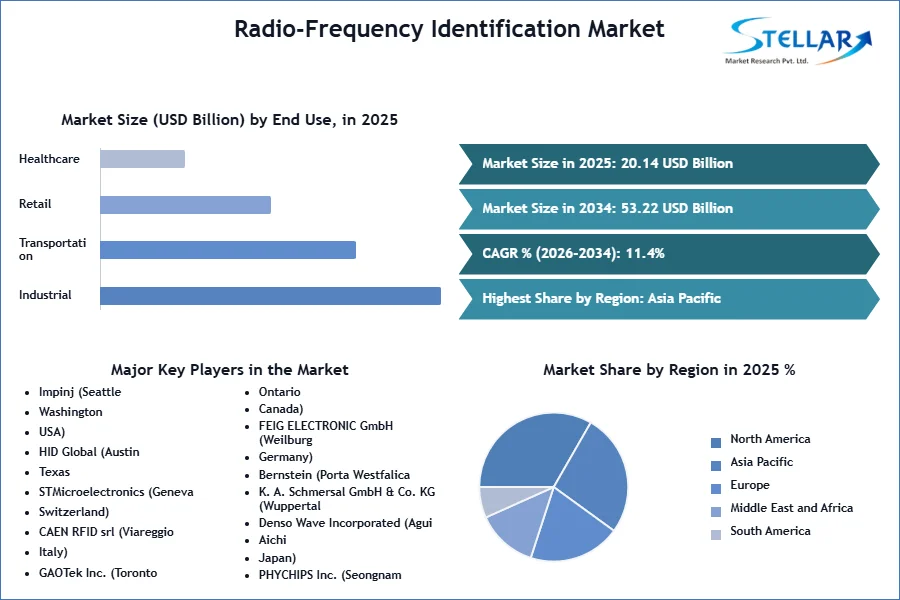
The global Radio-Frequency Identification (RFID) Market is entering a transformational growth phase, according to the latest exhaustive intelligence report released by Stellar Market Research. Valued at USD 20.14 Billion in 2025, the industry is projected to grow at a Compound Annual Growth Rate (CAGR) of 11.40% during the forecast period from 2026 to 2034, reaching a total market valuation of USD 53.22 Billion by 2034. As enterprise ecosystems demand frictionless asset visibility, zero-latency inventory tracking, and deep system automation, RFID technology has evolved from a basic digital barcode alternative into the foundational physical-to-digital layer of Industry 4.0.
This transition is fueled by the convergence of RFID hardware with edge computing, artificial intelligence (AI), and enterprise Internet of Things (IoT) architectures. Instead of merely reading static item IDs, modern RFID reader infrastructures aggregate contextual environmental data—such as location, temperature, and dwell time—allowing cloud analytics engines to dynamically optimize warehouse throughput, mitigate stockouts, and enforce anti-counterfeiting protocols across international borders.
Key Findings from the Report
-
Market Sizing & Growth: Global RFID revenue is forecasted to climb from USD 20.14 Billion in 2025 to USD 53.22 Billion by 2034, expanding at an 11.40% CAGR.
-
Dominant Component: RFID Tags maintained the largest market share in 2025, driven by massive item-level tagging initiatives in retail apparel, consumer electronics, and fast-moving consumer goods (FMCG).
-
Fastest-Growing Segment: RFID Readers & Infrastructure are expanding at the highest rate, reflecting rapid enterprise shifts toward continuous automated scanning via fixed overhead reader arrays over manual handheld operations.
-
Dominant Frequency Band: Ultra-High Frequency (UHF) dominates total market revenues, valued for its long-range detection, high data transfer rates, and ability to read hundreds of tags simultaneously in dense warehouse environments.
-
Key Application Sector: Retail and Supply Chain Management leads total adoption, with over 57% of enterprise retailers utilizing RFID to power omnichannel fulfillment and cut shrinkage by 30% to 40%.
-
Regional Dominance: North America generated the largest revenue share in 2025, anchored by deep technological penetration and aggressive mandatory tagging initiatives from major retail giants.
-
Regional Acceleration: Asia-Pacific represents the fastest-growing regional market, propelled by expanding manufacturing hubs, e-commerce adoption, and government logistics digitization projects across China, India, and Southeast Asia.
For further information, click the following link:https://www.stellarmr.com/report/req_sample/radio-frequency-identification-rfid-market/2328
Market Drivers and Restraints
Market Drivers
-
Demand for Omnichannel Precision & Loss Prevention: Enterprise retailers require real-time item accuracy of 95% to 99% to support Buy-Online-Pick-Up-In-Store (BOPIS) models, making automated item-level tracking essential.
-
Proliferation of Industry 4.0 & Industrial IoT (IIoT): Automated smart factories require hands-free asset tracking to orchestrate robotics, monitor work-in-progress (WIP) assembly, and optimize dynamic warehouse routing.
-
Regulatory Traceability Mandates: Heightened international regulations across pharmaceutical cold chains and food safety sectors mandate end-to-end serialized unit tracking.
Market Restraints
-
High Initial Capital & Infrastructure Integration Costs: Deploying enterprise-scale passive or active systems requires significant upfront investments in specialized readers, cabling, antenna tuning, and custom middleware integration.
-
Signal Interference & Environmental Dynamics: Metal, liquids, and high-density electrical noise continue to present signal reflection and attenuation challenges, requiring specialized tag casing and precise calibration.
Technology, Regulation, and Sustainability Trends
-
AI-Integrated Edge Readers: Next-generation fixed readers process data at the capture point, running local machine learning models to eliminate duplicate tag reads and predict inventory movement directly on the shop floor.
-
Sustainable & Eco-Friendly Tags: Manufacturers are actively shifting from traditional plastic substrate tags to recyclable paper-based, plastic-free, and aluminum-etched antenna configurations to align with global ESG directives and reduce electronic waste.
-
Cold-Chain & Healthcare Compliance: Stricter global health standards require dynamic temperature-sensing RFID tags for biologic drug transport, vaccine distribution, and high-value medical device tracking.
Regional Insights
-
North America: Remains the global revenue anchor. Strong enterprise adoption across the United States is propelled by widespread retail mandates, advanced healthcare asset management systems, and heavy defense logistics investments.
-
Asia-Pacific: Highlighted as the fastest-growing regional market. Rapid industrialization in China, India, and South Korea, coupled with expanding cross-border e-commerce networks and regional electronics manufacturing, is fueling unprecedented demand for passive tag rollouts.
-
Europe: Driven by strict ESG regulations, automotive supply chain traceability rules, and high adoption of RFID in luxury goods protection across Germany, France, and the UK.
Recent Industry Developments
-
Avery Dennison (2025): Invested USD 100 Million to construct a 25,000-square-meter manufacturing plant in Querétaro, Mexico—its largest RFID tag facility globally—to double production capacity for passive UHF RFID tags across North and South America.
-
Impinj (2025): Launched its next-generation enterprise reader IC platform, delivering enhanced receive sensitivity and extended read ranges to support dense overhead scanning in automated fulfillment centers.
-
HID Global (2024): Acquired specialized industrial IoT tracking providers to broaden its portfolio of ruggedized, high-temperature RFID transponders engineered for harsh manufacturing environments.
-
Zebra Technologies (2024): Released an integrated mobile RFID handheld reader solution featuring built-in Wi-Fi 6E capabilities and cloud-connected software to enable real-time floor-to-cloud data synchronization.
-
SATO Holdings (2024): Formed a strategic partnership with global packaging material suppliers to integrate eco-friendly paper-based RFID tags directly into primary consumer packaging lines.
Competitive Landscape
The global Radio-Frequency Identification (RFID) market features an increasingly consolidated competitive matrix, led by technology innovators and global packaging specialists. Key players focus on expanding manufacturing output, improving tag sensitivity, and acquiring software capabilities to deliver end-to-end hardware-to-cloud ecosystems.
Prominent market leaders include:
-
Impinj, Inc. (United States)
-
Avery Dennison Corporation (United States)
-
HID Global (United States)
-
STMicroelectronics (Switzerland)
-
Zebra Technologies Corporation (United States)
-
Nordic ID (Finland)
-
CAEN RFID srl (Italy)
-
Honeywell International Inc. (United States)
For further information, click the following link:https://www.stellarmr.com/report/req_sample/radio-frequency-identification-rfid-market/2328
Analyst Commentary
“The RFID industry has evolved from a basic inventory auditing tool into an essential real-time execution engine for modern enterprises,” stated a Senior Research Analyst at Stellar Market Research. “As supply chains face increasing volatility and demands for instant fulfillment, businesses can no longer rely on periodic manual checks. The convergence of low-cost passive UHF tags, edge-computed reader intelligence, and cloud integration enables organizations to build a digital twin of their physical operations. Over the forecast period through 2034, we expect market leadership to be defined by companies that successfully integrate sustainable tag materials with actionable, AI-driven data insights.”
Future Outlook
Through the forecast period ending in 2034, the RFID market will be characterized by pervasive item-level visibility. As unit tag costs continue to decline, adoption will rapidly spill over from apparel and healthcare into high-volume sectors like quick-service restaurants, parcel sorting, and smart urban transit. The market will see deeper structural integration with artificial intelligence, where automated systems will not only track asset locations but also predict supply chain bottlenecks, autonomously adjust reorder thresholds, and enforce lifecycle sustainability tracking from raw material origin to final recycling.
About Stellar Market Research
Stellar Market Research is a multifaceted market research and consulting company with professionals from several industries. Some of the industries we cover include medical devices, pharmaceutical manufacturers, science and engineering, electronic components, industrial equipment, technology and communication, cars and automobiles, chemical products and substances, general merchandise, beverages, personal care, and automated systems. To mention a few, we provide market-verified industry estimations, technical trend analysis, crucial market research, strategic advice, competition analysis, production and demand analysis, and client impact studies.
Address
Phase 3, Navale IT Zone, S.No. 51/2A/2, Office No. 202, 2nd floor, Near, Navale Brg, Narhe, Pune, Maharashtra 411041
Email
sales@stellarmr.com
Mobile
+91 9607365656