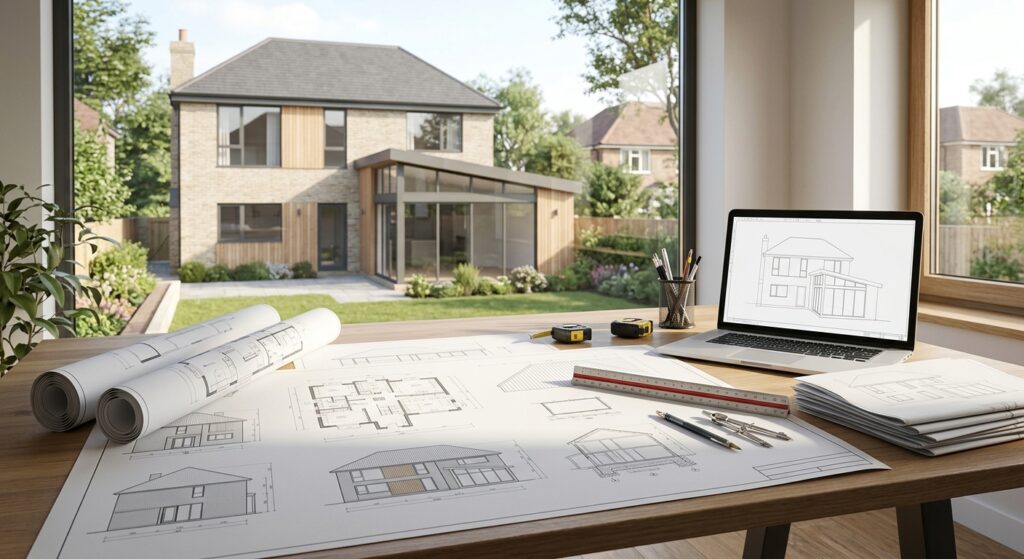
Residential construction has changed significantly as technology has become part of the planning and design process. Traditional hand-drawn plans are increasingly being replaced by accurate digital drawings that can be created, reviewed, adjusted, and shared more efficiently.
Today, homeowners, builders, contractors, and designers can use online drafting services to develop detailed plans without relying entirely on local, paper-based workflows. Digital drafting makes it easier to visualize a project before construction begins while reducing the risk of costly design mistakes.
From new homes and additions to renovations and accessory structures, digital tools are making residential planning more organized and adaptable.
Why Accuracy Matters in Construction Planning
Accuracy is one of the most important factors in any residential construction project. Even a small measurement error in a drawing can create problems during material ordering, construction, inspections, or approval processes.
Digital drafting services help improve accuracy by allowing dimensions, wall layouts, openings, room sizes, and other design elements to be precisely represented. Changes can also be made without recreating an entire drawing from scratch.
Modern drafting software allows designers to maintain consistent measurements throughout a project. This can help homeowners and contractors identify potential conflicts earlier, before they become expensive problems on the job site.
Accurate drawings also provide builders with clearer information about how different parts of the project are intended to fit together.
The Growing Role of CAD House Plans
CAD house plans have become an important part of modern residential design. CAD, or computer-aided design, allows detailed architectural drawings to be produced digitally with a high level of precision.
Unlike basic sketches, CAD plans can contain detailed dimensions, room layouts, doors, windows, structural elements, annotations, and other information required for planning.
One major advantage is flexibility. If a homeowner decides to move a wall, enlarge a room, change a window location, or modify the floor layout, the digital drawing can be updated much more efficiently.
CAD house plans can also serve as a useful communication tool. Homeowners can review the proposed layout, while contractors and other professionals can work from the same updated information.
How Online Drafting Services Improve Project Efficiency
One of the biggest changes in residential planning is the ability to access professional drafting assistance online. Online drafting services allow project information, measurements, sketches, photographs, and other references to be shared digitally.
This can make the initial planning process more convenient for homeowners who may not have access to a drafting professional nearby.
Digital communication can also speed up revisions. Instead of physically delivering revised drawings, files can be exchanged electronically. Clients can review updates and provide feedback, helping the project move forward with fewer unnecessary delays.
For busy homeowners and contractors, this flexibility can be particularly valuable. It allows drafting work to become part of a streamlined digital workflow rather than a separate, time-consuming process.
Better Visualization Before Construction Begins
Another major benefit of digital drafting is improved visualization. A homeowner may understand an idea in their head but have difficulty imagining exactly how it will appear in a finished building.
Digital plans turn those ideas into something concrete that can be reviewed before construction starts.
For example, a residential floor plan can show how bedrooms, bathrooms, kitchens, living areas, hallways, and storage spaces relate to one another. This makes it easier to identify inefficient layouts or areas that need improvement.
Some digital workflows can also support 3D visualization, helping clients understand spatial relationships, proportions, and design concepts more clearly.
Making decisions during the planning stage is generally easier than making major changes after construction has already begun.
Digital Drafting and Permit-Ready Planning
Residential construction often involves local requirements, documentation, and approval procedures. While drafting software does not automatically guarantee approval, properly prepared digital drawings can help organize the information needed for a construction or permit submission.
Depending on the project and local requirements, drawings may need to communicate dimensions, property information, building locations, setbacks, floor layouts, elevations, or other details.
Digital drafting makes it easier to update these drawings when changes are requested during the review process. Instead of starting over, the relevant portions can be revised and regenerated.
This flexibility can be especially useful when working on projects where several rounds of review or design adjustments are expected.
The Future of Digital Drafting in Residential Construction
The adoption of digital drafting services is likely to continue as residential construction becomes increasingly technology-driven. Cloud-based collaboration, digital measurements, 3D modeling, automated drafting tools, and improved visualization are making the planning process more connected than ever.
However, technology is most valuable when combined with professional knowledge. Software can produce precise drawings, but experienced professionals are still needed to interpret project requirements, identify design concerns, and prepare documentation appropriate for the intended purpose.
For homeowners, the goal should not simply be to obtain a digital drawing. The real objective is to create clear, accurate, practical documentation that supports better decisions throughout the construction process.
Digital drafting is therefore more than a replacement for traditional drawing methods. It is becoming an essential part of a modern residential planning workflow.
By using accurate CAD house plans, flexible online collaboration, and professional online drafting services, homeowners and construction professionals can approach projects with greater clarity and confidence. Better planning today can mean fewer surprises, smoother communication, and a more organized construction process tomorrow.