Learning to drive is an important step toward greater independence, whether someone is preparing for their first job, commuting to college, managing family responsibilities, or simply wanting more flexibility. In Accrington and surrounding areas of Lancashire, automatic driving lessons are becoming an increasingly considered option for new drivers.
The growth in interest is influenced by changes in vehicle technology, learner preferences, traffic conditions, and the desire for a simpler learning experience. While manual driving remains a popular choice, automatic cars can remove some of the more demanding mechanical tasks associated with learning to drive.
For anyone comparing driving instructors Accrington, understanding how automatic lessons work—and whether they suit a particular learner—is useful before choosing a course of instruction.
What Is Driving the Demand for Automatic Lessons?
One of the biggest reasons for the popularity of automatic driving lessons is simplicity. A manual car requires the driver to coordinate the clutch, gear lever, accelerator and brakes. For some learners, developing these skills alongside steering, observation and road positioning can initially feel overwhelming.
An automatic vehicle generally removes the need for manual gear changes and clutch control. The car selects the appropriate gear based on speed and driving conditions, allowing learners to concentrate more heavily on the road itself.
This can be particularly useful for people who find multitasking difficult during the early stages of learning.
Several factors are contributing to growing interest:
- Simpler vehicle controls: Learners do not need to operate a clutch pedal or manually change gears.
- Greater focus on road awareness: More attention can be dedicated to mirrors, signs, junctions and traffic.
- Modern vehicle trends: Automatic transmission is increasingly common in newer cars.
- Urban driving conditions: Stop-start traffic can be less tiring without repeated clutch operation.
- Learner confidence: Some people feel more comfortable progressing in a vehicle with fewer controls.
These advantages do not mean automatic driving is necessarily easier in every respect. Learners still need strong observation, anticipation, hazard perception and decision-making skills.

Automatic Cars and Accrington’s Driving Environment
The type of driving environment can influence how a learner experiences lessons. Accrington provides a mixture of residential streets, busier roads, junctions, roundabouts and connections to neighbouring areas of Lancashire.
For a learner, this creates opportunities to practise different aspects of everyday driving. Automatic transmission can be useful in situations involving frequent stopping and starting, but it does not remove the need to understand traffic flow or make safe decisions.
A learner should still develop the ability to:
- Read road signs and markings.
- Check mirrors consistently.
- Maintain appropriate speed.
- Position the vehicle correctly.
- Judge gaps safely.
- Anticipate other road users.
- Respond appropriately to hazards.
- Follow directions without losing concentration.
A qualified driving instructor Accrington learners choose should therefore focus on developing complete driving competence rather than simply teaching the mechanical operation of an automatic car.
Automatic vs Manual: Which Is Better for Learners?
There is no universal answer because the right transmission depends on the learner’s circumstances and future driving needs.
Automatic lessons may appeal to learners who prioritise straightforward vehicle operation. Manual lessons, meanwhile, can provide the flexibility of driving both manual and automatic cars after passing the appropriate test.
One practical consideration is the driving licence. A learner who takes their practical test in an automatic vehicle will generally receive an automatic-only licence. If they later want to drive a manual vehicle, they would need to take a further practical test in a manual car.
This makes it important to think beyond the immediate learning period.
Before choosing between automatic and manual instruction, learners can consider:
- What type of vehicle they expect to drive in the future.
- Whether they need access to a family member’s manual car.
- Their confidence with clutch and gear control.
- The availability of automatic vehicles.
- Their commuting or employment requirements.
- Their personal learning preferences.
Discussing these factors with experienced Accrington driving instructors can help learners make a more informed decision.
Common Challenges During Automatic Driving Lessons
Although automatic cars simplify some aspects of driving, learners can still encounter challenges.
Maintaining Concentration
Because an automatic vehicle handles gear changes, learners may initially become overly relaxed. However, they still need constant awareness of pedestrians, cyclists, motorcycles, vehicles and road signs.
Solution: Develop a routine of scanning mirrors, checking the road ahead and anticipating potential hazards.
Judging Speed
Without manually changing gears, some learners may initially pay less attention to how the vehicle is responding to changes in speed.
Solution: Regularly check the speedometer while also developing a better understanding of the vehicle’s movement and road conditions.
Junctions and Roundabouts
Junctions and roundabouts require good observation and decision-making regardless of transmission type.
Solution: Practise approach speed, lane positioning, mirror checks, signalling and safe gap selection repeatedly.
Parking and Manoeuvres
Automatic transmission does not automatically make manoeuvres easy. Learners still need accurate steering control, spatial awareness and patience.
Solution: Practise manoeuvres in different environments rather than relying on one familiar location.
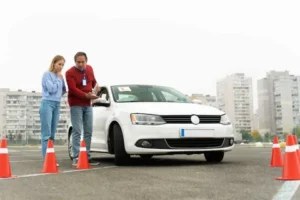
How to Get More Value From Automatic Driving Lessons
The quality of learning depends on more than simply the number of lessons completed. Consistent practice and constructive feedback can have a major influence on progress.
Learners should consider keeping a simple record of skills they have practised. For example, after each lesson they could note:
- Skills that have improved.
- Areas requiring more practice.
- Common mistakes.
- New road situations encountered.
- Questions to discuss during the next lesson.
Private practice, where legally permitted and appropriately supervised, can also reinforce skills between professional lessons.
Another important factor is choosing an instructor whose teaching approach matches the learner. Some people benefit from detailed explanations, while others learn more effectively through demonstration and repeated practice.
When researching cheap driving instructors Accrington, learners should avoid making cost the only deciding factor. Lesson structure, instructor experience, vehicle suitability, availability and teaching quality can all affect the overall learning experience.
The Role of Technology in Modern Driving Education
Technology is also influencing how learners prepare for driving. Modern vehicles often include features such as parking sensors, reversing cameras, driver information displays and other assistance systems.
These features can be useful, but learners should not become dependent on them.
A good driving education should develop fundamental skills that remain useful even when technology is unavailable. This includes effective observation, mirror use, steering control, hazard awareness and understanding the Highway Code.
Automatic vehicles are also becoming increasingly relevant as the automotive industry moves toward hybrid and electric vehicles. Many hybrid and fully electric cars use automatic-style transmission systems, making automatic driving experience potentially relevant to future vehicle ownership.
For learners considering automatic driving instructors in Accrington, this broader change in vehicle technology may be another reason to explore automatic instruction.
Choosing an Appropriate Driving Instructor
Finding the right instructor can make the learning process more structured and productive. Learners should look beyond advertising claims and consider practical factors such as qualifications, teaching experience, lesson availability and communication style.
Useful questions to ask include:
- Is the instructor qualified and appropriately registered?
- Do they regularly teach automatic learners?
- How are lessons structured?
- Can lessons be adapted to individual progress?
- How is feedback provided?
- What happens if a learner struggles with a particular skill?
- Is the vehicle suitable and well maintained?
Local providers such as Street Smart Driving School can be included in a learner’s research when comparing available automatic driving instruction in the Lancashire area.
The objective should be to find an instructor who helps the learner develop safe, independent driving habits—not simply someone who prepares them for a test.
Read More:
https://www.smartdrivingschool.uk/cheap-automatic-driving-instructor-accrington/