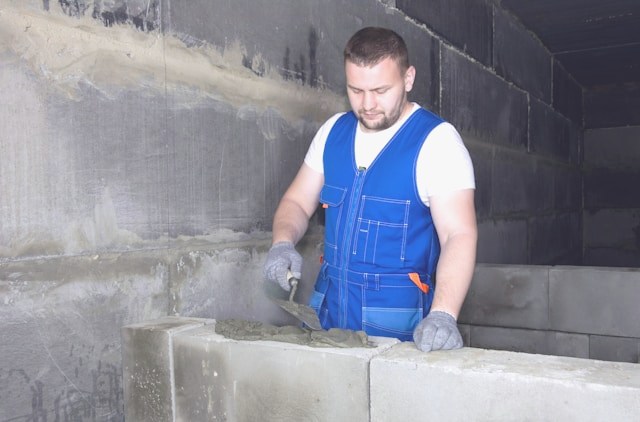
Auckland clay does not sit still. That is the sentence most people wish someone had said before they signed off a veneer that looked perfect in March and showed a stepped crack by August. So it is important to find a right brick and block layer in Auckland.
The city sits on a mix of residual clay, weathered Waitemata, and fill that was never as compact as the drawing suggested. Add a wet winter, a dry January, and a slab that moves a few millimetres while the brick skin tries not to, and the mortar takes the argument. Hairline at first. Then a step that follows the perpends down the corner like a staircase.
People blame the bricklayer. Sometimes they should. More often the wall was asked to do a job the foundation, the control joints, and the cavity ties were never set up to share.
A brick veneer in New Zealand is a rainscreen, not a load-bearing castle. It hangs off the frame on ties, sits on a lintel or a shelf, and needs room to move. Miss the control joint at the right spacing, run a long wall past a garage opening with no break, or bed the first course on a slab edge that is already out of level, and the crack is scheduled. It is just waiting for the clay to shrink.
What a competent crew does on site is quieter than the marketing. They check the slab or footing before a brick goes down. They look at the damp course. They ask where the windows sit relative to corners, because a pier under 800mm next to an opening is where veneers split. They put joint reinforcement where the manufacturer actually wants it — above openings, at corners — not as a superstition every fifth course and nowhere that matters.
Mortar mix is the other quiet failure. Too strong a mix on a wall that needs to flex is brittle. Too wet a mix in a west Auckland afternoon slumps and leaves a joint that weathers in three winters. Auckland rain is not gentle. Wind-driven rain on a west-facing wall finds every hole a rushed perpend left behind.
If you are hiring brick and block laying Auckland work for a new house or a repair, ask to see how they will handle movement before you ask about colour. Colour is the easy conversation. Movement is the one that shows up in the building report when you sell.
Repair is a different trade temperament from new work. You do not smash out a whole elevation because one corner stepped. You find whether the lintel rolled, whether a downpipe has been soaking the base course, whether the cavity is bridged with dropped mortar. Then you cut out, re-bed, and match the joint profile so the patch does not announce itself from the street. Matching old Auckland stock — those slightly uneven seventies bricks — takes patience. New extruded bricks next to weathered ones look like a patch even when the line is true.
Sandeep Singh’s crew at Mr Singh Brick & Block Laying work this way from Sunnyvale across the region. They are a Licensed Building Practitioner firm, which matters on restricted building work. A mate with a mixer is not an LBP. The council already knows the difference.
For a cracked veneer, take photos in the morning light, note whether the crack is wider after a dry week, and do not fill it with bathroom silicone. Silicone traps moisture and makes the next inspection worse. Call someone who lays brick for a living, not someone who paints over it.
That is the unfashionable advice. Auckland will keep moving. The wall can be allowed to move with it, or it can be built as if the ground were Christchurch limestone. Only one of those lasts.
Mr Singh Brick & Block Laying Ltd — 15 Waari Avenue, Sunnyvale — 020 410 79568 — singhbrickblock.co.nz