future-digital-prescribing-erx-medication-2026
Prescribing has changed more in the last decade than in the previous fifty. Today, 1.39 million U.S. prescribers use ePrescribing, and every state mandates electronic prescribing for controlled substances (EPCS). Paper pads and faxed scripts are now the exception, not the norm.
The shift goes beyond digitization. Modern medication workflows are patient-centered, interoperable, transparent about cost, and built for mobile. Four themes define this landscape: safety, affordability, access, and intelligence. The Future of Digital Prescribing: eRx & Medication in 2026 this article looks at how each one is reshaping care in 2026, and what health systems and vendors should weigh when building their prescribing strategy.
The Evolution of ePrescription (eRx) & Medication Management
The journey began with handwritten prescriptions, which were error-prone, hard to read, and easy to forge. Early electronic systems simply replaced paper with a digital transmission. Today’s eRx platforms are intelligent, networked ecosystems that connect prescribers, pharmacies, payers, and patients in real time.
Several forces drove adoption:
- Regulatory mandates that made electronic prescribing the default
- EPCS expansion to cover opioids, stimulants, and other controlled substances
- Specialty medication growth, which demands more complex workflows
- AI-assisted clinical decision support that helps prescribers make safer choices
Patient expectations have moved just as quickly. Over 55% of U.S. consumers prefer mobile apps to manage their prescriptions. That preference is pushing vendors to rethink what a modern ePrescription (eRx) & medication management experience looks like, for clinicians and patients alike.
Choosing a Healthcare Software Development Company for HIE and eRx
Building HIE and eRx capabilities in-house is demanding. Teams need FHIR expertise, DEA EPCS and PDMP compliance experience, and security knowledge across HIPAA, HITRUST, and SOC 2. That is why many organizations partner with an experienced healthcare software development company.
When evaluating a partner, look for:
- Proven FHIR and TEFCA experience across API-first and cloud-native builds
- Compliance expertise in EPCS, PDMP, and state HIE regulations
- eRx and HIE integration skills, including SMART on FHIR apps
- Scalable architecture that grows with participants and data volume
The right partner shortens time to market, reduces compliance risk, and keeps your platform ready for the next wave of interoperability mandates.
Core Workflows Powering Safe, Compliant Prescribing
EPCS Workflows and Controlled Substance Safeguards
EPCS is the backbone of compliant opioid and stimulant prescribing. A secure EPCS workflow rests on several pillars:
- Identity proofing to confirm the prescriber is who they claim to be
- Two-factor authentication at the moment of signing
- Audit trails that record every action taken on a prescription
- DEA-aligned logging that satisfies federal requirements
Together, these safeguards reduce fraud, prevent tampering, and give organizations a defensible record during audits.
PDMP Integration for Real-Time Oversight
Prescription Drug Monitoring Programs (PDMPs) track controlled substance dispensing across providers and pharmacies. When PDMP checks are embedded directly into the eRx workflow, prescribers no longer need to log into a separate portal. The patient’s history appears in context, helping flag diversion, doctor shopping, and duplicate therapy before a prescription is signed.
Drug Interaction Alerts and Clinical Intelligence
Real-time screening checks every new prescription against the patient’s profile for drug–drug, drug–allergy, and drug–condition interactions. The value of these alerts depends on the quality of the underlying clinical knowledge base. Current, well-maintained content keeps alerts relevant and helps prevent the alert fatigue that causes clinicians to ignore warnings.
Strong EPCS workflows, PDMP integration, Real-Time Prescription Benefit (RTPB), drug interaction alerts, formulary checks, price transparency, multi-pharmacy access, and specialty & compounding workflows are what separate a basic eRx tool from a complete medication management platform.
Affordability at the Point of Care: Real-Time Prescription Benefit (RTPB)
What RTPB Delivers
A prescription a patient cannot afford is a prescription that does not get filled. Real-Time Prescription Benefit (RTPB) addresses this by surfacing, inside the EHR and at the moment of prescribing:
- Patient-, medication-, and pharmacy-specific cost estimates
- Prior authorization flags
- Lower-cost therapeutic alternatives
Instead of discovering a cost problem at the pharmacy counter, the prescriber and patient can resolve it during the visit.
Impact on Adherence and Abandonment
Evidence shows that RTPB improves fill rates and reduces out-of-pocket costs, even when clinician acceptance of the alerts is modest. Seeing the price early changes the conversation. Adoption is substantial: over 1 billion RTPB transactions now occur annually across U.S. networks.
Formulary Checks and Price Transparency
RTPB works by pulling live formulary status and tiering from pharmacy benefit managers (PBMs). Prescribers see whether a drug is covered, what tier it sits on, and what alternatives exist. This kind of price transparency supports prescribing decisions grounded in both clinical need and what the patient can pay.
Expanding Access: Multi-Pharmacy, Specialty, and Compounding Workflows
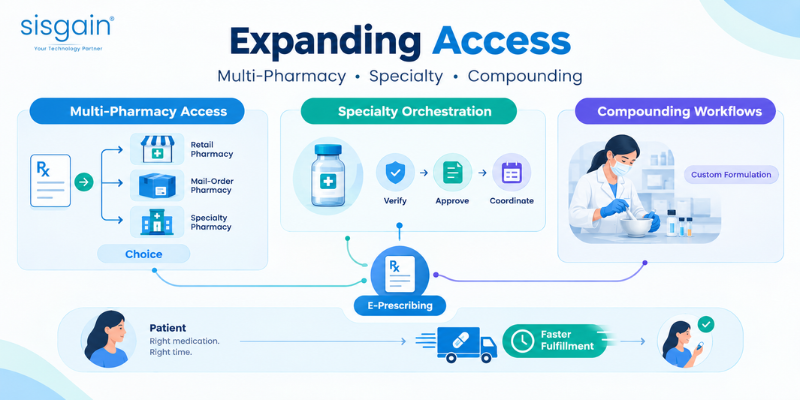
Multi-Pharmacy Access and Patient Choice
Patients increasingly want a say in where their medications come from. Modern platforms let them choose retail, mail-order, or specialty pharmacies at the time of prescribing, with cost and availability shown in real time. The benefit is fewer delays, fewer abandoned prescriptions, and more convenience.
Specialty Medication Orchestration
High-cost biologics and orphan drugs bring significant administrative complexity. Effective specialty workflows cover:
- Benefits verification
- Prior authorization automation
- Coordination with specialty pharmacies
Automating these steps shortens the time from prescription to first dose, which matters most for patients with serious or chronic conditions.
Compounding Workflows
Custom formulations need more detail than a standard script. Structured eRx support for compounding captures dosage form, strength, and compounding instructions in a format that integrates cleanly with pharmacy systems. This reduces ambiguity and the back-and-forth calls that slow fulfillment.
Strong multi-pharmacy access and specialty & compounding workflows ensure that access is not limited to the simplest prescriptions.
The Interoperability Backbone: HIE Software Solutions and eRx Platforms
Health Information Exchange (HIE) as the Nervous System
None of these capabilities work without data moving securely between systems. HIE systems act as the data highways connecting EHRs, pharmacies, PBMs, PDMPs, and payers. Standards make that exchange possible:
- NCPDP for pharmacy and prescribing transactions
- RxNorm for consistent medication terminology
- FHIR for modern, API-based data exchange
Modern eRx Platform Architecture
Today’s eRx platform is typically cloud-native and API-first. This architecture supports real-time benefit checks, mobile applications, and AI layers without rebuilding the core system each time. Teams pursuing e-prescription software development should prioritize modularity, scalability, and security from the start.
End-to-End Health Information Exchange Solutions
Comprehensive HIE software solutions unify medication history, allergies, insurance eligibility, and clinical context in one view. With that complete picture, prescribers can make safer decisions and avoid the gaps that cause adverse events. End-to-end health information exchange solutions turn fragmented data into usable clinical insight.
The Mobile-First Patient Experience
Patients now expect to manage medications the way they manage banking or shopping: from their phone. Leading patient-facing apps deliver:
- Refill reminders
- Cost comparisons
- Delivery tracking
- Telehealth-integrated prescribing
With more than 55% of consumers preferring mobile, UX priorities for eRx vendors are shifting. Mobile can no longer be an afterthought bolted onto a clinician-focused product. It has to be a core part of the design.
The Role of AI and Intelligent Automation
AI is moving from experiment to everyday tool in prescribing. AI-assisted platforms now:
- Suggest lower-cost alternatives
- Predict the likelihood of prior authorization approval
- Surface adherence risk signals
Machine learning models also help optimize formulary alignment and reduce prescription abandonment. The goal is not to replace clinical judgment but to remove friction, giving clinicians relevant, timely insight within their existing workflow.
Building or Buying: Strategic Considerations for Health Systems and Vendors
Organizations face a familiar decision: invest in in-house e-prescription software development, or partner with an established eRx platform provider. Building offers control and customization, but it demands deep regulatory expertise, certification effort, and ongoing maintenance. Buying or partnering speeds time to market and reduces compliance risk.
Whichever path you choose, evaluate against these criteria:
- EPCS certification and ongoing compliance support
- RTPB performance, with response times under one second
- PDMP connectivity across the states you serve
- Specialty workflow support, including prior authorization and compounding
- Mobile SDKs for patient-facing experiences

Conclusion
The digital prescribing landscape in 2026 is defined by intelligence, transparency, and patient empowerment. As workflows mature and interoperability deepens, the focus shifts from simply sending prescriptions electronically to orchestrating end-to-end medication journeys that are safer, more affordable, and effortlessly accessible, whether through a clinician’s EHR or a patient’s smartphone.
Organizations that invest now in EPCS compliance, real-time benefit tools, strong HIE connectivity, and mobile-first design will be best positioned to deliver the next generation of medication care.
Frequently Asked Questions
1. What is a Health Information Exchange (HIE) platform?
An HIE platform enables the secure, standards-based exchange of patient clinical data across different healthcare organizations. It supports care transitions, emergency access, population health analytics, payer-provider data exchange, and patient access APIs.
2. What is the difference between centralized, federated, and hybrid HIE models?
A centralized HIE stores records in a single clinical data repository. A federated (decentralized) HIE leaves records at the source and retrieves them on demand. A hybrid HIE model combines a central repository for high-volume data with query-based access for real-time needs. Hybrid models are registering the fastest growth in the market.
3. Why is HL7 FHIR R4 important for HIE software?
FHIR R4 is the mandated standard for ONC-certified EHRs, CMS payer compliance, and TEFCA exchange. Its modular resources, such as Patient, Medication, Observation, and Condition, allow granular, real-time data queries instead of document-based exchange.
4. What is TEFCA, and why does it matter?
The Trusted Exchange Framework and Common Agreement (TEFCA) is the federal framework for nationwide health data exchange. It is governed by a Recognized Coordinating Entity (RCE) and Qualified Health Information Networks (QHINs). As of April 2026, over 21,000 organizations were connected, so alignment with TEFCA is becoming a competitive requirement for HIE and eRx vendors.
5. How big is the health information exchange market?
The U.S. HIE market was valued at $336.9M in 2026 and is projected to reach $986.5M by 2034, a 9.41% CAGR. The global market was valued at roughly $1.90B to $2.30B in 2025 and is expected to reach $4.48B to $5.25B by 2034.
6. How do HIE software and eRx platforms work together?
HIE software supplies medication history, allergy information, and formulary data at the point of care. The eRx platform securely transmits the medication order to the pharmacy. Together they support safer, better-informed prescribing and fewer pharmacy call-backs.