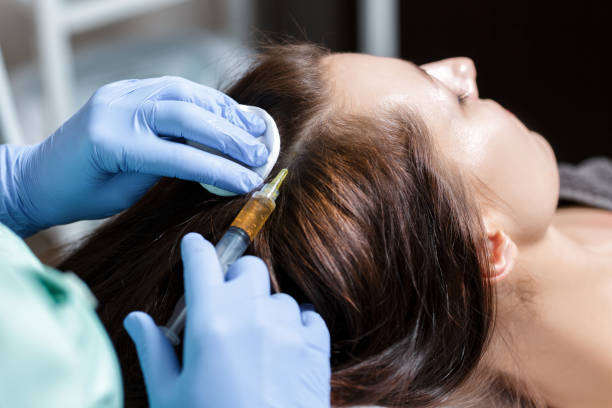
Needle mesotherapy. Cosmetic been injected in woman's head. Thrust to strengthen the hair and their growth
Understanding the Hair Growth Cycle
Hair grows in natural cycles that include a growth phase, a resting phase, and a shedding phase. PRP works by encouraging hair follicles to enter and remain in the growth phase for longer periods. Because hair growth is gradual, PRP treatments must be spaced in a way that supports this biological process rather than attempting to force rapid results.
Hair follicles need time to respond to growth signals released by platelets. This is why PRP treatments are delivered in phases rather than as a one-time procedure.
Initial Treatment Phase
Most individuals begin PRP hair treatment with an initial series of sessions. During this phase, treatments are usually scheduled about once every month. This spacing allows platelets to stimulate follicles while giving the scalp enough time to respond before the next session.
The initial phase typically lasts several months. During this period, many people notice reduced hair shedding, improved scalp health, and gradual thickening of existing hair strands. These changes indicate that follicles are becoming more active and responsive.
Maintenance Phase
After completing the initial treatment phase, PRP hair treatment usually shifts into a maintenance schedule. Maintenance sessions are spaced farther apart than initial treatments and are designed to preserve the results already achieved.
For many individuals, maintenance sessions every few months are sufficient to support follicle health and slow the progression of hair thinning. Hair loss is often influenced by genetics and aging, which means ongoing stimulation helps counteract these natural processes.
Skipping maintenance sessions does not immediately reverse results, but over time hair may gradually return to its previous thinning pattern if stimulation is not continued.
Factors That Influence Treatment Frequency
The ideal PRP schedule is not the same for everyone. Several factors influence how often sessions are needed.
The stage of hair thinning plays a major role. Early hair thinning typically responds faster and requires fewer sessions than more advanced thinning. Individuals with active but weakened follicles usually see better results with consistent early treatment.
Age and overall scalp health also affect response. Younger individuals or those with good circulation and healthy follicles may maintain results with fewer sessions over time.
Hormonal changes and stress levels can influence how quickly hair thinning progresses, which may impact how often PRP sessions are recommended.
PRP Frequency for Men and Women
PRP hair treatment is effective for both men and women, but treatment frequency may vary based on hair loss patterns. Men often experience localized thinning, while women tend to experience diffuse thinning across the scalp. These differences can influence how PRP is scheduled.
Women with widespread thinning may benefit from consistent maintenance sessions to support overall density, while men with targeted thinning areas may focus on maintaining specific regions.
Despite these differences, the general approach of an initial treatment phase followed by maintenance remains similar for both genders.
Signs That Maintenance Is Needed
There are subtle signs that may indicate it is time for a maintenance PRP session. Increased hair shedding, reduced hair thickness, or slower growth may suggest that follicles need renewed stimulation.
PRP works best as a proactive treatment rather than a reactive one. Regular sessions help keep follicles active before significant thinning returns.
Long-Term Commitment to PRP
PRP hair treatment should be viewed as a long-term hair health strategy rather than a one-time fix. While it does not permanently stop genetic hair loss, it can significantly slow progression and improve hair quality when performed consistently.
Many individuals find that once they reach their desired results, maintenance sessions become part of their long-term hair care routine, similar to skincare or fitness maintenance.
FAQs About PRP Hair Treatment Frequency
How many PRP sessions are needed at the beginning
Most people begin with several sessions spaced about a month apart to activate hair follicles and support early growth.
Can PRP sessions be done more frequently
PRP sessions are generally spaced to match the hair growth cycle. More frequent sessions do not necessarily improve results and may not allow enough time for follicle response.
Is maintenance really necessary
Maintenance sessions help preserve results and support long-term hair health. Without maintenance, natural thinning processes may gradually continue.
Do men and women need the same schedule
The general structure is similar, but individual hair loss patterns may influence how often maintenance sessions are recommended.
What happens if sessions are stopped
Hair does not immediately revert, but over time thinning may resume as follicles lose stimulation.
Can PRP frequency change over time
Yes, many individuals require fewer sessions once results stabilize, while others may adjust frequency based on hair changes.
Conclusion
PRP hair treatment sessions are most effective when performed according to a structured schedule that aligns with the natural hair growth cycle. An initial series of monthly sessions helps activate follicles and improve hair density, while maintenance sessions every few months support long-term results.
The exact frequency depends on individual hair thinning patterns, scalp health, and response to treatment. PRP works best as an ongoing hair health solution rather than a one-time procedure. With consistent sessions and realistic expectations, PRP hair treatment can help maintain stronger, thicker, and healthier hair for both men and women over time.