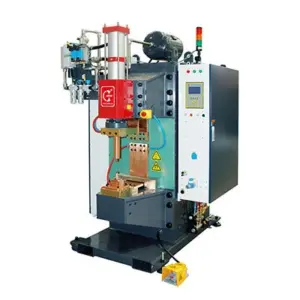
Resistance spot welding
In the fast-paced world of industrial manufacturing, efficiency, repeatability, and precision are non-negotiable. Among the array of metal-joining techniques, resistance spot welding (RSW) stands out as a reliable and cost-effective solution for joining sheet metals in automotive, aerospace, electronics, and appliance manufacturing. Heron Welder, a global leader in industrial welding solutions, offers state-of-the-art resistance spot welding machines designed to meet the demands of OEMs, automation integrators, and production engineers worldwide.
What is Resistance Spot Welding?
Resistance spot welding is a fusion-based joining process where two or more metal sheets are joined at discrete points through the application of heat generated by electrical resistance. The process relies on three critical factors:
-
Electrical Current – A high-amperage current passes through the electrodes to the workpiece.
-
Pressure – The electrodes apply controlled force to hold the sheets together.
-
Time – Precise timing ensures the metal fuses at the contact points without compromising surrounding material.
The combination of these elements creates small, robust welds, commonly known as spot welds, which provide excellent strength while minimizing distortion.
How Resistance Spot Welding Works
-
Preparation – Metal sheets are cleaned and aligned between the electrodes.
-
Clamping – The electrodes apply pressure to maintain intimate contact between the sheets.
-
Current Application – A precise pulse of high current flows through the contact point, generating heat due to electrical resistance.
-
Weld Formation – The heat melts the metal locally, forming a nugget that solidifies as the electrodes maintain pressure.
-
Cooling – After the weld pulse, the metal cools under pressure, ensuring a solid and durable bond.
Heron’s advanced resistance spot welding machines are equipped with intelligent controllers and adjustable parameters, allowing operators to optimize nugget size, welding current, and cycle time for maximum efficiency and repeatability.
Key Applications of Resistance Spot Welding
Resistance spot welding is widely used across industries where thin metal sheets and high-volume production are common:
-
Automotive Manufacturing – Joining car body panels, frames, and structural reinforcements.
-
Appliance Production – Assembling washing machines, refrigerators, and HVAC panels.
-
Electronics & Electricals – Fabricating enclosures, battery packs, and circuitry components.
-
Aerospace & Defense – Lightweight aluminum and steel sheet assemblies requiring precise welds.
Heron Welder machines support a variety of materials, including mild steel, stainless steel, and aluminum alloys, making them versatile solutions for diverse industrial applications.
Resistance Spot Welding vs. Other Welding Methods
Understanding the advantages of RSW compared to other joining methods is critical for manufacturing engineers:
| Welding Method | Advantages | Considerations |
|---|---|---|
| Resistance Spot Welding (RSW) | High-speed, repeatable, minimal distortion | Limited to sheet thicknesses |
| MIG Welding | Flexible, suitable for thicker materials | Slower, more heat input, more prep |
| TIG Welding | High-quality, precise, clean welds | Slower, labor-intensive |
| Laser Welding | Extremely precise, low distortion | High upfront cost, complex setup |
For high-volume automotive or appliance production, RSW is often the preferred choice due to its efficiency, low operating costs, and consistent weld quality.
Best Practices for Optimal Spot Welding
To maximize the performance of resistance spot welding, Heron recommends:
-
Material Preparation – Ensure clean, oxide-free surfaces for better conductivity.
-
Electrode Maintenance – Regularly dress and align electrodes to maintain uniform welds.
-
Process Monitoring – Use controllers to monitor current, pressure, and weld time.
-
Automation Integration – Combine RSW machines with robotic arms or conveyor systems for consistent and high-speed production.
-
Safety Protocols – Ensure proper insulation, eye protection, and machine guarding to prevent accidents.
Heron’s automated resistance spot welding systems come with intelligent process monitoring and adaptive controls, minimizing defects while enhancing throughput.
Why Choose Heron for Resistance Spot Welding
Heron Welder has been a trusted partner for industrial welding and metal-joining solutions worldwide. Our machines are engineered for:
-
Precision – Accurate weld placement for consistent quality.
-
Reliability – Robust components and long service life for demanding production environments.
-
Flexibility – Machines adaptable to different sheet metals, thicknesses, and automation setups.
-
Support – Comprehensive consultation, training, and after-sales service to optimize your welding processes.
By combining cutting-edge technology with decades of engineering expertise, Heron ensures that manufacturers achieve high productivity, low scrap rates, and superior weld integrity.
FAQs About Resistance Spot Welding
Q1: What materials can be welded using RSW?
A: RSW is ideal for mild steel, stainless steel, and aluminum alloys, commonly used in automotive, appliance, and electronics manufacturing.
Q2: How thick can sheets be for spot welding?
A: Typically, RSW works best with sheet thicknesses ranging from 0.5 mm to 3 mm, though Heron machines can adapt for specific applications.
Q3: Is resistance spot welding suitable for automated production?
A: Yes. RSW is highly compatible with robotic and conveyor-integrated production lines, offering fast cycle times and repeatable quality.
Q4: How do I maintain electrode quality?
A: Regular dressing and alignment are essential to prevent deformation and ensure consistent weld nuggets.
Q5: Can Heron customize a spot welding system for my factory?
A: Absolutely. Heron provides tailored solutions including controllers, automation, and integration to meet specific production requirements.
Take Your Metal-Joining to the Next Level
For OEMs, production engineers, and factory decision-makers looking for reliable, efficient, and high-precision welding, Heron Welder offers customizable resistance spot welding solutions. From standalone machines to fully automated production lines, our expertise ensures your manufacturing operations achieve consistent quality and optimized throughput.
Request a quote or consult Heron today to explore how our resistance spot welding machines can elevate your production processes.