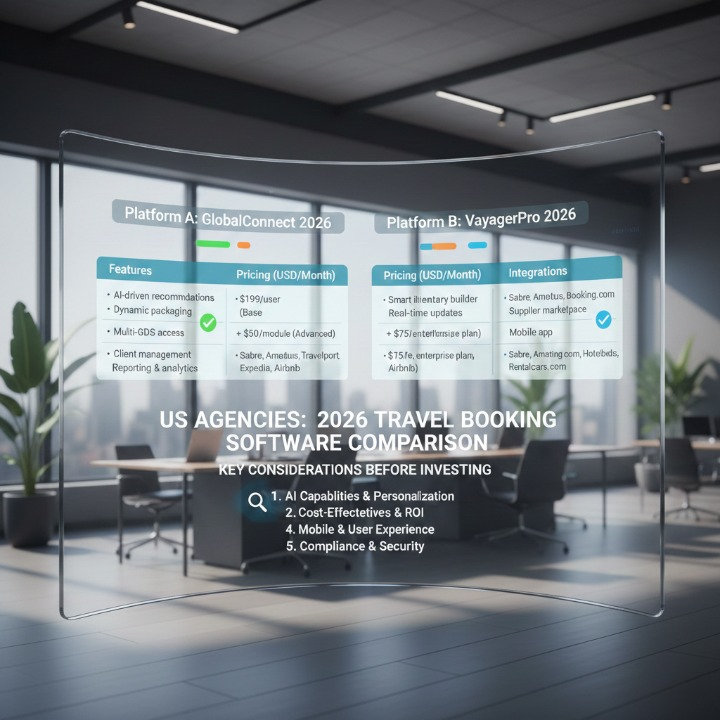
Travel Booking Software Comparison: What US Agencies Need to Know Before Purchasing in 2026
US modern travel agencies have proven operationally efficient through the use of travel booking software. Spreadsheet-driven, email-based, and manual confirmation systems are no longer viable in an industry where profitability depends on speed, accuracy, and customer experience. Agencies continuing to manage reservations manually risk duplicate entries, pricing irregularities, delayed confirmations, and lost bookings due to human error.
The impact of choosing the wrong system can be devastating: operational bottlenecks, frustrated agents, non-compliance risks, and failed supplier integrations that reduce customer confidence. Conversely, selecting the appropriate platform can centralize operations, automate repetitive tasks, enhance reporting accuracy, and support long-term scalability.
This extensive comparison guide is aimed at US travel agencies, tour operators, wholesalers, and DMCs. It provides regulatory knowledge and practical evaluation standards to assist decision-makers in making confident choices in 2026.
What Is Travel Booking Software?
At its core, travel booking software is a centralized, online tool that enables travel agencies to search, price, book, manage, and report on travel services such as flights, hotels, transfers, tours, and packages. It can function as a customer-facing interface or an operational engine depending on setup.
It typically integrates the features of a travel reservation system, a CRM, accounting tools, and supplier integrations into one ecosystem. For agencies replacing manual processes or disconnected tools, this unification drastically reduces operational friction.
Available Systems in the Market
SaaS Platforms
Cloud-based systems accessed via a browser on a subscription basis. Also known as cloud-based travel booking software, they suit agencies seeking lower upfront costs and automatic updates.
On-Premise or Hybrid Solutions
Installed locally with external API connections. Less common today but still used by legacy enterprise agencies.
B2B Platforms
Designed for wholesalers, consolidators, and agencies that sell to sub-agents. Also called a B2B travel reservation system, these platforms include agent login portals, commission management, and markup controls.
B2C Platforms
Front-office systems serving as an online booking system for travel agency websites. They allow travelers to search and book directly.
Enterprise Systems
Complex multi-branch, franchise, and international business ecosystems requiring large-scale automation and compliance controls.
Working in a US Agency Setting
An average US agency integrates its platform with airline, hotel, and tour inventories via GDS integration software and supplier APIs. Real-time availability is synchronized to the dashboard, enabling agents to verify reservations instantly. Payment gateways and automatic invoicing are typically integrated.
When applied correctly, the system becomes the hub for operations, analytics, compliance monitoring, and revenue optimization.
Why US Agencies Need Travel Booking Software
US travel agencies operate in a high-expectation environment. Customers demand instant confirmations, transparent pricing, mobile access, and secure payments. Manual processes cannot keep up.
Pain Points Without Automation
Agencies using outdated systems commonly face:
- Double bookings due to unsynced inventory
- Pricing errors from manual markups
- Slow confirmation emails
- Fragmented supplier communication
- Revenue leakage from missed upsell opportunities
Without the ability to automate travel reservations, productivity and service quality decline.
Measurable Benefits of Modern Systems
Implementing a robust system results in:
- Ability to reduce booking errors through automation
- Improved workflow efficiency to streamline travel agency operations
- Faster confirmations and automated documentation
- Unified dashboards that increase travel agency revenue through analytics-driven decisions
Automation also strengthens brand credibility, as customers notice instant confirmations, professional invoices, and smooth payment processes.
Important Comparable Features in Booking Software
Functional depth, integration capability, compliance standards, and scalability should be carefully evaluated in a booking software comparison.
Booking and Inventory Automation in Real-Time
Key features include:
- Real-time inventory management
- Dynamic pricing support
- Automated ticketing
- Supplier API connections
- Inbuilt GDS integration software
A fully automated booking system eliminates manual availability checks and redundant data entry.
Payment & Security Features
Security is critical in the US market. Agencies should verify:
- Secure online payment processing
- Tokenized payment storage
- Fraud detection measures
- PCI DSS compliance
Using PCI compliant booking software protects both the agency and its customers from costly breaches.
CRM & Reporting Capabilities
Integrated travel CRM integration tools enable:
- Customer segmentation
- Automated email workflows
- Loyalty tracking
- Lead source attribution
High-level reporting dashboards provide revenue trends, supplier performance analysis, and booking channel breakdowns.
Mobile & Cloud Accessibility
Modern agencies operate remotely. Web or mobile-based platforms allow agents to access bookings anywhere. Cloud architecture supports remote teams and enhances business continuity during disruptions.
Online Travel Booking Software for Various Types of US Agencies
Each business model requires tailored solutions.
Small Agencies
Entrepreneur-led agencies prioritize usability and affordability. Systems marketed as travel booking software for small agencies typically include basic automation, limited API integrations, and simple dashboards.
Corporate Travel Management Firms
Require policy enforcement, expense integration, and approval workflows. Advanced corporate travel management software provides multi-level reporting and traveler tracking.
Tour Operators
Operators benefit from itinerary builders, contract rate management, and group booking tools. Platforms may overlap with OTA booking software capabilities but offer deeper customization.
OTAs & DMCs
Online agencies and destination management companies need scalable, API-intensive solutions. Powerful DMC booking software USA platforms support multilingual portals, supplier extranets, and layered commission structures.
Costs and Pricing Models in the USA
Understanding travel booking software pricing is essential before committing.
Common Pricing Models
Subscription-Based Travel Software
Monthly or annual fees based on user count and features.
Per-Booking Fee Travel Software
Charges applied to each confirmed reservation.
Enterprise Licensing
Custom pricing plans for large-scale deployments.
Hidden Costs
- Implementation fees
- API connection charges
- Training sessions
- Ongoing support and updates
Evaluating travel software ROI should include labor savings, error reduction, increased conversion rates, and improved customer retention.
Compliance and Security Requirements for US Agencies
Regulatory compliance builds credibility and reduces risk exposure.
Key Areas of Compliance
- PCI DSS standards for payment data
- State-level data privacy regulations
- Accessibility guidelines for an ADA compliant travel website
- Secure hosting infrastructure forming an encrypted booking platform
Understanding US travel tech regulations ensures agencies avoid penalties and reputational damage.
How to Compare Travel Booking Software Effectively
Conducting a thorough travel booking software comparison involves a structured process.
Step 1: Define Operational Requirements
Map current workflows and identify bottlenecks.
Step 2: Request Live Demonstrations
Evaluate usability, navigation speed, and reporting depth.
Step 3: Check Integration Compatibility
Confirm compatibility with accounting tools, CRM platforms, payment gateways, and supplier APIs.
Step 4: Evaluate Support Infrastructure
Review SLAs, onboarding programs, and training resources. Checking independent travel software reviews USA can provide additional insight.
Step 5: Assess Scalability
Ensure the system can grow alongside booking volume and geographic expansion.
Common Mistakes to Avoid When Buying Travel Software
Even experienced agencies make avoidable errors:
- Choosing based solely on price rather than functionality
- Overlooking integration requirements
- Ignoring compliance verification
- Failing to test live support responsiveness
Exploring travel booking software alternatives and researching the best travel software for agencies can provide perspective before committing.
FAQs
What factors determine the best platform for a US agency?
The best system depends on agency size, supplier network, integration needs, and reporting complexity.
What influences overall system cost in the United States?
Factors include subscription tier, booking volume, API usage, and support packages. Evaluating travel booking software cost USA requires examining both fixed and variable expenses.
Can small agencies adopt advanced booking platforms?
Yes. Many systems are modular and scalable, allowing agencies to start small and expand over time.
How important is PCI compliance?
Extremely important. Using PCI compliant travel booking software reduces liability and strengthens customer trust.
Conclusion
Selecting the right travel booking software is a strategic decision that shapes operational efficiency, compliance posture, customer experience, and revenue growth. A structured evaluation process grounded in feature comparison, regulatory awareness, integration checks, and ROI analysis helps agencies avoid costly missteps.
In 2026 and beyond, agencies that invest in scalable, secure, and automation-driven systems will outperform competitors still relying on manual workflows. Schedule demonstrations, compare platforms carefully, assess long-term value, and make a data-driven decision that supports sustainable growth in the evolving US travel market.