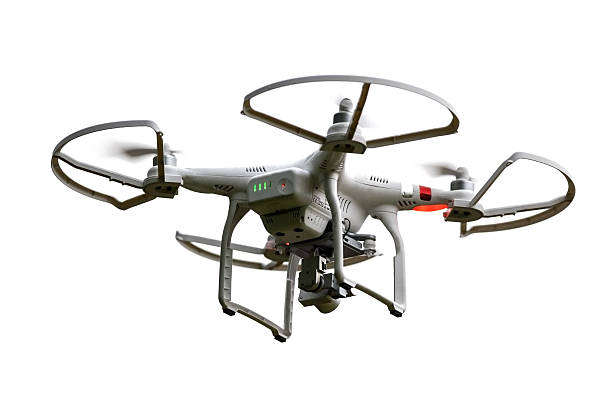
Waunakee, WI, USA - June 20, 2015: Small, remotely controlled drone with camera hovers in the sky. Privacy and safety concerns are becoming a hot topic for these devices as drones becore cheaper and more widely available.
We often think of manufacturing as a slow, heavy process rooted in massive buildings that never move. It is a world of giant specialized machines, sprawling supply chains, and timelines that stretch across months or even years. But as our global landscape shifts and the need for tools becomes more urgent and unpredictable, that old model is starting to feel like a relic of the past. If you are in a remote area or a fast moving situation, you do not have months to wait for a shipment from a distant factory. This is where Firestorm Labs enters the story.
Based in San Diego, this team is not just building new equipment; they are rethinking the very idea of what a factory can be. They are moving away from the centralized, “one size fits all” approach and toward something much more agile. By combining advanced 3D printing with modular design, they are proving that you can bring the power of a professional production line right to the edge of where the work is actually happening.
The Problem with the Old Way
To appreciate what Firestorm Labs is doing, you have to look at the traditional bottlenecks. Historically, if you wanted to build something complex, you needed a specialized facility. If a part broke or a new need arose, you had to order it from a warehouse, wait for it to be packed, and then hope it survived the journey through a complicated logistics network.
This system is fragile. It relies on everything going right—roads staying open, ships staying on schedule, and factories staying online. In a crisis or a remote operation, one broken link in that chain can bring everything to a halt. Firestorm Labs saw this vulnerability and decided to bypass the chain entirely. They wanted to move the “making” as close to the “using” as possible.
A Factory in a Shipping Container
The centerpiece of this vision is something they call the xCell. Imagine a high tech manufacturing hub that fits entirely inside a standard shipping container. It is a self contained unit that can be loaded onto a truck, a ship, or a cargo plane and dropped off almost anywhere.
Within a day of arriving, it can be unfolded and powered up, ready to start producing professional grade components. It does not need a connection to a city power grid or a team of fifty engineers to run it. It is designed to be lean and independent, operating off generators and managed by just a couple of people. Inside those metal walls, industrial 3D printers use high strength polymers to build parts that are ready for immediate use. It is essentially a bubble of modern industrial capability that can exist in the middle of a desert, an arctic tundra, or a disaster zone.
Speed and the Power of Choice
The real magic of this setup is the speed. Because the system uses additive manufacturing, it can go from a digital file to a physical product in a matter of hours. This is a massive leap forward from traditional methods that might take weeks to produce the same item.
Drone technology is at the heart of this rapid production capability, as the xCell is specifically optimized to print, assemble, and launch these platforms on site. This allows teams to iterate on their designs in real time. If a specific mission requires a different sensor mount or a more aerodynamic wing, they do not have to wait for a new shipment. They simply update the digital design and print the improved version that afternoon. This ability to adapt to changing conditions on the fly is what makes the technology so transformative.
Open Architecture and Collaboration
One of the most refreshing things about the Firestorm approach is their commitment to an open system. In many industries, companies try to lock you into their specific ecosystem. If you buy their machine, you have to buy their parts and use their software forever.
Firestorm Labs has taken a different path. Their architecture is vendor agnostic, meaning their manufacturing cells are designed to produce parts for a wide variety of platforms, not just their own. This creates a collaborative environment where different organizations can share digital designs and print them wherever they are needed. It turns manufacturing into a shared language rather than a closed secret. It is a “build once, print anywhere” philosophy that makes the entire network more resilient.
Sustainability through Precision
Beyond the tactical and industrial advantages, there is a very practical sustainability angle to this model. Traditional manufacturing is incredibly wasteful because it relies on overproduction and long distance transport. We build thousands of items, store them in warehouses, and burn massive amounts of fuel shipping them around the world—often to have them sit on a shelf and never be used.
The Firestorm model is built on “just in time” production. You carry raw materials, which are much easier to transport than finished goods, and you only print what you actually need. If a mission calls for ten units, you print ten. If a part breaks, you print a replacement. This reduces the logistics tail and ensures that resources are used efficiently. You are no longer shipping empty air in cardboard boxes; you are shipping the potential to create.
Conclusion
Firestorm Labs is proving that the future of making things is not found in bigger factories, but in smarter ones. By taking the power of professional production and putting it into a mobile, adaptable package, they are solving the age old problem of distance and delay. They have removed the gap between having an idea and holding the solution in your hand. As we move into an era where we need to be more resilient and responsive than ever before, the ability to build exactly what we need, right where we stand, is going to be the most important tool we have.
Frequently Asked Questions
- Where is Firestorm Labs located?
The company is headquartered in San Diego, California, though it operates facilities and partnerships across the country, including a significant research presence in Rome, New York. - How long does it take to set up one of their mobile factories?
The xCell manufacturing unit is designed to be fully operational within twenty four hours of being delivered to a site. - What kind of materials do they use?
They primarily focus on high strength, professional grade polymers that are durable enough for flight and harsh environmental conditions, though the system is designed to be adaptable to new materials. - Can the system operate off the grid?
Yes. The xCell units are designed to be self-sufficient and can run on generators or large battery arrays, making them ideal for remote or austere environments. - Is the technology only for military use?
While it has clear benefits for defense and contested logistics, the ability to manufacture on site is incredibly valuable for disaster relief, search and rescue, and remote industrial projects like mining or energy. - How fast can they print a complete airframe?
The company has demonstrated the ability to print an entire airframe in under ten hours, meaning a complete system can go from a concept to a flight ready platform in a single day.