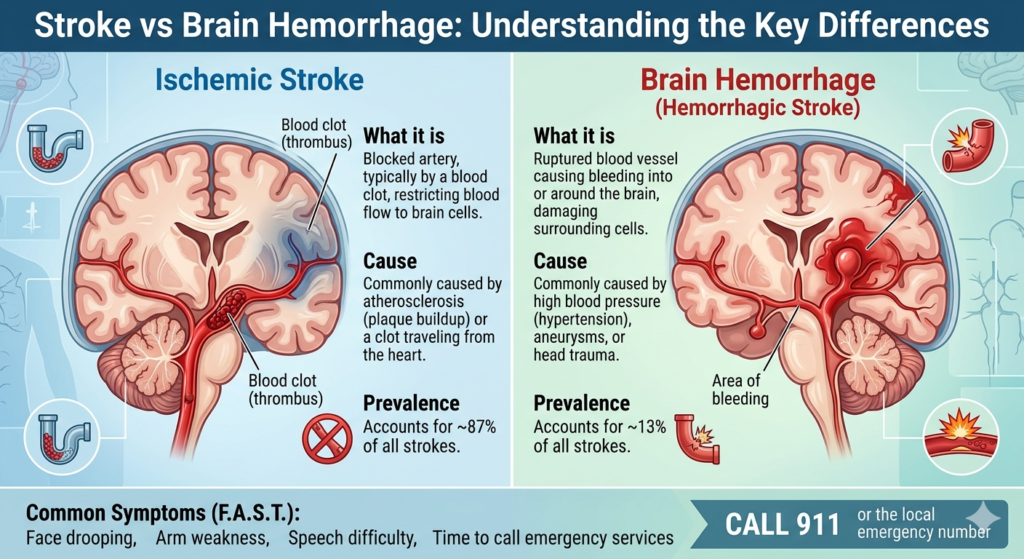
Let me clear up the confusion I see almost every week in my clinic. Patients and families often use the words “stroke” and “brain hemorrhage” as if they mean the same thing. They do not. A brain hemorrhage is one type of stroke, but not all strokes are hemorrhages. Understanding the difference can save a life, because the treatment for one is completely opposite to the treatment for the other.
I am a neurosurgeon. I have operated on bleeding brains and I have managed clot-related strokes with medicines. Let me walk you through what happens inside your head during each of these events, and why it matters so much to get the right diagnosis fast.
What Actually Happens in a Stroke
Think of your brain as a busy city. The streets are blood vessels. A stroke happens when blood flow to a part of the brain is suddenly cut off. Without blood, brain cells do not get oxygen. They start dying within minutes.
About 85 per cent of all strokes are what we call ischemic strokes. “Ischemia” means lack of blood. Something blocks the pipe. Usually a blood clot forms in an artery that is already narrowed by cholesterol deposits. Sometimes a clot travels from the heart or a neck artery and gets stuck in a smaller brain vessel.
The result is that a specific area of the brain goes silent. If that area controls your left arm, your left arm stops working. If it controlled your speech, you cannot form words. The symptoms come on suddenly – within seconds or minutes – and they do not go away on their own.
What a Brain Hemorrhage Is
Now picture a pipe bursting instead of getting clogged. That is a brain hemorrhage. A blood vessel inside your skull tears open. Blood spills into the surrounding brain tissue. That blood does two terrible things.
First, it destroys the brain cells it touches directly. Second, it takes up space. Your skull is a fixed box. There is no room for extra blood. So the bleeding pushes on healthy brain tissue, raising pressure inside your head. That pressure can crush the brain stem – the part that controls breathing and heartbeat.
Hemorrhages account for only about 15 per cent of strokes, but they cause nearly half of all stroke deaths. They are less common but much more dangerous.
The Causes Are Different
Ischemic strokes usually come from long‑term problems. High blood pressure that damages artery walls. High cholesterol that builds plaques. Diabetes. Smoking. Atrial fibrillation – an irregular heartbeat that throws clots. These things develop over years.
Brain hemorrhages also have high blood pressure as a major cause. Weak spots in artery walls, called aneurysms, can burst. Abnormal tangles of blood vessels – arteriovenous malformations – can rupture. Head trauma, blood thinners, and bleeding disorders are other triggers.
Here is a crucial point. Many patients who have a hemorrhage never had any warning. An aneurysm can be there since birth, silent, until one day it tears.
Symptoms: How to Tell the Difference
Both cause sudden neurological deficits – weakness, numbness, trouble speaking. But a hemorrhage often adds something extra.
With an ischemic stroke, the main symptoms follow a pattern. Sudden numbness or weakness on one side of the face, arm, or leg. Confusion. Trouble seeing in one or both eyes. Trouble walking or loss of balance. Severe headaches are less common unless the stroke is large.
With a brain hemorrhage, the same stroke symptoms occur, but almost always with a sudden, explosive headache. Patients describe it as “the worst headache of my life.” It comes on in seconds. Often with nausea, vomiting, and a decreasing level of consciousness. Seizures at the onset are also more common with hemorrhage.
But let me be honest. Even doctors cannot always tell the difference just by symptoms. That is why every suspected stroke patient gets a CT scan immediately. The scan shows bleeding clearly. If there is no blood, we assume an ischemic stroke.
Treatment Is Opposite
This is where the stakes get high. For an ischemic stroke, we want to dissolve the clot or remove it. The clot‑busting drug called tPA can save brain tissue if given within a few hours. In larger hospitals, neurosurgeons or interventional radiologists can thread a catheter up to the brain and pull the clot out mechanically.
For a brain hemorrhage, clot‑busting drugs would be a disaster. They would make the bleeding worse. Instead, we control blood pressure aggressively. We reverse any blood thinners. And if the clot is large enough or causing dangerous pressure, I take the patient to surgery. I open the skull, remove the clot, and stop the bleeding.
Two completely opposite approaches for two conditions that can look the same to a family member at home.
Why Time Is Everything
In both cases, minutes matter. For ischemic stroke, the saying is “time is brain.” Every minute of delay, nearly two million brain cells die. For hemorrhage, every minute of continued bleeding raises pressure and crushes more tissue.
The message is simple. If someone suddenly cannot move one side of their body, or their face droops, or they cannot speak, or they have a sudden blinding headache with vomiting – do not wait. Do not give them tea. Do not let them sleep it off. Get them to a hospital with a CT scanner and a stroke team.
Long‑Term Recovery
Surviving a stroke or hemorrhage is only the first step. Rehabilitation is where real recovery happens. Physical therapy for movement. Speech therapy for communication. Occupational therapy for daily tasks. The brain can rewire itself, but it needs time and consistent work.
Patients who had a hemorrhage often recover differently. The blood itself is toxic to brain cells. Even after we remove the clot, the damage from that chemical irritation can take months to improve.
When to See a Specialist
If you or a family member has had a stroke or a brain hemorrhage, follow‑up care is essential. You need someone who understands the nuances of brain recovery and prevention of a second event. In Jharkhand, you can find a Neuro Expert doctor in Ranchi who specialises in both surgical and non‑surgical management of these conditions. For ongoing care after a stroke or to evaluate those silent aneurysms before they bleed, a Neuro Doctor in Ranchi can guide you through medications, lifestyle changes, and monitoring.
Final Words from My Desk
Stroke and brain hemorrhage sound similar, but they are as different as a clogged pipe and a burst pipe. One needs opening. The other needs patching. The only way to know which one you are dealing with is a CT scan, done fast. If you ever see someone with sudden neurological symptoms, do not guess. Just run. The brain does not wait for second opinions.