The Art and Science of Anechoic Chamber Design: Creating the Quietest Places on Earth
In a world saturated with noise, the quest for silence has driven remarkable engineering innovations. Anechoic Chamber Design represents the pinnacle of acoustic engineering, creating environments so quiet that the human ear can detect the subtle sounds of its own circulatory system. These extraordinary rooms are not merely silent; they are engineered to eliminate all sound reflections, providing the closest thing to a “sound-free” environment on Earth .
Understanding the Core Principles of Anechoic Chamber Design
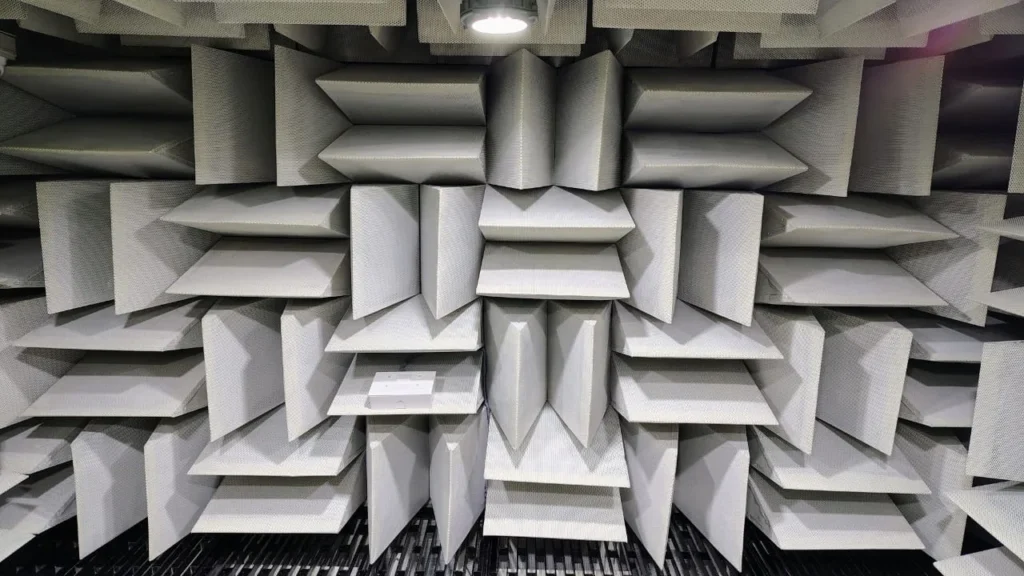
The foundation of effective Anechoic Chamber Design rests on two critical principles: sound absorption and vibration isolation. Sound absorption is achieved through the use of specialized wedges, typically made from fiberglass or mineral wool, which line every surface of the chamber. These wedges capture and dissipate sound waves, effectively preventing echoes . Vibration isolation is equally vital; the chamber must be protected from structure-borne sound and vibrations that could compromise the pristine acoustic environment.
The construction employs a “room-within-a-room” concept. The inner chamber is built within the outer building, separated by a system of springs or neoprene rubber mounts to prevent vibrations from travelling through the building’s structure . This meticulous Anechoic Chamber Design allows for incredible sensitivity, with some chambers achieving background noise levels of -12.4 dBA, making them some of the quietest places on the planet .
Key Features of Acoustic Anechoic Chambers
A well-executed Anechoic Chamber Design involves several integrated features. The most crucial is the use of sound-absorbing wedges that cover all six surfaces of the room, including the ceiling and walls. The floor, often a wire mesh trampoline, is acoustically transparent to ensure no reflections occur from below . This design is essential for creating a truly free-field environment where sound behaves as if it is in infinite space.
The choice of materials is critical. The wedges must be designed to have a specific cut-off frequency, which determines the lowest frequency they can absorb. For example, large chambers can be designed with cut-off frequencies lower than 40 Hz, allowing for exceptionally accurate low-frequency testing . This meticulous attention to detail in Anechoic Chamber Design ensures high-precision acoustic testing for industries ranging from automotive to aerospace .
Applications of Semi-Anechoic Chamber Design
The applications of Anechoic Chamber Design are vast and varied. In the automotive industry, these chambers are used for Noise, Vibration, and Harshness (NVH) testing, helping manufacturers create quieter, more comfortable vehicles . For audio and electronics, they are indispensable for testing the response of loudspeakers, microphones, and other devices without room interference . Researchers use them to study human hearing, develop new audio technologies, and even simulate the sound of rain on a roof .
As a leader in this industry, SomNandi Industries has extensive experience in developing custom Anechoic Chamber Design solutions for diverse applications, showcasing an ability to deliver projects with precision engineering and customized acoustic requirements .
Conclusion: The Future of Acoustic Testing
Anechoic Chamber Design continues to evolve as the demand for precision and control in acoustic environments grows. From standard testing to cutting-edge research and development, these chambers enable breakthroughs that were previously impossible. Whether for a semi-anechoic chamber for a laboratory or a full anechoic suite, the careful engineering and construction of these spaces represent a remarkable human achievement in controlling sound. Companies like SomNandi Industries are at the forefront of delivering these complex, highly specialized projects for advanced acoustic solutions .