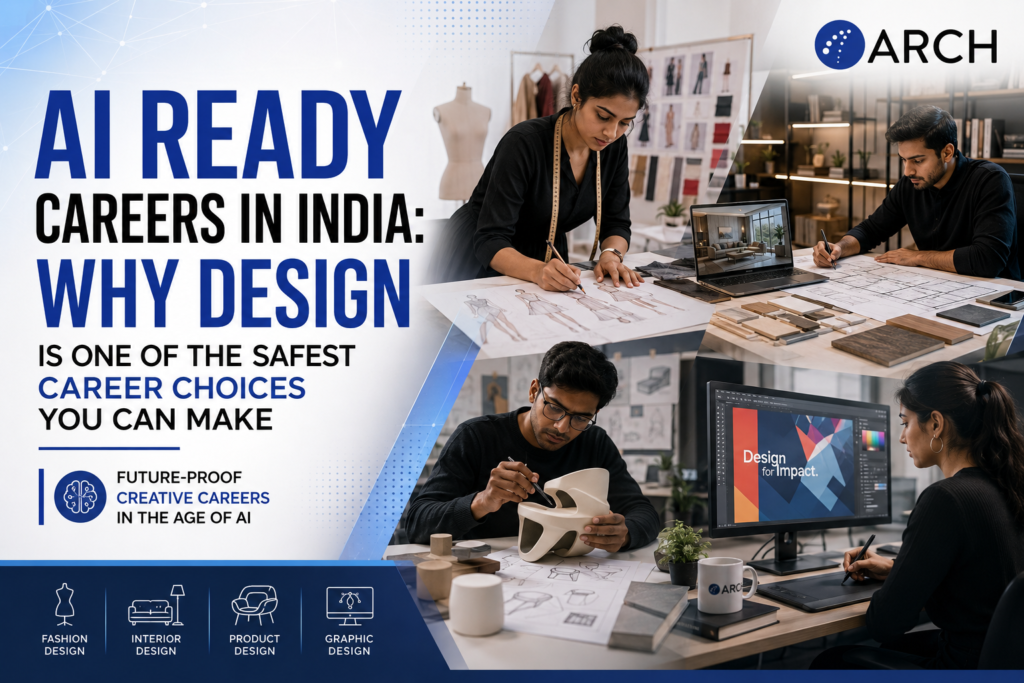
Design is one of the most AI-resistant career choices available to students in India today. While artificial intelligence can automate repetitive tasks, it cannot replicate human empathy, cultural sensitivity, creative intuition, or the ability to solve problems for real people in real contexts. Students who choose design are not running from AI, they are building skills that work alongside it.
The Question Every Student in India is Asking Right Now
If you have just completed your 12th and are thinking about your future, one question is probably sitting in the back of your mind, often louder than any other:
“Will the career I choose today still exist by the time I graduate?”
It is a fair question. Reports about AI replacing jobs appear almost daily. Entire categories of work are being automated. And for a student standing at the start of their professional journey, this uncertainty can feel paralyzing.
But here is what most of those headlines miss: not all careers are equally vulnerable to AI. And when you look carefully at which careers in India are genuinely future-proof, design rises consistently to the top.
What AI Can Do — and What It Cannot
To understand why design is one of the safest careers in India right now, it helps to be clear about what AI is actually capable of, and where it reaches its limits.
AI excels at tasks that are repetitive, rule-based, and data-driven. It can process thousands of invoices, flag anomalies in spreadsheets, generate standard written copy, or produce images based on text prompts. In these areas, automation is genuinely replacing human labour.
But AI cannot do the following:
- Walk into a client’s home, understand their family’s lifestyle, and translate that into a living space that feels emotionally right
- Sense the cultural weight of a textile tradition and decide how to reinterpret it for a contemporary fashion collection
- Sit across from a jewellery client, understand what a piece of jewellery will mean to them personally, and design accordingly
- Understand what a product needs to feel like in someone’s hand, not just look like on a screen
- Solve a visual communication problem for an audience whose context, values, and habits require deep human understanding
These are the things designers do every day. And they are precisely the things that make design one of the most resilient and future-ready career choices available in India today.
Why Design Specifically Resists Automation
The World Economic Forum’s 2025 Future of Jobs Report highlights creativity, critical thinking, and empathy as the three skills least likely to be automated in the next decade. Design education builds all three, simultaneously and deliberately.
When a student pursues Fashion Design, they are not simply learning to make garments. They are learning to read cultural trends, understand consumer psychology, develop a creative voice, and build collections that communicate meaning. These are profoundly human skills.
When a student studies Interior Design, they learn to translate a client’s vision, often unspoken, into a physical space that serves both function and feeling. No AI can replicate the judgment that comes from years of learning how people actually live in spaces.
Graphic Design, formally known as Communication Design, is built on understanding how human beings process visual information, make decisions, and form emotional connections with brands and messages. The discipline is not about making things look nice. It is about communicating with precision for a specific human audience. That requires human insight at every step.
Product Design involves understanding how people physically interact with objects, ergonomics, material response, manufacturing constraints, and the emotional relationship between a person and a product. AI can generate product concepts, but it cannot replace the designer who knows what a product must feel like in the real world.
Each of these disciplines is built on human-centred thinking. And human-centred thinking is, by definition, something only humans can do well.
The Designers Who Will Thrive Are Those Who Use AI as a Tool
It is important to be clear about one thing: the goal is not to avoid AI. The goal is to understand it well enough to use it strategically.
The most successful designers of the next decade will be those who combine strong creative and critical thinking foundations with fluency in AI-powered design tools. They will use AI to accelerate research, generate initial concepts, test options quickly, and produce assets at scale, while applying their own judgment, taste, and human understanding to shape the final outcome.
This is the model that forward-thinking design institutions are already building. For students who want to develop both creative depth and technology fluency, an AI integrated BBA course that combines design thinking with business and management skills is also worth considering, it prepares students to lead at the intersection of creativity, technology, and strategy.
Design Careers Are Not Just Surviving AI — They Are Growing
Here are the facts about the Indian creative economy in 2026:
India’s fashion market is projected to reach $115 billion this year. The country’s interior design and real estate sector is on track to cross $1 trillion by 2030. The jewellery industry, of which Jaipur’s gem and jewellery sector is a cornerstone, generates tens of thousands of crores annually and continues to grow in both domestic demand and international exports. India’s digital economy, which employs tens of thousands of communication and digital designers, is expanding faster than any sector in the country.
These are not shrinking industries. They are growing ones. And in every single one of them, demand for skilled designers is rising, not falling.
About ARCH College of Design and Business, Jaipur
Established in 2000 and located in Malviya Nagar Institutional Area, Jaipur, ARCH College of Design and Business is one of the best design colleges in India for students who want a future-ready education grounded in real-world relevance. Over 25 years, ARCH has shaped more than 7,500 alumni across fashion, jewellery, interior, product, graphic, digital design, photography, and business, recognised with the Times Business Award for Institutional Excellence in Design Education and the CSR Universe Climate Action Award for Sustainable Fashion, among many others. Built on the philosophy of Empower, Co-Create, and Innovate, ARCH prepares students not just for the jobs of today, but for the creative economy of the future.
How to Choose a Design Program That Prepares You for the AI Era
Not every design education is equal. When evaluating a program, the following factors determine how well it will prepare you for a career that grows alongside AI — rather than being threatened by it.
- Human-centred curriculum: Does the program teach you to think from a user’s perspective, or just to follow trends and produce outputs?
- Industry integration: Are you working on live projects with real clients and companies from early in your studies?
- Entrepreneurship support: Does the college give you tools to build your own practice, not just train you to work for someone else?
- Technology fluency: Are contemporary design tools, including AI-assisted tools, embedded naturally into the learning process?
- Track record: What are graduates doing three and five years after they leave? Where are they placed, and what are they building?
These questions apply equally whether you are evaluating Fashion Design, Interior Design, Product Design, or Graphic Design programs. The best design colleges in India will have clear, confident answers to all five.
Design is the Career AI Makes More Valuable, Not Less
The students who will build the most resilient and rewarding careers in India over the next twenty years are not those who avoided AI, they are those who chose professions rooted in human creativity, empathy, and judgment, and then learned to use AI as a powerful tool within that practice.
Design is exactly that profession.
If you are a Class 12 student who is creative, curious, and looking for a career in India that will grow with you, not be replaced beneath you, a design education is one of the clearest, most confident choices you can make in 2026.