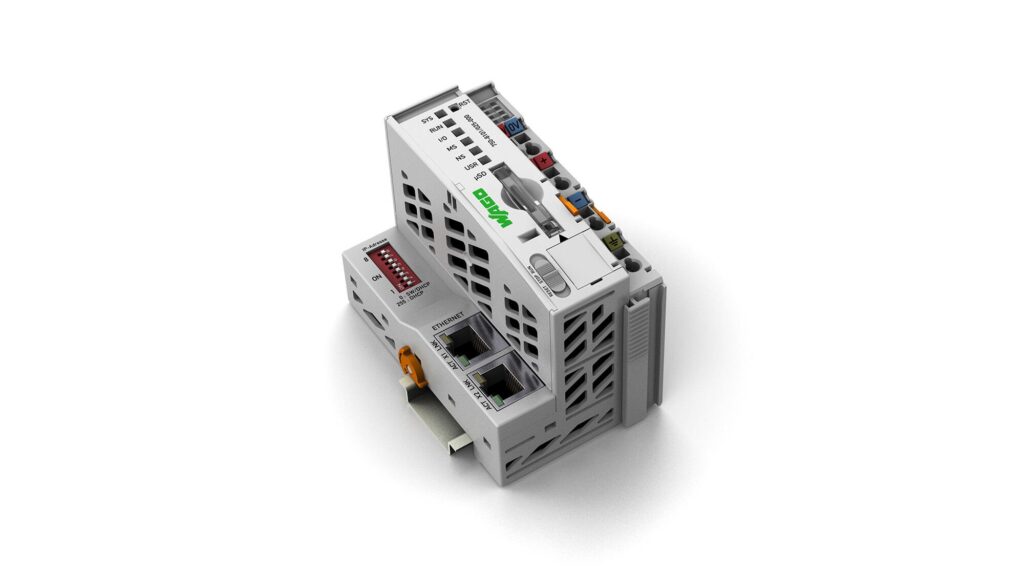
Programmable Logic Controller
Introduction: Edge Computing Meets Industrial Control Systems
Edge computing is transforming how industrial systems operate. Instead of sending every signal to a centralized cloud, control decisions are increasingly made inside the cabinet by the Programmable Logic Controller. Cloud-based processing often fails in real-time environments due to latency, jitter, and loss of deterministic behavior. Even slight delays can disrupt millisecond-level responses required for motor shutdowns, alarms, or interlocks.
Bandwidth constraints also limit continuous transmission of raw field data. Industrial systems demand local decision-making where signals originate. Before any data reaches the controller, Signal Conditioners act as the first normalization and protection layer-isolating, filtering, amplifying, and converting signals into stable, standardized outputs suitable for PLC input modules.
What Are Signal Conditioners in PLC Systems?
Signal conditioning includes amplification, isolation, filtering, linearization, and signal conversion. In industrial environments, analog sensors often produce noisy, low-level, and unstable signals due to electromagnetic interference and ground loops.
Solutions provide galvanic isolation between input, output, and power supply, ensuring secure and error-free transmission. Zero and span adjustment compensate for signal shifts, while switchable filters prevent interference.
The signal path follows a clear structure:
Field Sensor → Signal Conditioner → PLC Input Module
For example, temperature signal conditioners record signals from Pt, TC, Ni, KTY, and RTD sensors and convert them into analog standard signals before entering the PLC.
Why Signal Quality Matters for Edge Computing?
Poor signal quality leads to unstable control behavior and false triggers. Noise distortion can cause repeated threshold crossings, creating unnecessary alarms. Sensor drift affects closed-loop systems such as temperature regulation or motor speed control, leading to inefficiencies.
Accurate signals directly influence alarm reliability and equipment health monitoring. WAGO’s threshold value switches react to configurable measurement limits, triggering alarms or emergency stops when required. Stable conditioning ensures decisions are based on real process conditions.
How Signal Conditioners Enable Edge Processing
By delivering scaled and stable signals, Signal Conditioners reduce PLC CPU workload. Instead of software filtering, the controller receives ready-to-use standardized inputs.
Digital signal outputs (DO) respond to configurable measurement range limits, enabling threshold logic and interlock functions at field level. Minimizing signal fluctuation improves deterministic scan cycles within the Programmable Logic Controller, reducing unnecessary reprocessing.
Integration with Modern PLC Architectures
Modern architectures use distributed I/O and cabinet-level signal aggregation.Architecture modules support hybrid analog-digital systems, converting temperature, frequency, current, and voltage signals into standard outputs.
Current and voltage signal conditioners measure AC/DC values up to 300 VAC/VDC, while 3-phase power measurement modules provide Modbus® communication for secure signal transmission. Integration focuses on protocol conversion and signal integrity, not analytics.
Key Industrial Use Cases
Applications include vibration monitoring using frequency signal conditioners and temperature analytics in furnaces with RTD or thermocouple inputs.
Energy monitoring benefits from isolated current transformers and Rogowski coil solutions measuring up to 4000 A. Predictive fault detection relies on stable thresholds that detect early anomalies in rotating machinery.
Future Role of Signal Conditioners in Smart Factories
Future systems integrate embedded microcontrollers for diagnostics, auto-scaling, and fault signaling such as wire-break detection.
Edge-native hardware will increasingly combine conditioning functions directly within I/O modules. Self-calibrating designs will maintain accuracy through zero and span adjustments ensuring reliable edge performance without replacing PLC logic.