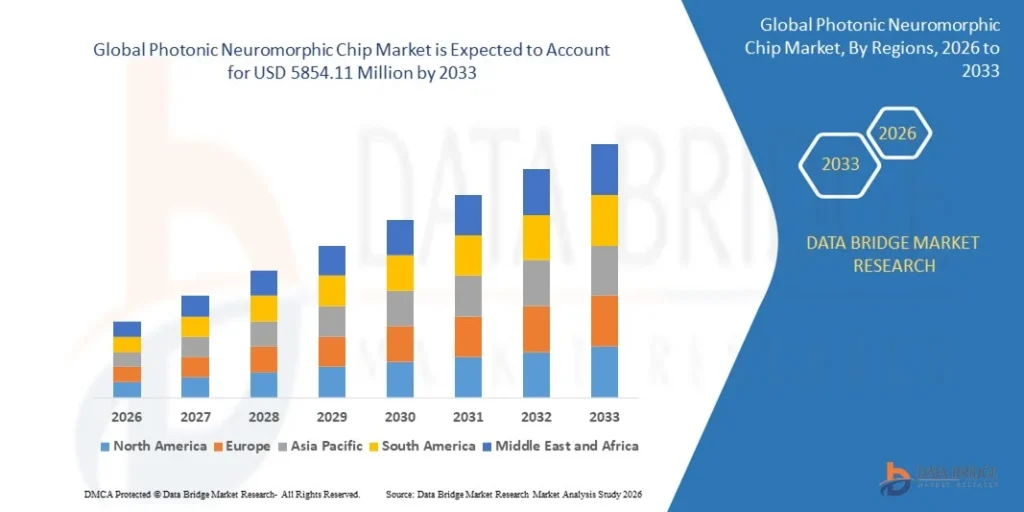
The Photonic Neuromorphic Chip market was valued at USD 822.64 Million in 2025 and is expected to reach USD 5,854.11 Million by 2033, growing at a CAGR of 27.8% (2025-2033). Get insights on trends, segmentation, and key players with Data Bridge Market Research Reports.
Introduction
As artificial intelligence (AI) continues to advance at an unprecedented pace, the limitations of conventional electronic computing architectures are becoming increasingly apparent. Traditional silicon-based processors struggle with energy efficiency, speed, and scalability when tasked with complex neural network workloads. To overcome these challenges, researchers are turning to an innovative solution inspired by both the human brain and the physics of light: photonic neuromorphic chips.
Definition
A photonic neuromorphic chip is a computing device that mimics the structure and operation of biological neural networks using light (photons) instead of electrical signals, enabling ultra-fast, energy-efficient information processing. By leveraging optical components such as waveguides, modulators, and lasers to implement neurons and synapses, these chips are well suited for parallel, low-latency tasks like artificial intelligence, pattern recognition, and real-time signal processing.
Understanding Neuromorphic Computing
Neuromorphic computing aims to mimic the structure and operation of the human brain. Unlike traditional von Neumann architectures, which separate memory and processing units, neuromorphic systems integrate computation and memory. They rely on artificial neurons and synapses that process information in parallel, much like biological neural networks.
This brain-inspired approach offers several advantages:
- Massive parallelism
- Low latency
- Event-driven processing
- Reduced power consumption
However, most existing neuromorphic chips – such as those developed using CMOS technology – still rely on electronic signals. While effective, electronic systems face inherent physical limitations, including heat dissipation, signal interference, and bandwidth constraints.
Why Photonics?
Photonics uses light (photons) instead of electrons to transmit and process information. Light travels faster than electrical signals and does not suffer from resistive heating, making it an attractive medium for high-performance computing.
When combined with neuromorphic principles, photonics offers several compelling benefits:
- Ultra-high speed: Optical signals operate at terahertz frequencies.
- Low energy consumption: Minimal heat generation compared to electronic circuits.
- High bandwidth: Multiple wavelengths can be used simultaneously through wavelength-division multiplexing.
- Reduced crosstalk: Optical signals are less susceptible to electromagnetic interference.
These advantages make photonic neuromorphic chips especially promising for next-generation AI workloads.
What Is a Photonic Neuromorphic Chip?
A photonic neuromorphic chip is a hardware platform that implements neural network operations using optical components instead of—or alongside—electronic ones. In these chips:
- Neurons are often represented by nonlinear optical devices such as lasers or modulators.
- Synapses are implemented using tunable optical elements like phase shifters or microring resonators.
- Signals are encoded as light intensity, phase, wavelength, or time delays.
By performing matrix multiplications and signal propagation optically, these chips can execute neural network inference at extremely high speeds with minimal energy usage.
Key Components and Technologies
Several photonic components enable neuromorphic functionality:
1. Optical Waveguides
Waveguides route light across the chip, similar to wires in electronic circuits.
2. Microring Resonators
These compact structures act as tunable synapses, controlling how much light passes through based on resonance conditions.
3. Lasers and Photodetectors
Lasers generate optical signals, while photodetectors convert light back into electrical signals when needed.
4. Nonlinear Optical Elements
Nonlinearity is essential for neuron-like behavior. Devices such as semiconductor optical amplifiers and saturable absorbers help achieve this.
5. Hybrid Electronic-Photonic Integration
Many systems combine photonics for computation and electronics for control, learning, and memory storage.
Applications of Photonic Neuromorphic Chips
Artificial Intelligence and Machine Learning:
Photonic neuromorphic chips excel at accelerating neural network inference tasks such as image recognition, natural language processing, and speech recognition.
Data Centers:
With growing energy demands, data centers can benefit significantly from the low-power, high-throughput nature of photonic AI accelerators.
Edge Computing:
Autonomous vehicles, drones, and IoT devices require fast, efficient on-device processing—an ideal use case for photonic neuromorphic hardware.
Telecommunications:
Optical neural networks can be integrated directly into fiber-optic communication systems for real-time signal processing and optimization.
Scientific Computing:
High-speed pattern recognition and signal analysis in physics, astronomy, and bioinformatics are well suited to photonic computing platforms.
Challenges and Limitations
Despite their promise, photonic neuromorphic chips face several hurdles:
- Manufacturing complexity: Fabricating nanoscale photonic components with high precision is challenging.
- Limited on-chip memory: Storing synaptic weights optically remains an active research area.
- Training difficulty: Most photonic systems excel at inference, while training is often performed electronically.
- Integration issues: Combining photonics with existing CMOS processes requires careful design and optimization.
- Scalability: Large-scale, fully optical neural networks are still largely experimental.
Overcoming these challenges will require advances in materials science, device engineering, and system-level design.
Recent Advances and Research Trends
In recent years, major universities, research labs, and technology companies have made significant progress in this field. Silicon photonics has emerged as a leading platform due to its compatibility with existing semiconductor fabrication processes. Researchers have demonstrated optical neural networks capable of performing complex tasks at picosecond speeds and femtojoule energy levels.
Additionally, emerging materials such as phase-change materials, graphene, and lithium niobate are opening new possibilities for tunable and reconfigurable photonic synapses.
The Road Ahead
Photonic neuromorphic chips are still in the early stages of development, but their potential impact is enormous. As AI models grow larger and more demanding, the need for faster, more efficient hardware will only increase. Photonic computing offers a path beyond the limits of traditional electronics.
In the future, we may see fully integrated optical brains powering everything from smart cities to autonomous robots and next-generation supercomputers. While widespread commercial adoption may take time, the foundation is already being laid today.
Future Trends of the Photonic Neuromorphic Chip Market
Rapid Growth in AI and Edge Computing:
The increasing demand for high-speed, low-power AI processing is expected to drive strong growth in the photonic neuromorphic chip market. Applications in edge computing, autonomous systems, and real-time data analytics will accelerate adoption as traditional electronic chips reach performance and energy limits.
Advancements in Silicon Photonics:
Ongoing progress in silicon photonics and CMOS-compatible manufacturing will make photonic neuromorphic chips more scalable and cost-effective. Improved fabrication techniques will support large-scale integration and faster commercialization.
Hybrid Electronic–Photonic Architectures:
Future designs will increasingly combine electronic control with photonic computation. These hybrid architectures will balance flexibility, learning capability, and ultra-fast inference, making them attractive for data centers and AI accelerators.
Increased Investment and Research Collaboration:
Rising investments from governments, research institutions, and technology companies will boost innovation. Collaborative ecosystems will accelerate breakthroughs in materials, device performance, and system-level integration.
Growth Rate of Photonic Neuromorphic Chip Market
According to Data Bridge Market Research, the photonic neuromorphic chip market was estimated to be worth USD 822.64 million in 2025 and is projected to grow at a compound annual growth rate (CAGR) of 27.80% to reach USD 5854.11 million by 2033.
Learn More: https://www.databridgemarketresearch.com/reports/global-photonic-neuromorphic-chip-market
Conclusion
Photonic neuromorphic chips represent a bold and exciting step toward the future of computing. By harnessing the speed of light and the efficiency of brain-inspired architectures, they promise to overcome many of the limitations faced by conventional processors. Although challenges remain, ongoing research and technological advancements continue to push this field forward.