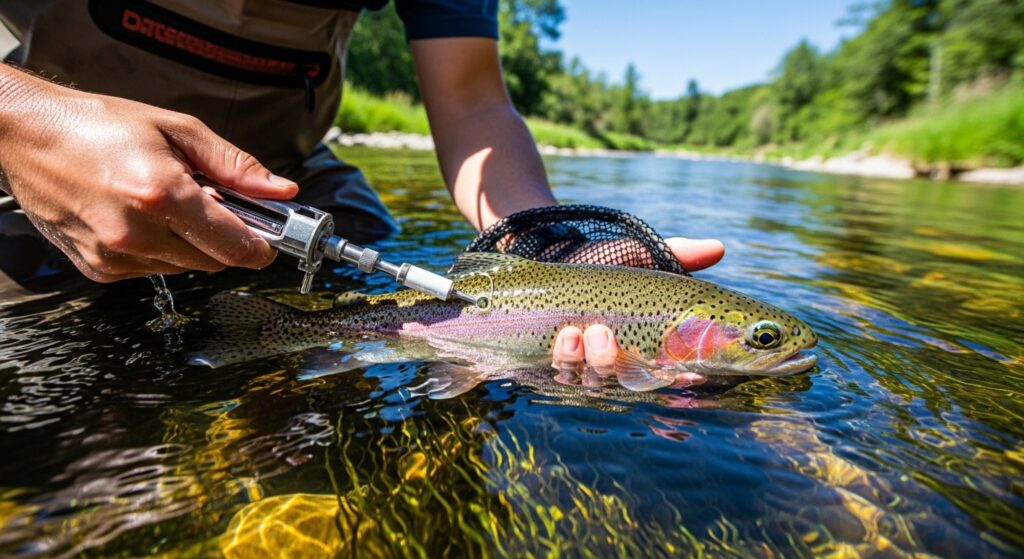
Introduction: Why PIT Tagging Has Become a Cornerstone of Aquatic Research
Aquatic ecosystems are among the most complex and dynamic environments on Earth. Understanding how fish and other aquatic species behave, migrate, reproduce, and respond to environmental pressures requires precise, reliable, and long-lasting identification methods. This is where PIT tagging for aquatic species monitoring has proven to be a genuine game-changer for scientists and fisheries managers worldwide.
PIT tagging — short for Passive Integrated Transponder tagging — allows researchers to uniquely identify individual aquatic animals using a tiny microchip implanted beneath the skin or within the body cavity. Unlike conventional external tags that can fall off, fade, or cause behavioral disruption, PIT tags are permanent, passive, and require no battery. Each tag emits a unique alphanumeric code when activated by a compatible reader, providing precise identification data without disturbing the animal.
Since its introduction to fisheries research in the 1980s, pit tagging has evolved into a globally adopted standard for monitoring aquatic biodiversity. From salmon runs in the Pacific Northwest to freshwater turtle populations in Europe, researchers across disciplines rely on this technology for its unmatched combination of durability, accuracy, and minimal biological impact.
How PIT Tagging Works: The Technology Behind the Science
At its core, a PIT tag is a passive RFID device, typically encased in biocompatible glass. Standard sizes range from 8 mm to 23 mm in length, with frequencies most commonly at 125 kHz or 134.2 kHz (ISO 11784/11785 compliant). The tag contains a microchip and an antenna coil sealed in a hermetic casing designed to last decades within a host organism.
When a tagged animal passes near an antenna connected to a reader, the reader emits a low-frequency electromagnetic field that powers the tag momentarily. The tag then transmits its unique 15-digit code back to the reader — no battery, no active transmission required. This passive design is the key to the tag’s extraordinary longevity.
Modern detection systems range from handheld wand readers for field work to fixed instream antenna arrays installed at fish ladders, weirs, and monitoring stations. These systems allow for automated, continuous data collection — a significant leap forward from labor-intensive manual observation.
Key Applications of PIT Tagging in Aquatic Studies
1. Fish Migration and Movement Ecology
Migration research is one of the most well-established applications of pit tagging. Salmonid species — including Chinook salmon, steelhead, and Atlantic salmon — have been the focus of extensive PIT tag studies across North America and Europe.
The Columbia River Basin Monitoring Program, coordinated by NOAA Fisheries and the Pacific States Marine Fisheries Commission (PSMFC), has relied heavily on PIT tag data since the early 1990s. The program’s database, known as PTAGIS (Pacific Ocean and Inland Columbia Basin PIT Tag Information System), currently contains over 200 million detection records from tagged fish — one of the largest fish tracking datasets in the world.
By monitoring when and where tagged individuals pass detection antennas, researchers can calculate:
- Migration timing and speed
- Survival rates between detection sites
- Route selection at dam bypass systems
- Travel time delays caused by hydroelectric structures
This data has directly informed dam management strategies, fish passage improvements, and endangered species recovery plans for species listed under the U.S. Endangered Species Act.
2. Population Dynamics and Survival Analysis
Pit tagging enables sophisticated mark-recapture analyses that are fundamental to fisheries population science. By releasing known numbers of tagged individuals and recapturing or detecting them over subsequent seasons, scientists can estimate population size, survival probability, and recruitment rates with statistical confidence.
The Cormack-Jolly-Seber (CJS) model and its derivatives are commonly applied to PIT tag detection data to produce robust survival estimates. Studies in rivers managed for sport fisheries have demonstrated that these estimates are significantly more accurate than those derived from traditional fin-clipping or external tagging due to the near-zero tag loss rate associated with PIT tags.
A 2015 study published in the North American Journal of Fisheries Management found that PIT tag retention rates in juvenile salmonids exceeded 98% over a 12-month period, confirming their reliability for long-term individual tracking.
3. Habitat Use and Microhabitat Selection
Beyond migration corridors, pit tagging supports fine-scale habitat studies. Portable antenna arrays can be deployed in specific stream reaches, pools, or near spawning beds to detect tagged fish with no need for physical recapture. This approach is particularly valuable for understanding:
- Refugia use during high-temperature events
- Nocturnal vs. diurnal habitat shifts
- Intraspecific competition for feeding territories
- Post-stocking habitat adaptation in hatchery fish
Researchers studying brown trout (Salmo trutta) in Welsh upland streams have used PIT detection grids to map individual home ranges at sub-meter resolution — data that would be practically impossible to gather with external tags.
4. Hatchery Program Evaluation
Fisheries managers use pit tagging extensively to evaluate the performance of hatchery-reared fish released into wild systems. Tagged hatchery cohorts can be tracked from release through maturation and return, providing critical metrics such as:
- Smolt-to-adult survival ratios
- Straying rates to non-natal streams
- Contribution to wild spawning populations
- Return timing relative to wild-origin fish
The Washington Department of Fish and Wildlife (WDFW) and Oregon Department of Fish and Wildlife (ODFW) routinely PIT tag hundreds of thousands of hatchery salmonids annually to evaluate the efficacy and ecological impact of supplementation programs.
5. Amphibian and Other Aquatic Species Research
While salmonids receive the most attention, pit tagging has proven highly effective for a wide range of aquatic species:
- Freshwater turtles: Long-lived species with slow demographic turnover benefit greatly from permanent individual identification. Studies on European pond turtles (Emys orbicularis) have used PIT tags to track individuals over 15+ years.
- Eels: European eel (Anguilla anguilla) migration studies rely on this technology to understand spawning migration triggers and route selection.
- Amphibians: Giant salamanders and hellbenders in North America have been tagged to study population decline rates and conservation response.
- Crayfish and invertebrates: Emerging research is adapting nano-sized PIT tags for larger macroinvertebrate species, expanding the technology’s taxonomic scope.
Long-Term Research Value: Why PIT Data Gets More Valuable Over Time
One of the most underappreciated aspects of pit tagging is the compounding scientific value of longitudinal datasets. Unlike snapshot surveys, PIT tag detection records accumulate over decades, enabling research questions that simply cannot be addressed with short-term data.
Intergenerational studies become possible when researchers tag juvenile fish and later detect their offspring at the same monitoring sites — linking family history to survival success across generations.
Climate change research benefits significantly from long-term PIT tag records. Shifts in migration timing, altered thermal tolerance, and changed habitat selection patterns become statistically apparent only when baseline data spans multiple decades. VodaIQ develops monitoring solutions that support continuous, long-term data capture with field-ready hardware engineered for remote and challenging aquatic environments.
Dam removal impact assessments are another area where long-term PIT data proves invaluable. Before-and-after comparisons require pre-removal baseline datasets — often built over many years of systematic tagging — to quantify colonization rates, reestablishment of migration corridors, and recovery of upstream populations.
Challenges and Considerations in PIT Tagging Programs
While the benefits are substantial, researchers must address several practical considerations:
Minimum size thresholds: Most standard-sized PIT tags require fish to be at least 60–80 mm in total length for safe implantation. Smaller nano tags (approximately 8 × 1.4 mm) have expanded the range of eligible subjects, but these require specialized readers with reduced detection ranges.
Detection efficiency: Fixed antenna arrays have variable detection probabilities depending on water conductivity, antenna size, fish swimming speed, and tag orientation. Statistical models must account for imperfect detection to avoid biased survival estimates.
Tagging effects: Although impact is minimal, any surgical procedure carries some risk of infection or stress. Best practices, including sterile technique, appropriate anesthetic protocols (e.g., MS-222 or clove oil), and post-tagging recovery periods, are essential to minimize effects.
Data management: Large programs generate enormous volumes of detection data. Robust database architecture, standardized data formats, and interoperable software systems are essential for extracting meaningful insights.
Commercial and Conservation Integration
The commercial fisheries and conservation sectors increasingly recognize the strategic value of systematic tagging programs. Government agencies, NGOs, and academic institutions routinely collaborate on shared initiatives, contributing to national databases that inform stock assessments, regulatory decisions, and international treaty obligations.
The technology has also found a strong role in aquaculture, where tagging individual broodstock enables selective breeding programs, feed conversion tracking, and disease management — adding direct economic value alongside ecological insight.
Conclusion
Few technologies in aquatic science offer the combination of longevity, precision, and passive operation that pit tagging delivers. Its ability to permanently and uniquely identify individual animals — across years or even decades — makes it indispensable for understanding population dynamics, migration ecology, habitat use, and the long-term impacts of environmental change.
As datasets grow larger and analytical tools become more sophisticated, the scientific return on pit tagging investments continues to compound. For researchers, conservationists, and fisheries managers committed to evidence-based stewardship of aquatic ecosystems, pit tagging is not just a tool — it is the foundation of a rigorous, long-term research strategy.
Whether you are designing a new monitoring program or scaling an existing one, investing in quality pit tagging infrastructure today means generating irreplaceable ecological knowledge for decades to come.