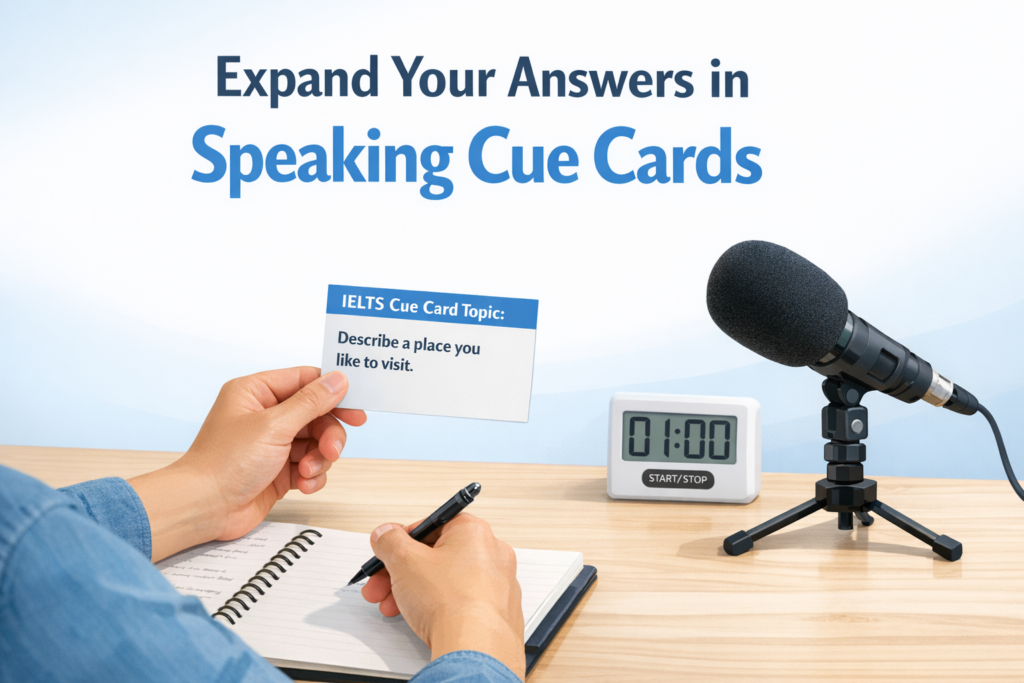
Many students find it hard to speak for long in IELTS speaking. In Part 2, you get a topic and need to talk for 1–2 minutes. This part is called speaking cue cards. Some students give very short answers and lose marks. To score better, you need to expand your answers by adding more ideas, details, and examples. You do not need difficult English. Simple and clear sentences work well.
What Are Speaking Cue Cards
In IELTS speaking Part 2, you receive a card with a topic and a few points to guide you. You get 1 minute to prepare and then speak for up to 2 minutes. These speaking cue cards help you organize your ideas. However, it is important not to just read the points. You should add extra information so that your answer becomes longer and more complete.
Why Expanding Answers Is Important
Expanding your answers helps improve your speaking score. It shows that you can speak without long pauses and explain your ideas clearly. It also reflects your vocabulary and grammar skills. Short answers may end quickly, but longer answers show better fluency. This is why practicing speaking cue cards with expanded answers is very useful.
Use the “Why, What, When, Where” Method
A simple way to expand your answer is to ask yourself small questions like why, what, when, and where. For example, if the topic is about a trip, you can talk about where you went, when you went, why you chose that place, and what you did there. This method helps you add more content naturally while speaking in speaking cue cards.
Add Personal Experience
Adding personal experience makes your answer more natural and easy to explain. If the topic is about a teacher, you can talk about when you met them, what subject they taught, and how they helped you. Personal stories are easy to remember and help you speak longer in speaking cue cards.
Use Simple Linking Words
Linking words help connect your ideas and make your speech smooth. You can use simple words like first, then, after that, also, because, and finally. For example, you can say, “First, I visited the place with my family. Then, we explored the market. After that, we had dinner.” These small words help you expand your answers in speaking cue cards.
Describe Details Clearly
Instead of giving short answers, try to describe details. For example, instead of saying “I went to a park,” you can say “I went to a big park near my home. It has green trees, a walking track, and a small lake.” Adding details makes your answer longer and more interesting in speaking cue cards.
Use Examples
Examples make your ideas clear and help you speak for a longer time. For instance, you can say, “I like reading books. For example, I recently read a story about travel and adventure.” This simple method works well to expand answers in speaking cue cards.
Practice Speaking Daily
Regular practice is very important. Try to speak on any topic for 1–2 minutes every day. You can pick a topic, set a timer, and record your voice. After that, listen to your recording and check if your answers are too short or if you are repeating words. Daily practice helps improve your performance in speaking cue cards.
Use a Simple Structure
Following a simple structure can help you stay organized. Start with a short introduction, then explain the main points, add extra details, and finish with a natural ending. This approach makes it easier to speak clearly and confidently in speaking cue cards.
Avoid Long Pauses
Pauses can reduce your fluency score. If you forget a word, do not stop speaking. Try to explain the idea using simple words. For example, you can describe something instead of using a difficult word. This helps you continue speaking smoothly in speaking cue cards.
Use Basic Vocabulary Smartly
You do not need difficult vocabulary to score well. Simple words used correctly are enough. Focus on clear meaning and correct grammar. For example, saying “I felt very happy and relaxed” is simple but effective. This approach works well in speaking cue cards.
Practice with Real Topics
Practicing with real IELTS topics can help you feel more confident. Common topics include a place, a person, a hobby, or a memory. When you practice these topics, you become more comfortable and perform better in speaking cue cards.
Stay Calm and Confident
Confidence is very important while speaking. Even if your English is simple, try to speak clearly and calmly. Take a deep breath, speak slowly, and do not rush. Staying confident helps you give better answers in speaking cue cards.