For many players, attending a tennis tournament should be an exciting experience — full of anticipation, adrenaline, and the thrill of competition. Yet, all too often, participants encounter confusion, delays, and stress, not because of their performance but due to inefficient tournament management. Manual systems, once the backbone of event organisation, are now struggling to keep up with the growing scale and professionalism of Indian tennis.
The Limitations of Manual Management
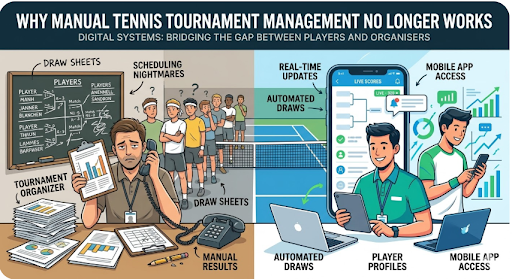
- Traditional tennis tournament management relies heavily on spreadsheets, paper-based registration, WhatsApp groups, and constant phone calls. While workable for small, local events, this approach introduces multiple risks:
- Human error in registrations: Duplicate entries, missed payments, or incorrect details
- Confusing match schedules: Manual updates often fail to reflect last-minute changes
- Delayed results: Scores may take hours to communicate, frustrating players and parents
- Loss of historical data: Records are scattered and often inaccessible for future reference
- Inefficient communication: Multiple channels lead to missed messages and misunderstandings
For players, these errors translate into missed matches, unfair matchups, or unnecessary anxiety. Imagine training for months and arriving to find your match has been rescheduled without notice — frustration and stress replace excitement, impacting both performance and morale.
How Players Experience Manual System Problems
The emotional impact of these inefficiencies is often overlooked. Players may feel:
- Overlooked or undervalued, especially if communication is inconsistent
- Stressed about timings, unsure if they will play on time
- Frustrated with delays that eat into warm-up routines and focus
- Anxious about fairness, particularly when draws and scores are mismanaged
Parents and coaches are equally affected, scrambling to track updates while trying to support young athletes. Over time, these experiences can erode trust in organisers and reduce participation in future tournaments.
Key Challenges of Managing Tournaments Manually
Some common issues that organisers face with manual systems include:
- Paper-based registrations that are prone to errors
- Manual draw creation, often leading to unfair pairings
- Complex multi-category scheduling, increasing the likelihood of overlaps
- Tracking match results manually, causing delays in rankings
- Handling withdrawals or last-minute changes without disrupting the entire schedule
Even small mistakes can escalate, affecting players’ emotional experience and the smooth flow of the tournament.
Digital Systems: Bridging the Gap Between Players and Organisers
Modern tennis tournament management platforms offer solutions that directly impact player experience while simplifying organisers’ work. Centralised software allows:
- Automated registration and draw creation to prevent errors
- Real-time scheduling and notifications to keep players informed
- Instant results and live scoring updates to maintain transparency
- Long-term record storage for ranking history and performance tracking
By removing manual bottlenecks, players enjoy a stress-free tournament experience, while organisers can focus on enhancing the event rather than firefighting problems.
Why Manual Management Is No Longer Enough
The growth of tennis in India demands more than traditional tools. Players now expect timely updates, fair scheduling, and accurate results, while organisers face increasing pressure to maintain professional standards. Manual systems struggle to meet these expectations, highlighting the need for structured, technology-driven solutions.
The one Solution Players Appreciate
Among the platforms making waves in India, TennisKhelo is often mentioned by organisers and players for its ability to tackle real-world challenges. Without appearing self-promotional, users frequently note that it:
- Centralises all registrations, draws, and scheduling on one dashboard
- Sends instant notifications to players and coaches when matches change
- Maintains accurate records, reducing disputes and errors
- Simplifies multi-category tournaments, keeping both players and organisers on track
Players and parents often share positive experiences of tennis tournaments run on such systems, appreciating the clarity, fairness, and smooth execution.
Conclusion: A Step Towards Modern, Player-Friendly Tennis Tournaments
Manual tournament management may have been sufficient a decade ago, but today it can lead to frustration, confusion, and missed opportunities for players. By adopting structured digital systems, organisers can ensure:
- Accurate registrations and draws
- Clear communication for players and coaches
- Efficient scheduling across multiple categories
- Transparency in scoring and ranking
Platforms like TennisKhelo illustrate how technology can solve operational challenges while enhancing the player experience, making tournaments more enjoyable, fair, and professional.