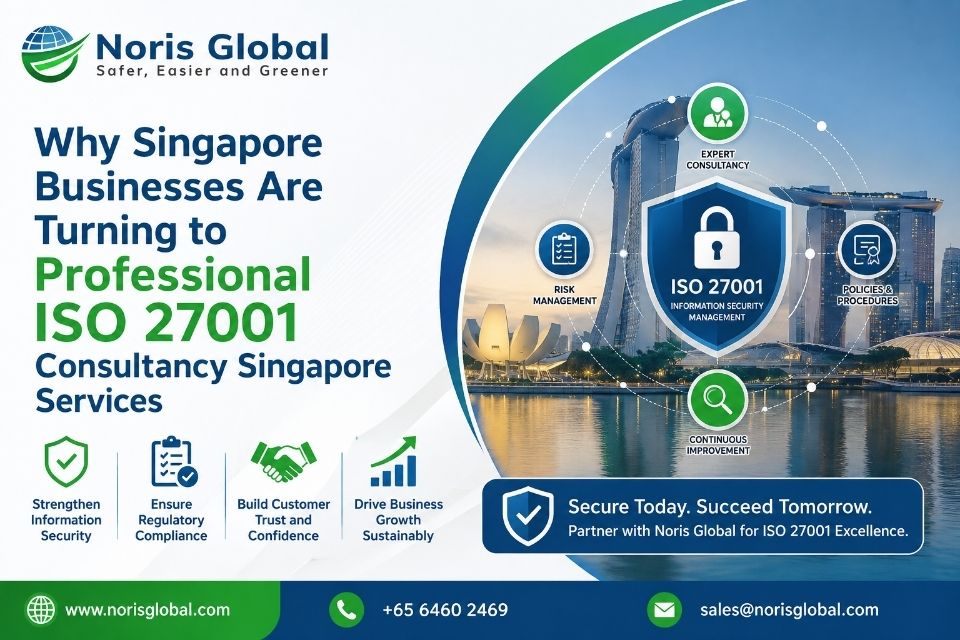
If you run a business in Singapore and you have started fielding questions from clients about data security certifications, you are not alone. Banks, healthcare providers, tech firms, and even mid sized logistics companies across the country are being asked the same thing by their customers and regulators. Can you prove your information security is under control? This is exactly where an experienced ISO 27001 Consultancy Singapore comes into the picture, helping organisations move from scattered security practices to a certified, defensible system.
Singapore has built its reputation as a trusted business hub partly on the strength of its regulatory environment. The Personal Data Protection Act, the Cybersecurity Act, and sector specific requirements from MAS and other regulators all point businesses toward stronger information security governance. ISO 27001 has become the practical answer for companies that want a recognised framework rather than reinventing their own approach from scratch.
What ISO 27001 Actually Means for Your Business
ISO 27001 is the international standard for information security management systems. It gives a company a structured way to identify risks to its data, decide how to treat those risks, and prove to auditors, clients, and partners that security is being managed deliberately rather than by accident.
For a Singapore business, certification often becomes a condition of doing business rather than a nice addition to the company profile. Many government tenders, financial sector contracts, and enterprise clients now list ISO 27001 as a prerequisite before they will even open commercial discussions. Working with a knowledgeable ISO 27001 Consultancy Singapore team removes the guesswork from meeting these expectations.
Why Local Expertise Matters More Than You Might Think
Some business owners assume that any consultant familiar with the ISO 27001 standard can do the job. In practice, the local context changes a great deal. A consultancy based in Singapore understands how the standard interacts with PDPA obligations, how local auditors from bodies like SAC accredited certification firms tend to assess evidence, and how Singapore specific industries such as fintech, healthcare, and logistics apply the controls in Annex A.
Noris Global has built its practice around this local understanding. Rather than handing clients a generic template and leaving them to interpret it, the team works through each clause of the standard against the client’s actual operations, systems, and staff capabilities. This is the difference between passing an audit on paper and running a security system that genuinely protects the business day to day.
What a Good ISO 27001 Consultancy Singapore Actually Does
A proper engagement is not just documentation writing. It typically covers several distinct phases, each building on the last.
- A gap analysis that compares your current security practices against the full requirements of ISO 27001, so you know exactly where the effort needs to go
- Risk assessment and treatment planning that identifies what could realistically go wrong with your information assets and what controls make sense for your size and industry
- Policy and procedure development written in language your staff will actually read and follow, not just legal boilerplate
- Staff training and awareness sessions, since most security failures come from people, not technology
- Internal audits conducted before the real certification audit, so surprises are caught early
- Support during the certification audit itself, including preparing management and staff for auditor interviews
Skipping any of these steps tends to show up later, either as a failed audit or as a certificate that looks good on paper but does not reflect how the business actually operates.
The Real Cost of Getting This Wrong
Companies sometimes try to handle ISO 27001 internally using a spare staff member and a bundle of downloaded templates. It rarely goes smoothly. The standard requires specific evidence, consistent record keeping, and an understanding of how auditors interpret vague sounding clauses like continual improvement or management review. Without that experience, businesses often fail their first audit attempt, which costs more in time and certification fees than hiring the right consultancy from the start.
There is also a quieter cost. A security management system built without proper risk analysis tends to focus on the wrong things. Staff end up filling in forms that do not reflect real threats, while genuine gaps in areas like access control or vendor management go unnoticed. An experienced ISO 27001 Consultancy Singapore avoids this by grounding the entire system in what actually matters for your specific business.
Business Continuity Deserves Equal Attention
Information security and business continuity are close cousins, and many Singapore companies pursuing ISO 27001 also look into ISO 22301, the standard for business continuity management. If a fire, flood, cyber incident, or supply chain disruption hit your operations tomorrow, would your business know exactly what to do in the first hour?
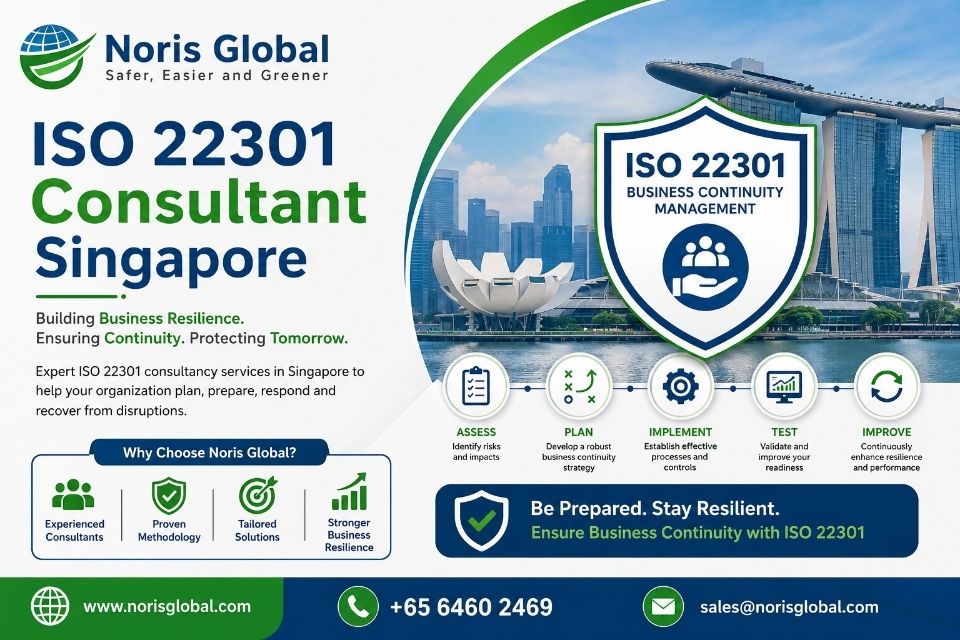
A qualified ISO 22301 Consultant Singapore helps organizations build tested recovery plans, identify critical business functions, and set realistic recovery time objectives. Many clients find that pairing ISO 27001 with ISO 22301 creates a much stronger overall resilience posture, since the two standards reinforce each other around risk management and incident response.
Noris Global offers both services under one roof, which means clients working with an ISO 22301 Consultant Singapore team from the same firm handling their ISO 27001 project get a joined up approach rather than two disconnected systems that overlap in confusing ways.
Choosing the Right Partner
When evaluating an ISO 27001 Consultancy Singapore option, a few questions tend to separate genuinely capable firms from those offering a shortcut.
Ask how many certifications they have supported through to completion, and in which industries. Ask whether they will be present during the actual certification audit or whether their involvement stops once documentation is handed over. Ask how they handle staff training, since a system nobody understands will not survive its first surveillance audit a year later.
It also helps to ask about ongoing support. Certification is not a one time event. Surveillance audits happen annually, and the management system needs to evolve as the business changes. A consultancy that disappears after the initial certificate is only solving half the problem.
A Practical Path Forward
For most Singapore businesses, the journey from a standing start to ISO 27001 certification takes somewhere between four and nine months, depending on company size and how mature existing practices already are. Smaller companies with straightforward operations sometimes move faster, while organizations with complex IT environments or multiple business units need more time to map out risks properly.
The businesses that move through this process smoothly are usually the ones that treat it as a genuine improvement project rather than a compliance exercise to survive. Working with an established ISO 27001 Consultancy Singapore team from day one sets that tone early, and it tends to make the difference between a certificate that sits in a drawer and a security system the whole company actually relies on.
Noris Global works alongside Singapore businesses through every stage of this process, from the first gap analysis to the final certification audit, and continues supporting clients through the years of surveillance audits that follow.
Frequently Asked Questions
How long does ISO 27001 certification usually take in Singapore?
Most organizations complete the process in four to nine months. The timeline depends on company size, how mature current security practices are, and how quickly staff can complete required training and documentation work.
Is ISO 27001 certification mandatory for businesses in Singapore?
It is not a legal requirement in most industries, though it has become a practical necessity for companies bidding on government contracts, working with financial institutions, or serving enterprise clients who require proof of strong information security governance.
What is the difference between ISO 27001 and ISO 22301?
ISO 27001 focuses on protecting information assets and managing security risks. ISO 22301 focuses on keeping the business running during and after a disruption. Many companies pursue both since they address related but distinct risks.
Can a small business afford ISO 27001 consultancy?
Costs scale with company size and complexity, so a small business with straightforward operations typically pays less than a large enterprise with multiple departments and systems. A gap analysis at the start gives a realistic picture of scope and cost before committing.
Do we need to hire a consultant, or can we manage certification internally?
Some companies with dedicated security staff manage parts of the process internally, but most benefit from outside guidance, particularly around risk assessment methodology and preparing for the certification audit itself. Getting this wrong the first time often costs more than hiring proper support from the start.