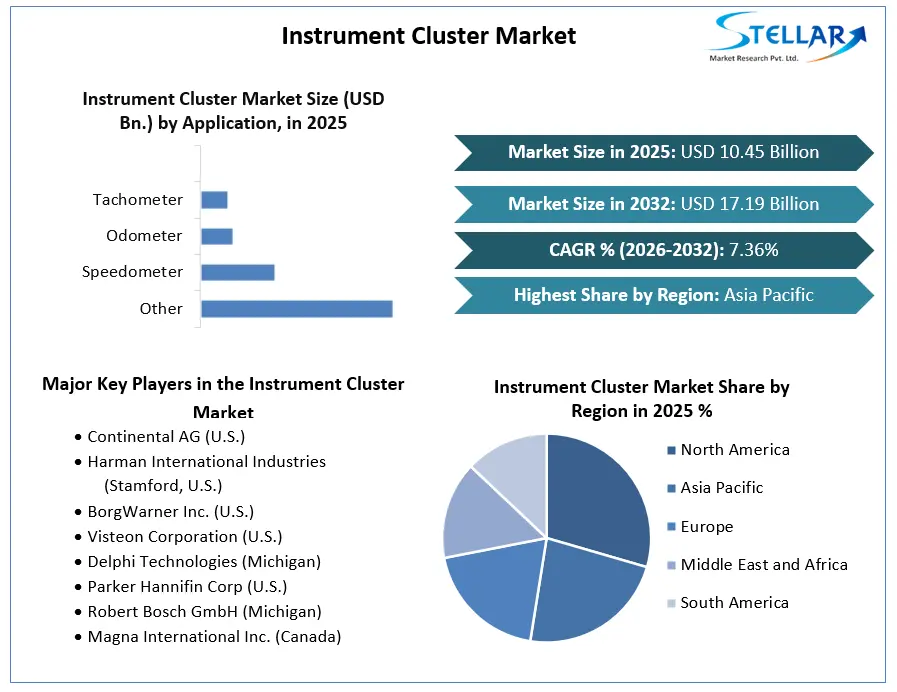
The global Instrument Cluster Market is undergoing a structural transition as automakers accelerate the move toward software-defined cockpits and integrated safety telemetry, according to comprehensive intelligence published by Stellar Market Research. Valued at USD 10.45 billion in 2025, the market is projected to reach USD 17.19 billion by 2032, expanding at a compound annual growth rate (CAGR) of 7.36%.
As vehicle architectures evolve from legacy distributed Electronic Control Units (ECUs) to centralized Cockpit Domain Controllers (CDCs), the primary display panel in front of the driver is transforming from a basic speed readout into an intelligent situational awareness hub. The rapid rise of electric vehicles (EVs) and Advanced Driver Assistance Systems (ADAS) is compelling OEMs to deploy high-resolution digital and hybrid clusters that present real-time battery thermal state, energy flow, lane-keep guidance, and predictive maintenance alerts in the driver’s direct line of sight.
Key Findings from the Report
-
Valuation & Pace: Global market revenue is forecasted to grow from USD 10.45 billion in 2025 to USD 17.19 billion by 2032, backed by a sustained 7.36% CAGR.
-
Hybrid Segment Dominance: Hybrid instrument clusters continue to account for the largest revenue share, providing automotive manufacturers with a cost-effective bridge that marries analog gauge reliability with digital screen capabilities.
-
Digital Acceleration: Purely digital instrument clusters represent the fastest-growing technology segment, driven by falling automotive-grade display costs and luxury vehicle demand.
-
Speedometer & GPS Integration: By application, speedometers hold the primary market share, increasingly fused with GPS navigation and dynamic speed-limit warnings.
-
Regional Dominance: The Asia-Pacific region leads global market demand, bolstered by massive vehicle production volumes in China, India, and Japan, alongside aggressive domestic EV adoption.
-
Investment Shift: Global automotive Tier-1 suppliers are prioritizing capital investment in silicon-level Cockpit Domain Controllers that unify cluster telemetry with central infotainment.
For further information, click the following link:https://www.stellarmr.com/report/req_sample/instrument-cluster-market/2388
Market Drivers and Restraints
Market Drivers
-
Proliferation of Software-Defined Cockpits: Vehicle buyers increasingly expect smartphone-like graphics, retina-class resolutions, photorealistic rendering, and customizable dashboard themes, driving OEMs to replace mechanical dials with digital displays.
-
ADAS & Autonomous Safety Telemetry: Safety mandates require instantaneous visual alerts for lane departure, forward collision risk, and pedestrian detection, positioning the instrument cluster as the primary safety interface.
-
Global Electric Vehicle Transition: EVs require specialized cluster graphics to present real-time regenerative braking feedback, battery state-of-charge, range predictions, and thermal alerts.
Market Restraints
-
High Hardware and System Integration Costs: Advanced digital units carry substantial bill-of-materials costs, with replacement units ranging between USD 150 and USD 1,100, impacting post-warranty affordability.
-
Thermal & Electrical Vulnerabilities: Digital panels remain susceptible to extreme thermal environments, power fluctuation dropouts, and display controller glitches that compromise gauge reliability.
Technology, Regulation, and Sustainability Trends
-
Centralized Domain Architectures: Automators are moving away from dedicated cluster processors toward multi-core System-on-Chip (SoC) platforms running hypervisors, allowing safety-critical cluster software (AUTOSAR) and infotainment OS (Android Automotive) to run concurrently on one processor.
-
Cybersecurity Compliance: Strict enforcement of regulations such as UNECE R155 and R156 mandates robust hardware-security modules within digital cluster controllers to prevent remote over-the-air (OTA) gauge tampering.
-
Functional Safety (ISO 26262): Primary driving indicators must meet ASIL-B and ASIL-D functional safety specifications, ensuring that speed and warning indicators never freeze or fail silently during operation.
-
Sustainable Electronics: OEMs are adopting low-power OLED and mini-LED backlighting technologies to reduce auxiliary electrical loads on EV traction batteries.
Regional Insights
-
Asia-Pacific: Retains market leadership due to high automotive assembly lines in China, Japan, India, and South Korea. India’s rapidly growing EV ecosystem—projected to reach multi-fold penetration growth by 2032—is accelerating demand for localized digital instrument panels in both two-wheeler and passenger car segments.
-
Europe: Represents the second-largest market, anchored by premier luxury OEMs including Audi, BMW, Mercedes-Benz, and Porsche. Europe leads in the adoption of high-end curved OLED displays, driver monitoring integration, and augmented reality head-up displays.
-
North America: Positions as a key growth node characterized by high consumer preference for full-size pickup trucks and SUVs equipped with large digital cockpits, tow-assist gauge interfaces, and connected off-road telemetry.
Recent Industry Developments
-
Continental AG (2025): Launched its next-generation ultra-wide curved driver display incorporating invisible safety indicators, reducing cockpit power draw by 20%.
-
Robert Bosch GmbH (2025): Partnered with major chipmakers to roll out a unified Cockpit Domain Controller that reduces vehicle wiring harness complexity by 15% while powering dual driver displays.
-
Visteon Corporation (2025): Expanded its SmartCore domain controller production capacity in Asia to address surging demand for multi-display digital cockpits in mid-tier electric vehicles.
-
Denso Corporation (2026): Introduced an advanced driver-monitoring system integrated directly into the digital instrument cluster housing, enhancing driver fatigue detection to comply with Euro NCAP ratings.
-
Magneti Marelli (2026): Unveiled a modular hybrid cluster series targeted at emerging markets, delivering customizable LCD screens alongside traditional gauges at a 25% lower manufacturing cost.
For further information, click the following link:https://www.stellarmr.com/report/req_sample/instrument-cluster-market/2388
Competitive Landscape
The global instrument cluster market is highly competitive and dominated by established Tier-1 automotive suppliers, including Continental AG, Robert Bosch GmbH, Denso Corporation, Visteon Corporation, Magneti Marelli, and Nippon Seiki Co., Ltd. Industry leaders are actively consolidating software stacks, expanding display supplier partnerships, and deploying over-the-air update capabilities to maintain market share across both premium and entry-level vehicle platforms.
Analyst Commentary
“The automotive instrument cluster is no longer an isolated speedometer assembly—it has become the command center for driver safety and vehicle intelligence,” said a Senior Research Analyst at Stellar Market Research. “As automakers transition to centralized compute architectures, the winners in this market will be Tier-1 suppliers that can deliver ASIL-compliant functional safety alongside low-latency, photorealistic graphics engines at competitive price points.”
Future Outlook
Through 2032, the market will witness complete convergence between instrument clusters, central infotainment, and head-up display systems. As 3D optical displays and augmented reality HUDs gain commercial scale, traditional primary displays will increasingly serve as fall-safe redundant visual nodes, ensuring uninterrupted driving telemetry under all environmental conditions.
About Stellar Market Research
Stellar Market Research is a multifaceted market research and consulting company with professionals from several industries. Some of the industries we cover include medical devices, pharmaceutical manufacturers, science and engineering, electronic components, industrial equipment, technology and communication, cars and automobiles, chemical products and substances, general merchandise, beverages, personal care, and automated systems. To mention a few, we provide market-verified industry estimations, technical trend analysis, crucial market research, strategic advice, competition analysis, production and demand analysis, and client impact studies.
Address
Phase 3, Navale IT Zone, S.No. 51/2A/2, Office No. 202, 2nd floor, Near, Navale Brg, Narhe, Pune, Maharashtra 411041
Email
sales@stellarmr.com
Mobile
+91 9607365656