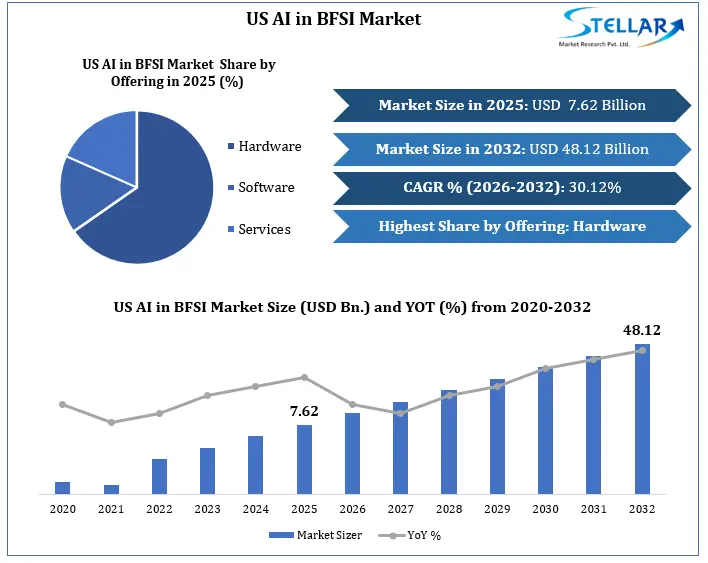
The US AI in BFSI Market is experiencing a structural paradigm shift, according to a comprehensive intelligence study released by Stellar Market Research. As financial institutions face mounting pressures to modernize legacy architectures and optimize operational expenditure, artificial intelligence has transitioned from a supplementary tech tool to the core operational backbone of modern banking, financial services, and insurance.
The American financial landscape is undergoing a massive digital overhaul. Traditional banking models are increasingly constrained by legacy systems, rising customer expectations for hyper-personalization, and complex compliance frameworks. The integration of advanced machine learning (ML), natural language processing (NLP), and generative AI solutions provides a vital lifeline. Financial entities are no longer just automating back-office routines; they are deploying autonomous AI agents capable of proactive fraud mitigation, real-time credit scoring, and algorithmic advisory services. This transformation represents a crucial strategic inflection point, redefining how capital is managed, secured, and distributed across the United States.
Key Findings from the Report:
-
Valuation Trajectory: The market exhibits a sharp upward trajectory, backed by surging enterprise capital expenditures directed toward cloud-based and on-premise AI deployments.
-
Dominant Segment: Software solutions command the largest market share, driven by extensive application programming interface (API) integrations for automated risk analytics and anti-money laundering (AML) tracking.
-
Fastest-Growing Segment: Financial Advisory and automated wealth management are expanding at the highest growth rate, fueled by consumer demand for real-time, data-backed portfolio optimization.
-
Deployment Dynamics: Hybrid and cloud-native AI infrastructures are witnessing accelerated adoption, allowing mid-sized credit unions and regional banks to compete with tier-one financial giants.
-
Risk Mitigation Impact: Fraud detection and prevention systems account for a primary portion of enterprise software allocation, driven by the proliferation of sophisticated cyber threats.
-
Regional Concentration: North America remains the leading regional ecosystem globally, anchored by the dense concentration of US-based financial hubs and hyperscale cloud providers.
-
Investment Relevance: Venture capital and internal R&D budgets are heavily favoring compliance-tech (RegTech) and generative AI applications to drastically slash administrative overhead.
For further information, click the following link:https://www.stellarmr.com/report/req_sample/us-ai-in-bfsi-market/2938
Market Drivers and Restraints:
-
Driver 1: Explosion of Digital Transactions: The relentless surge in digital banking, mobile payments, and online trading platforms generates massive datasets that manual compliance and security teams cannot process effectively without AI intervention.
-
Driver 2: Escalating Need for Operational Efficiency: Financial institutions face compressed profit margins due to macroeconomic pressures, making AI-driven automation essential for reducing customer acquisition costs and streamlining labor-intensive back-office workflows.
-
Driver 3: Advanced Fraud and Cyber Threat Vectors: Sophisticated financial crimes necessitate real-time, cognitive threat-detection systems that can isolate transaction anomalies faster than conventional rule-based engines.
-
Restraint 1: Legacy Infrastructure Friction: Integrating advanced AI models with decades-old core banking mainframes (such as legacy COBOL systems) presents steep technical hurdles and demands specialized migration expertise.
-
Restraint 2: Evolving Regulatory Compliance Complexity: The rapidly shifting legal landscape surrounding data privacy, algorithmic transparency, and consumer protection creates compliance burdens that can delay deployment timelines.
Technology, Regulation, and Sustainability Trends:
The convergence of cognitive computing and financial compliance has brought AI governance to the forefront. Regulatory bodies increasingly mandate algorithmic explainability, forcing financial institutions to adopt “glass-box” AI models over opaque “black-box” systems. On the technology front, the migration from basic reactive chatbots to proactive generative AI agents has fundamentally altered customer touchpoints. Furthermore, green data center initiatives and energy-efficient neural network computations are aligning institutional AI expansions with broader Environmental, Social, and Governance (ESG) mandates.
Regional Insights:
The United States serves as the epicenter of North America’s market dominance, propelled by aggressive technology investments from major financial institutions in New York, San Francisco, and Charlotte. Emerging regional pockets across secondary financial centers are also noting exponential traction, driven by local fintech startup ecosystems and state-level sandboxes that encourage collaborative financial innovation. Regulatory frameworks promoted by agencies such as the National Institute of Standards and Technology (NIST) provide a reliable blueprint for secure, responsible AI deployment across US markets.
Recent Industry Developments:
-
Swift (2024): Unveiled plans for an AI-powered cross-border payment fraud defense service utilizing pseudonymized data to spot anomalies in real time.
-
Google Cloud (2025): Released an enterprise study highlighting that 53% of financial services executives have integrated active AI agents into production pipelines to optimize risk management.
-
IBM (2025): Reported that its AI business book surpassed $9.5 billion, propelled heavily by BFSI clients adopting generative AI to modernize core legacy mainframes.
-
Microsoft (2026): Scaled its fiscal capital expenditure to approximately $145 billion, with a major strategic focus on expanding cloud and AI data center infrastructure to service heavy enterprise workloads.
-
Leading US Banking Institutions (2026): Expanded internal rollouts of proprietary generative copilots to tens of thousands of employees, significantly boosting automated document synthesis and market research workflows.
Competitive Landscape:
The US AI in BFSI market features a consolidated yet intensely competitive vendor ecosystem. Market leaders—including Google Cloud, Microsoft Corporation, Amazon Web Services (AWS), IBM Corporation, NVIDIA, and specialized financial tech firms like Palantir, FICO, and SAS Institute—are actively competing through strategic cloud partnerships, proprietary financial foundation models, and tailored end-to-end security frameworks. Competitive differentiation increasingly hinges on compliance readiness, data privacy assurances, and seamless interoperability with existing banking infrastructure.
Analyst Commentary:
“The US financial sector has crossed the Rubicon regarding artificial intelligence,” says a Senior Research Analyst at Stellar Market Research. “Institutions are no longer experimenting with isolated proof-of-concepts. Instead, AI has become core operational fabric. The organizations pulling ahead are those successfully harmonizing aggressive automation with strict algorithmic transparency and risk governance, ensuring that speed does not compromise systemic security.”
Future Outlook:
Through the forecast period, the US AI in BFSI market is poised for hyper-growth. As generative models mature and edge-computing capabilities expand, financial institutions will transition closer to fully autonomous banking ecosystems. Regulatory alignment will tighten, favoring vendors who embed built-in compliance verification. Ultimately, market success will belong to institutions that harness cognitive intelligence to simultaneously deliver hyper-personalized consumer experiences and impenetrable security guardrails.
For further information, click the following link:https://www.stellarmr.com/report/req_sample/us-ai-in-bfsi-market/2938
About Stellar Market Research
Stellar Market Research is a multifaceted market research and consulting company with professionals from several industries. Some of the industries we cover include medical devices, pharmaceutical manufacturers, science and engineering, electronic components, industrial equipment, technology and communication, cars and automobiles, chemical products and substances, general merchandise, beverages, personal care, and automated systems. To mention a few, we provide market-verified industry estimations, technical trend analysis, crucial market research, strategic advice, competition analysis, production and demand analysis, and client impact studies.
Address
Phase 3, Navale IT Zone, S.No. 51/2A/2, Office No. 202, 2nd floor, Near, Navale Brg, Narhe, Pune, Maharashtra 411041
Email
sales@stellarmr.com
Mobile
+91 9607365656