It’s usually late, or it’s a Sunday, or it’s right after someone’s clocked a competitor’s van looking sharp outside a job site. That’s when the phone comes out and the search happens. Most people typing car wrap near me in cork aren’t browsing casually, they’ve already decided, they just need someone local who can actually deliver on it. Truth is, that search says a lot about where a business is at, they’ve hit the point where the plain car or van just isn’t cutting it anymore and something needs to change, fast, before the next job or the next school run or whatever it is that’s making them notice it in the first place.
Why the “Near Me” Part Actually Matters
Let’s be real, wrapping isn’t the kind of job you want handled by someone three counties away who ships you a kit and a YouTube tutorial. It needs measuring, fitting, actual hands-on installation, and if something goes wrong with the vinyl six months down the line, you want someone reachable, not someone you found once on a forum. Local matters here in a way it doesn’t for a lot of other purchases. Someone based nearby knows the roads, knows the weather patterns, knows what tends to hold up and what peels within a year around here specifically. That local knowledge isn’t marketing fluff either, it genuinely changes the quality of advice you get before the job even starts.
What’s Actually Involved in Getting a Car Wrapped
People picture this as basically applying a giant sticker and that’s not really it. It starts with design, working out colours, layout, where the logo sits, how it flows around doors and mirrors without looking chopped up or awkward. Then it’s printed onto proper vinyl and cut to match the specific panels of that specific vehicle, no two jobs are identical even on the same car model because paint condition and body lines vary slightly. Installation is its own craft, heat-shrinking the material down flat over curves so there’s no bubbling, no lifting corners, nothing that looks rushed. Rushed jobs show up fast, usually within weeks, and once an edge starts lifting the whole thing tends to unravel from there.
Full Coverage or Partial, and How to Actually Decide
Not everyone needs the whole car covered bonnet to boot. A lot of the time a partial wrap, logo on the doors, contact details along the side, maybe a splash of colour across the back, does the job just as well for a fraction of the cost. Full wraps make more sense when the vehicle needs to genuinely stand out or when a business wants total colour control regardless of what the car came in from the factory. It really comes down to budget and what the goal is, there isn’t a single correct answer that applies to every business walking through the door.
Scaling It Up: Fleet Branding and Why One Van Is Rarely the Whole Story
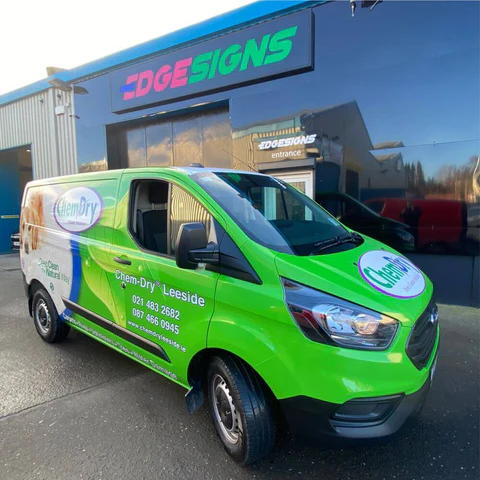
Once a business has more than one vehicle on the road, the conversation shifts pretty naturally toward fleet branding, and this is where consistency starts to matter more than any single clever design idea. Every van, every car, same colours, same fonts, same logo placement, so a customer spotting one vehicle on the motorway and a different one parked outside a job three weeks later instantly recognises both as the same company. That kind of repeated visual consistency builds a level of trust that a one-off flashy wrap on a single car just can’t replicate on its own. People start trusting the brand almost subconsciously, without ever really thinking about why.
Materials and Surviving the Irish Weather Grind
Nobody enjoys talking about this bit but it’s genuinely important. Irish weather chews through cheap vinyl, rain, wind, UV, road salt in winter, it all adds up over the months. Poor quality material starts fading or lifting at the edges within a year, sometimes less if it’s parked outdoors constantly without any real cover. Good vinyl, properly fitted, should last five years plus with reasonable care, hand washing instead of aggressive pressure washing, avoiding harsh chemical cleaners, parking in shade when it’s practical to do so. None of that’s exciting advice, but it’s the difference between a wrap that earns its cost back several times over versus one that needs redoing within twelve months.
Spotting a Good Installer Before You Commit
This matters more than most people realise going in, and it’s worth taking seriously. Some installers handle flat panels beautifully but fall apart the moment there’s a mirror housing or a tight curve around a wheel arch. Ask for real photos of finished jobs, actual vehicles they’ve wrapped, not renders or design mockups dressed up to look like the real thing. If someone hesitates to show previous work or gets vague about specifics, take that as a signal worth noting. Genuine reviews from real customers help too, and they’re usually not hard to find if the work’s actually good.
Why This Beats a Lot of Other Advertising, Pound for Pound
The short answer here is simple, a wrapped vehicle keeps working without anyone having to pay for it again and again. Digital ads stop the second the budget runs out, social posts get buried within hours, but a wrapped car parked outside the shop or doing the school run is advertising every single day, rain or shine, without another invoice landing in the inbox. It’s not glamorous, it won’t go viral, but it’s steady, it’s visible, and over a few years it adds up to serious exposure for very little ongoing cost compared to most other marketing routes available to a small business.
The Bottom Line
At the end of the day, a plain car or van is a missed opportunity sitting in plain sight, doing nothing while it could be doing something. Whether it’s a single vehicle or a proper fleet branding rollout across ten vans, the logic stays exactly the same, get the design right, use decent materials, have it installed by someone who actually knows what they’re doing with curves and contours, and that vehicle becomes a quiet, constant advertisement for years without anyone having to think about it twice. So if that late-night search for someone reliable nearby is already happening, the smart move is picking people who can show real finished work, not just promises, and taking it from there.