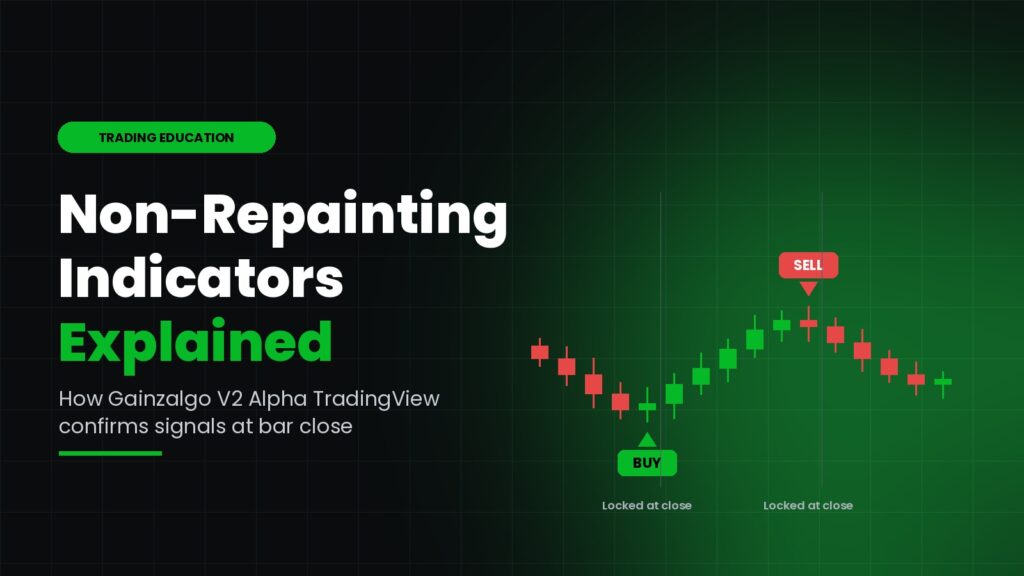
Few things damage a trader’s confidence faster than a signal that vanishes. You see a clean buy arrow on yesterday’s chart. Yet when you watched the same bar live, that arrow never appeared, or it flickered on and off before settling somewhere else.
This behaviour is called repainting. Over two decades of reviewing chart tools, I have seen it ruin more strategies than bad entries ever did. A repainting tool shows a perfect history, but that history was never tradable in real time.
For this reason, many traders now ask one question before they study any TradingView trade signals indicator: does it repaint? This guide explains what repainting is, why it happens, and how to test for it. It also looks at how Gainzalgo V2 Alpha TradingView handles the problem through bar-close confirmation. The goal is not to sell you a tool. Instead, the goal is to help you judge any algorithmic trading indicator with a sharper eye.
What Repainting Is and How It Happens
Repainting means an indicator changes its past values after new data arrives. In simple terms, the chart you study today is not the chart you would have seen live. As a result, historical signals look more accurate than they really were.
On TradingView, scripts are written in Pine Script. Pine calculates on every price tick while a caWhat Repainting Is and How It Happensndle is still open. Once the candle closes, the value is locked for that bar. Problems start when a script treats an unfinished candle as if it were final.
There are four common causes of repainting:
- Intrabar signals. A script prints an arrow while the candle is still forming. The arrow may disappear if price reverses before the close.
- Future data from higher timeframes. A poorly written request to a higher timeframe can pull values that did not exist yet at that moment in time.
- Pivot and zigzag any tools then draw the signal back on the original bar, which hides the delay.logic. A swing high can only be confirmed after several later bars. Many tools then draw the signal back on the original bar, which hides the delay.
- Offsets and lookahead. Shifting plots backward makes a signal look earlier than it truly was.
Not every change on a live bar is a flaw, though. All indicators move while a candle is open, because price is still moving. The real issue is whether a confirmed, closed signal ever changes later. That distinction is the core of every honest discussion about repainting.
Why Non-Repainting Matters for Backtests and Live Trading
A backtest is only as honest as the signals behind it. If a script repaints, every past trade is judged with hindsight. Consequently, win rates and profit factors can look far better than live results will ever be.
Think of it like grading a test after you have seen the answer key. The score looks great, but it tells you nothing about real skill. In the same way, a repainting backtest tells you nothing about how the signals will behave tomorrow.
Non-repainting design matters for three practical reasons:
- Reliable review. When signals stay fixed, you can scroll back and study what actually happened. Your trade journal then matches the chart.
- Trustworthy alerts. An alert that fires on a confirmed bar will not contradict the chart an hour later. This keeps automated workflows consistent.
- Better risk planning. Stop-loss and take-profit levels are only useful if the entry point is real. Moving entries make position sizing guesswork.
In addition, non-repainting logic builds discipline. You learn to wait for the candle to close instead of reacting to every tick. Over time, that patience often matters more than any single setting.
However, non-repainting does not mean always correct. A fixed signal can still be a losing signal. It simply means the signal you see in history is the same one you would have seen live.
How Gainzalgo V2 Alpha TradingView Approaches Non-Repainting
Gainzalgo V2 Alpha TradingView is built around one central rule: a signal is evaluated only when the bar closes. According to the developer’s published script notes, every configuration in the suite shares this bar-close confirmation behaviour. Because of this, a signal that appears on a closed candle is meant to stay where it was printed.
Bar-close confirmation
The bar-close approach is the simplest and most widely accepted defence against repainting. Instead of reacting to each tick, the script waits for the candle to finish. Only then are its conditions checked. As a result, the mid-bar flicker that troubles many tools is avoided by design.
The trade-off is a small delay. You receive the signal at the close of the bar, not halfway through it. For most traders, that delay is a fair price for a history that can be trusted.
A multi-phase evaluation model
The Alpha preset is described by its developer as the configuration with the widest internal rule set. Its logic reviews several market conditions in sequence, including:
- rapid shifts in price structure
- small cycle changes within a trend
- short, local bursts of momentum
- transition behaviour between market phases
In other words, Gainzalgo V2 Alpha TradingView does not rely on one oscillator crossing a line. Instead, it checks several layers of conditions before it prints anything. The developer’s notes on the wider suite also describe conditional sequencing, where one layer must confirm the previous one. If a stage fails, the setup is cancelled.
Why sequencing supports stable signals
This structure matters for repainting in a quiet but important way. When several confirmations must line up on a closed bar, there is less room for a half-formed signal to slip through. Therefore, the output of this algorithmic trading indicator is designed to be fixed once it is plotted.
Built-in levels and alerts
Gainzalgo V2 Alpha TradingView also plots stop-loss and take-profit levels with each signal. In addition, it supports native TradingView alerts. Since alerts are tied to confirmed bars, the notification you receive should match what the chart shows later.
As a TradingView trade signals indicator, it is designed for lower timeframes as well as higher ones. Still, faster charts produce more signals, and more signals mean more noise to manage. That is true for any tool, not just this one.
How to Verify an Indicator Does Not Repaint
Claims are easy to make, so test them yourself. The checks below work for Gainzalgo V2 Alpha TradingView and for any other script you are considering.
- Use Bar Replay. Open TradingView’s Bar Replay tool and step forward one candle at a time. Note where each signal appears. Then let replay run to the present and compare. If any arrow moved or vanished, the script repaints.
- Screenshot live signals. Leave a chart open during a live session. Take a screenshot each time a signal appears. The next day, reload the chart and compare it with your images.
- Compare alerts with the chart. Set alerts on a demo symbol for a week. Afterwards, check that every alert time matches a signal still visible on the chart.
- Watch the open candle. Signals that appear and disappear before the close are normal intrabar movement. What matters is that closed-bar signals never change.
- Forward test on a demo account. Finally, run the tool on paper for several weeks. Real fills, spreads, and slippage will show you far more than any backtest.
If a tool passes these tests, its history is likely honest. If it fails even one, treat its backtest results with caution.
Common Misconceptions About Non-Repainting Tools
Over the years, I have heard the same myths repeated in trading forums again and again. Clearing them up will save you time and, quite possibly, money.
Myth 1: Non-repainting means no lag. In reality, the opposite is closer to the truth. Waiting for the bar to close always adds some delay. The benefit is accuracy of record, not speed.
Myth 2: A non-repainting backtest predicts the future. It does not. It only shows how fixed signals behaved in one past period. Markets change, so results must be checked again over time.
Myth 3: Every moving signal is repainting. Not quite. A signal that shifts while a candle is still open is normal behaviour. Repainting only refers to closed bars being altered afterwards.
Myth 4: More filters always mean better signals. Extra layers can reduce noise, but they can also cause missed moves. Therefore, the right balance depends on your timeframe and trading style.
Keeping these points in mind helps you set realistic expectations. Moreover, it makes it easier to compare one TradingView trade signals indicator with another on fair terms. Ultimately, understanding the method behind Gainzalgo V2 Alpha TradingView matters more than any single claim about it.
Limitations and Responsible Use
Even a well-built non-repainting script has limits. First, bar-close logic adds a short delay, so fast markets may move before you act. Second, no rule set fits every market phase. Choppy, low-volume sessions can produce signals that fail quickly.
Moreover, published performance figures for any algorithmic trading indicator should be read carefully. Results depend on the symbol, timeframe, period, and costs used in the test. A figure from one market rarely transfers cleanly to another.
For that reason, experienced traders treat Gainzalgo V2 Alpha TradingView as a decision aid rather than an autopilot. A sensible routine might look like this:
- Confirm signals with higher-timeframe trend and key support or resistance.
- Risk a small, fixed share of your account on each trade.
- Avoid trading during major news releases unless you have a plan for it.
- Keep a journal, and review losing trades as closely as winning ones.
Used this way, any TradingView trade signals indicator becomes one part of a process. It should never be the whole process. Trading always carries risk, and past results never guarantee future returns.
Final Thoughts
Repainting turns chart history into fiction, while non-repainting design keeps it honest. In short, the key test is simple: does a closed-bar signal ever change? Gainzalgo V2 Alpha TradingView answers this with bar-close confirmation and a layered, sequential rule set. Even so, you should verify that behaviour yourself with Bar Replay, live screenshots, and demo trading. Many readers also ask, is gainzalgo legit? The fairest answer is to judge GainzAlgo the same way you would judge any tool: test its signals in real time, compare them with the chart later, and trust only what you can confirm with your own data.