Electronic Medical Record (EMR) software and Revenue Cycle Management (RCM) are two of the most important parts of modern healthcare operations. The EMR holds the clinical story of each patient visit, while RCM turns that visit into a claim, a payment and a reconciled balance. When the two run as disconnected systems, teams often re-enter the same data, billing errors creep in, claims are delayed, and administrative workloads grow.
Combining clinical documentation and revenue cycle workflows in one integrated system addresses many of these gaps. For clinics, hospitals and other providers in the UAE, this matters because every missed detail can slow reimbursement. If you are also evaluating financial management tools, our guide to Best RCM Software in the UAE covers the buyer’s side in more depth.
What Is EMR Software with Built-in RCM?
EMR software manages patient records, diagnoses, clinical notes, treatment plans and medical histories. RCM covers the financial workflow that follows: patient registration, insurance eligibility checks, charge capture, coding, claims submission, payment posting and denial management.
Built-in RCM connects these two worlds. Information documented during a patient encounter can support downstream billing steps, subject to appropriate review and validation by qualified staff. Building such connected platforms usually involves broader healthcare software services, from system design and integration to ongoing maintenance. Providers planning a new or upgraded platform can explore EMR software development to see what is involved.
Why EMR and RCM Integration Matters
Reduces Duplicate Data Entry
When patient and encounter information is shared across clinical and billing departments, staff spend less time retyping the same details. Consistent, accurate records also reduce the mismatches that cause downstream billing problems.
Improves Charge Capture
Services documented during a visit can be linked to charge capture workflows, so fewer billable items are overlooked. Appropriate documentation and review are still necessary, because the goal is to capture exactly what was done, no more and no less.
Supports More Accurate Claims
Diagnoses, procedures, provider information and other required details can flow from the clinical record into billing. Validation checks can then flag missing or inconsistent information before a claim is submitted, rather than after a payer rejects it.
Strengthens Coordination Between Departments
Clinicians, coders, billing teams and administrators work from more consistent information. Shared workflows also improve visibility into outstanding tasks and unresolved billing issues, so problems are found earlier.
Key Features to Look for in Integrated EMR and RCM Software

Unified Patient and Encounter Records
Look for consistent patient demographics, encounter details, diagnoses and treatment information across the clinical and financial modules, protected by appropriate access controls.
Automated Charge Capture and Coding Support
Documented services should support charge capture and coding workflows. Automated suggestions should always be reviewed by qualified personnel and should not replace applicable coding requirements.
Insurance Eligibility and Claims Management
Strong platforms cover eligibility verification, preauthorization workflows where applicable, claim validation, submission tracking and payer response handling. Configurable payer rules are valuable because requirements differ between insurers.
Denial Management and Payment Posting
An integrated system can track denial reasons, assign follow-up tasks, record payments and reconcile balances, so denied claims do not sit unnoticed.
Financial Reporting and Dashboards
Administrators should be able to review outstanding claims, denial trends, collection performance and accounts receivable. The most useful reports connect operational activity with financial results.
Interoperability and Security
The software should integrate with other healthcare systems and provide role-based access, audit trails and secure information exchange.
How Integrated EMR and RCM Software Supports UAE Healthcare Providers
Every facility has its own specialties, insurance arrangements and workflows, so the software should fit how the organization actually operates. Providers should also verify relevant local claims exchange integrations and payer-specific requirements. These can differ by emirate, facility and payer, so integration capabilities should be confirmed rather than assumed.
Choosing a technology partner is just as important as choosing the product. A healthcare software solution provider in Dubai that understands UAE workflows can help you assess what your facility needs. Healthcare software development in Dubai is one example of the services available locally. A healthcare software development company Dubai organizations trust should also be able to implement, integrate and maintain both clinical and financial software over time. When comparing partners, assess technical experience, integration documentation, security practices, training and ongoing support.
The Role of Clinical Documentation Improvement in RCM
Complete, accurate and timely clinical documentation supports appropriate coding, billing and claims review. Common challenges include missing details, unclear clinical notes, inconsistent diagnoses and incomplete encounter records. Regular documentation review and feedback help teams find and close these gaps.
Many providers turn to clinical documentation improvement services in Dubai, such as RCM services in Dubai, for professional support in improving documentation quality. Whatever route you choose, documentation improvement should accurately reflect the care provided. It must never encourage unsupported diagnoses or unnecessary services.
EMR and RCM Integration vs. Separate Systems
Integrated systems typically offer smoother data sharing, tighter workflow coordination and more unified reporting than separate EMR and billing platforms. They may also reduce data silos. However, they still need careful configuration, staff training and testing, and implementation can be complex.
Separate systems can work well too, provided they exchange data reliably and follow well-defined processes. No single architecture is always superior, so choose based on your operational needs rather than assumptions.
Common Challenges When Integrating EMR and RCM
Providers often run into the same set of obstacles:
- Data migration from legacy systems
- Inconsistent patient or encounter information
- Difficulty mapping clinical data to billing requirements
- Integration costs and implementation timelines
- Staff training and workflow adoption
- Privacy, access control and security requirements
- Vendor support and ongoing software updates
A structured implementation plan, data validation, thorough testing, user training and clear responsibilities can reduce most of these risks.
How to Choose the Right Integrated EMR and RCM Solution
Define Clinical and Financial Requirements
Identify your clinical specialties, encounter types, billing workflows, payer mix and reporting needs before speaking to vendors.
Verify Integration Capabilities
Ask vendors to demonstrate how clinical documentation flows into coding, charge capture, claims and payment workflows.
Evaluate Reporting and Usability
Check that clinicians, coders, billers and administrators can reach the information they need without unnecessary complexity.
Assess Security and Compliance
Review access permissions, audit trails, data exchange, backup procedures and applicable UAE requirements.
Compare Costs and Support
Consider implementation, customization, training, licensing, maintenance and integration expenses. Request references and a practical demonstration using representative workflows from your own facility.
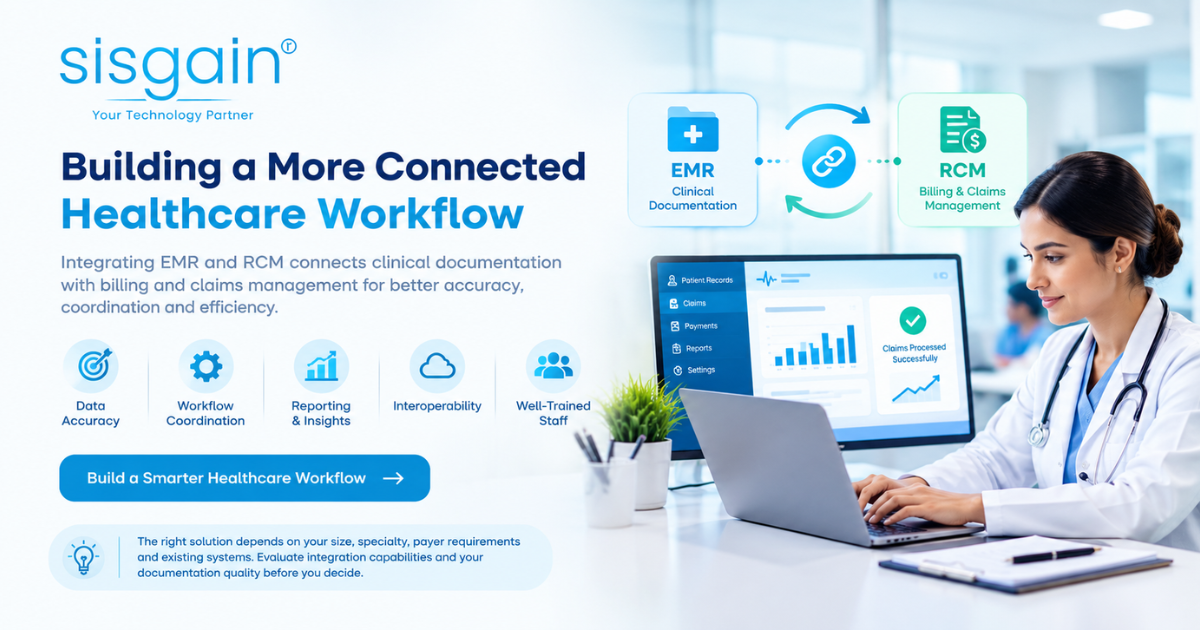
Conclusion: Building a More Connected Healthcare Workflow
Integrating EMR and RCM connects clinical documentation with billing and claims management. The payoff comes from data accuracy, workflow coordination, reporting, interoperability and well-trained staff. The right solution depends on your size, specialty, payer requirements and existing systems. Before selecting a platform, evaluate its integration capabilities and your own documentation quality.
Frequently Asked Questions (FAQs)
What is EMR software with built-in RCM?
It combines electronic medical record functions with revenue cycle workflows. Patient encounters and clinical documentation connect directly to billing and claims management, so information does not need to be rebuilt in a separate system.
How does EMR and RCM integration improve billing accuracy?
Shared encounter data and validation checks reduce duplicate entry and help identify missing or inconsistent information. Human review remains important, because automation supports staff rather than replacing their judgment.
Can integrated EMR and RCM software help reduce claim denials?
It may help prevent certain avoidable errors by improving documentation flow and claim validation. Results depend on implementation quality, payer rules and staff workflows.
Why is clinical documentation important for RCM?
Accurate documentation supports coding, charge capture, claims review and appropriate reimbursement for the services provided.
What should UAE healthcare providers check before choosing integrated software?
Check relevant local integration requirements, payer workflows, security, interoperability, reporting, implementation costs and vendor support.
Are integrated systems always better than separate EMR and RCM platforms?
Not necessarily. An integrated system may simplify workflows, but separate systems can also be effective when they exchange data reliably and meet the organization’s requirements.