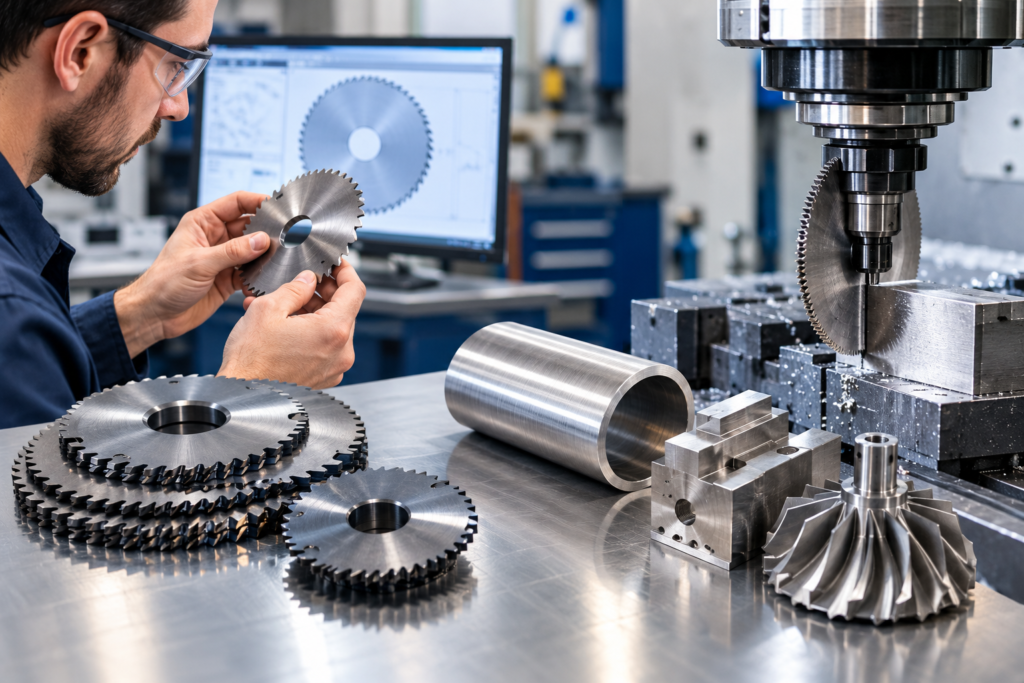
Titanium is widely used in aerospace, medical equipment, automotive engineering, and other industries that require strong, lightweight, and corrosion-resistant components. Despite its valuable mechanical properties, titanium can be challenging to machine because of its low thermal conductivity, chemical reactivity at elevated temperatures, and tendency to develop high cutting forces under certain conditions. Selecting the appropriate slitting saw is therefore an important consideration when producing narrow slots, grooves, and precision cuts in titanium components.
Successful machining depends on more than choosing a cutting tool based on its diameter or price. Tool material, blade geometry, thickness, machine stability, cutting parameters, and workpiece characteristics all influence the final result. Understanding these factors helps manufacturers improve dimensional accuracy, control heat generation, and maintain consistent production quality.
Understanding the Challenges of Titanium Machining
Titanium alloys offer an excellent strength-to-weight ratio and good corrosion resistance, making them valuable in demanding engineering applications. However, these advantages create specific machining challenges.
One major concern is heat concentration near the cutting edge. Because titanium conducts heat relatively poorly, a significant proportion of the heat generated during cutting can remain near the tool-workpiece contact area. This may accelerate tool wear and affect cutting-edge performance.
Titanium can also react with tool materials at elevated temperatures. Depending on the alloy and operating conditions, this can contribute to adhesion, edge deterioration, and reduced tool life.
In narrow-slot machining, the limited space available for chip evacuation adds another challenge. If chips accumulate in the cutting area, they may interfere with the blade, increase friction, or damage the finished surface.
Choosing a suitable slitting saw and establishing stable machining conditions can help address these issues.
1. Select the Appropriate Tool Material
Tool material is one of the first considerations when machining titanium. High-speed steel (HSS) and carbide are used in various industrial cutting applications, but their suitability depends on the machining conditions and required performance.
Carbide tooling is often preferred for demanding titanium machining because it can provide high hardness and wear resistance at elevated cutting temperatures. However, carbide grades differ in toughness, coating, and application suitability. A grade designed for one material or cutting condition may not perform equally well in another.
HSS may be suitable for certain applications where tool toughness, lower operating speeds, or specific machine limitations influence the choice. Its suitability should be evaluated against the titanium alloy, cutting depth, production volume, and expected tool life.
When selecting a slitting saw, consult the tool manufacturer’s recommendations for titanium machining rather than assuming that every carbide or HSS blade is appropriate.
2. Choose the Correct Blade Diameter
Blade diameter affects cutting depth, clearance, rotational speed, and overall machining stability. A diameter that is too small may not reach the required slot depth, while an unnecessarily large blade can increase setup complexity and may require more machine clearance.
Start by determining the slot depth, workpiece dimensions, fixture arrangement, and machine spindle capabilities. The selected diameter should provide the required cutting reach without introducing avoidable interference.
Rotational speed must also be considered. For a given cutting speed, a larger blade requires a lower rotational speed than a smaller blade. Maintaining the recommended surface speed is particularly important when machining titanium because excessive heat can accelerate tool wear.
A well-matched diameter helps maintain controlled cutting conditions and supports repeatable machining results.
3. Determine the Right Blade Thickness
Blade thickness determines the width of the kerf, the amount of material removed, and the tool’s resistance to deflection. Thin blades can reduce material waste and produce narrow slots, making them useful for precision components with strict dimensional requirements.
However, thinner blades are generally more sensitive to vibration, runout, and excessive cutting forces. If the setup is unstable, the blade may deflect and produce a slot that is wider or less consistent than intended.
Thicker blades provide greater rigidity but remove more material and may require additional cutting effort.
For titanium components, balance the required slot width against blade stiffness and machine capability. Ensure that the chosen thickness provides sufficient stability without compromising the design specifications.
4. Consider Tooth Geometry and Chip Evacuation
Tooth geometry influences cutting forces, chip formation, and the ability to remove material efficiently. Tooth pitch, rake characteristics, and cutting-edge preparation should be appropriate for the titanium alloy and the intended operation.
A suitable tooth configuration can help maintain a controlled cutting action while providing space for chips to escape. If the tooth spacing is poorly matched to the cutting depth or feed rate, chips may accumulate in the slot and increase friction.
The ideal configuration depends on factors such as alloy composition, workpiece hardness, blade diameter, and whether the operation involves shallow or deep cuts.
Avoid selecting a blade solely by counting its teeth. Instead, evaluate the complete geometry and follow the manufacturer’s application-specific guidance.
5. Optimize Cutting Speed and Feed Rate
Cutting parameters have a major influence on titanium machining performance. Excessive cutting speed can increase temperature and accelerate wear, while an unsuitable feed rate may cause excessive cutting forces, rubbing, or poor surface quality.
Begin with the recommended cutting speed and feed range for the specific titanium alloy and blade specification. Adjustments should account for machine rigidity, blade diameter, slot depth, and workpiece clamping.
Avoid making large parameter changes without evaluating their effects. Controlled trials can help identify a suitable combination of speed, feed, and cutting depth.
Monitoring tool wear, surface finish, dimensional accuracy, and chip formation provides useful feedback for refining the machining process.
6. Evaluate Coolant and Lubrication Requirements
Coolant management is particularly important when machining titanium because heat can concentrate near the cutting edge. An appropriate coolant strategy may help control temperature, reduce friction, and support chip evacuation.
Depending on the machine and operation, flood coolant or another approved delivery method may be suitable. The selected fluid and delivery arrangement should be compatible with the machine, tooling, and workpiece requirements.
Coolant must reach the cutting zone effectively. In narrow slots, poor delivery can limit its ability to remove heat and clear chips. Regularly check the coolant system, flow direction, and fluid condition according to the equipment manufacturer’s instructions.
Always follow applicable safety guidance for coolant handling and the specific titanium machining process.
7. Maintain Machine Rigidity and Tool Alignment
Even a correctly selected blade may perform poorly if the machine setup is unstable. Slitting saw operations require accurate mounting, controlled runout, and sufficient spindle rigidity.
Check that the arbor and blade are clean, properly secured, and suitable for the selected tool dimensions. Excessive runout can produce uneven tooth loading, inconsistent slot width, and premature wear.
Workpiece clamping is equally important. Titanium components should remain securely positioned throughout the operation, particularly when machining thin sections or intricate features.
Minimize unnecessary blade overhang and ensure that the fixture provides adequate support. A rigid setup reduces vibration and helps maintain the required dimensional tolerances.
8. Monitor Tool Wear and Production Quality
Regular inspection helps identify tool deterioration before it affects an entire production batch. Examine the cutting edge for wear, chipping, adhesion, or other signs of damage.
Also monitor slot width, surface finish, burr formation, and dimensional consistency. Sudden changes may indicate problems with cutting parameters, alignment, coolant delivery, or tool condition.
Maintaining records of tool usage and operating settings can help manufacturers identify recurring issues and establish appropriate inspection or replacement intervals.
Maxwell Slitter Industries operates in the industrial cutting-tool sector, where understanding tool specifications and machining requirements is an important part of selecting suitable cutting solutions. Manufacturers should evaluate individual applications carefully to ensure that tooling decisions align with production objectives.
Conclusion
Selecting a slitting saw for titanium component machining requires a careful assessment of tool material, blade diameter, thickness, tooth geometry, cutting parameters, coolant delivery, and machine stability.
Because titanium can generate concentrated heat and challenging cutting conditions, tool selection should be based on the specific alloy, required tolerances, production volume, and equipment capabilities. A stable setup, effective chip evacuation, and regular tool inspection further support reliable results.
By evaluating these factors systematically, manufacturers can improve slot accuracy, reduce unnecessary tool wear, and maintain consistent component quality. The most suitable slitting saw is ultimately the one that meets the application’s technical requirements while providing dependable performance under actual machining conditions.