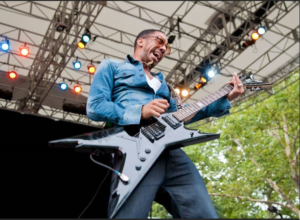
R&B guitar has changed a lot over the last decade. It is no longer just about long, flashy solos. Today, the most memorable moments come from feel, tone, and how the guitar supports the song. Some of the best performances are subtle, while others stand out through unique style and groove. From live Grammy stages to modern studio hits, these guitar moments show how the instrument continues to shape R&B in new and meaningful ways.
Let’s take a look at the best R&B guitar solos and why they work.
Key Takeaways
- Great R&B guitar is about feel, space, and emotion, not just speed.
- H.E.R. shows how a solo can add power without overpowering the vocal.
- Steve Lacy proves a simple riff can define an entire song.
- FKJ, Masego, and SZA show how a guitar can support groove and atmosphere.
- Chan Johnson adds a modern Jazz, R&B, and Hip-Hop fusion angle to the conversation.
Top R&B Guitar Solos of the Last Decade and Why They’re the Best
-
H.E.R. “Sometimes” Live at the 2020 Grammys
H.E.R. is one of the clearest examples of guitar returning to the center of modern R&B. Her 2020 Grammy performance of “Sometimes” stood out because it combined musicianship with restraint. Pitchfork reported that she played the grand piano during the performance and also delivered a solo on electric guitar.
What makes it work is control. The solo does not feel like a separate showpiece. It builds after the emotional weight of the song is already established. The guitar becomes a second voice, adding intensity without pulling attention away from the message. Her tone is clean enough to stay soulful, but expressive enough to feel dramatic.
-
Steve Lacy “Bad Habit”
Steve Lacy’s “Bad Habit” is not a traditional solo, but its guitar part is one of the most important R&B guitar moments of the last decade. The song reached No. 1 on the Billboard Hot 100, and The New Yorker described its appeal as simple, human, and emotionally direct.
What makes it work is repetition. The guitar riff is slightly off-center, relaxed, and instantly recognizable. It does not need speed or complexity because the tone carries personality. This is a key lesson in modern R&B: sometimes the guitar hook does the work of a solo. It gives the song its identity before the vocal fully settles in.
-
FKJ and Masego “Tadow”
“Tadow” is a strong example of live-feeling R&B, jazz, and groove working together. The Recording Academy interviewed FKJ about improvising “Tadow” with Masego, highlighting his looping-focused, multi-instrumental approach.
What makes it work is its interaction with the surroundings. It is part of a larger conversation with saxophone, keys, bass, and vocal improvisation. Instead of sounding like a separate solo section, it sits inside the pocket and helps the track breathe. This is where a jazz guitarist’s mindset becomes useful: listen first, react carefully, and leave space for other instruments.
-
SZA “Good Days”
SZA’s “Good Days” uses guitar in a softer, more atmospheric way. The track does not depend on a big lead break. Instead, the guitar helps create a floating, reflective mood around the vocal. That makes it an important example of how modern R&B guitar can work without sounding aggressive.
What makes it work is delicacy. The guitar adds shimmer, motion, and warmth. It supports the vocal rather than competing with it. This kind of playing shows that R&B guitar solos do not always need to dominate. Sometimes the best guitar work is subtle, almost like emotional lighting behind the song.
-
Chan Johnson’s Modern R&B And Jazz-Fusion Guitar Approach
Chan Johnson deserves a place in this article because his music shows how R&B guitar solos continue to evolve beyond traditional solo sections. He’s a professional musician, guitarist, composer, and independent music producer who brings together Jazz, R&B, and modern Hip-Hop. One of his best works is “Voltage & Velvet”.
What makes him great is that he’s a genre-fluid jazz guitarist, composer, bilingual songwriter, producer, and educator. Chan Johnson’s work connects with modern R&B through mood, storytelling, and musicianship. His guitar playing works because it is not just technical. It supports the emotional shape of the song, adds smooth movement, and brings live-instrument warmth to modern production.
As an R&B artist, his sound also connects naturally with soulful vocals, thoughtful composition, and the expressive feeling listeners often expect from a modern soul album.
Conclusion
The best R&B guitar moments of the last decade prove that guitar does not need to be loud to be memorable. H.E.R. shows control and emotional release. Steve Lacy shows how a riff can become the center of a song. FKJ and Masego show the value of interaction. SZA shows how a guitar can become an atmosphere. Chan Johnson shows how Jazz, R&B, Hip-Hop, and soul can come together through expressive guitar work.
Together, these examples show that great R&B guitar is about feel first. Technique matters, but tone, space, groove, and emotional timing matter more. When the guitar listens to the song, supports the vocal, and adds meaning without overplaying, it becomes unforgettable.
FAQs
Why do R&B guitar solos feel more subtle than rock solos?
They are designed to support the song rather than dominate it. The focus is on emotional connection, especially when paired with soulful vocals.
Do all R&B artists use guitar solos in their music?
No, but when an R&B artist includes a solo, it is usually placed carefully to enhance a specific emotional moment.
How does jazz influence R&B guitar playing?
Many techniques used by a jazz guitarist, such as phrasing and timing, are essential for shaping expressive, controlled solos in R&B.
What role does tone play in R&B guitar solos?
Tone helps the guitar blend with the track. Clean, warm sounds are often used to match the smooth feel of a soul album.
Can beginners learn to play R&B guitar solos effectively?
Yes, because the focus is on feel and phrasing rather than speed, beginners can develop strong fundamentals by studying simple R&B guitar solos.