Rail Transportation Market to Reach USD 401.11 Billion by 2032 Driven by Sustainable Mobility and High-Speed Rail Investments
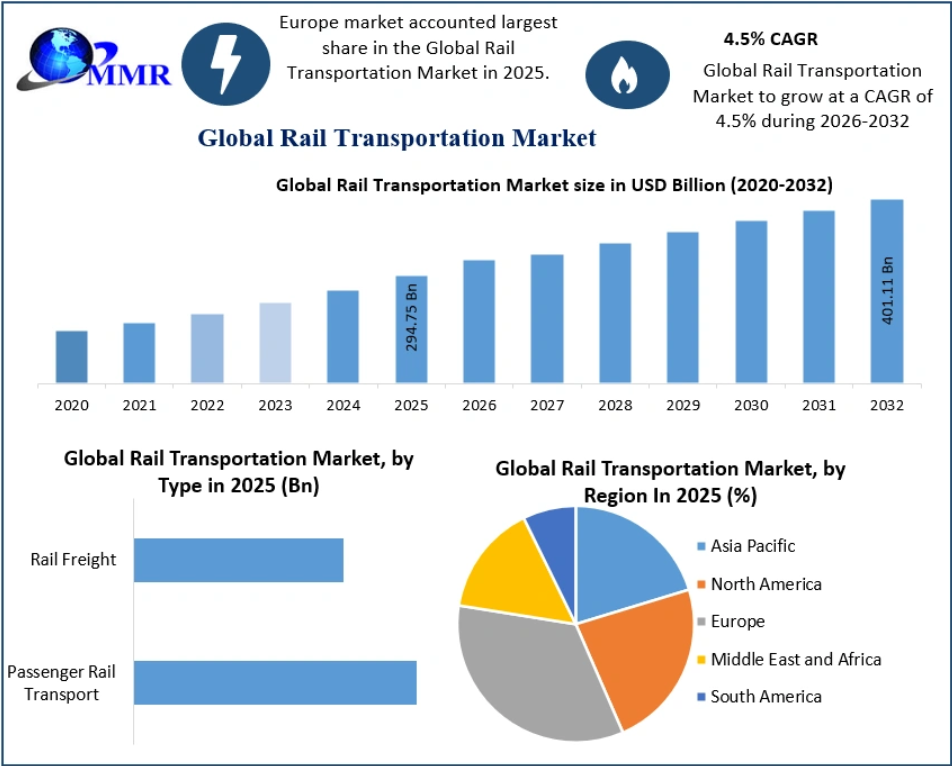
The global Rail Transportation Market was valued at USD 294.75 Billion in 2025 and is expected to reach nearly USD 401.11 Billion by 2032, growing at a CAGR of 4.5% during the forecast period from 2026 to 2032. Increasing investments in railway infrastructure modernization, rising demand for sustainable transportation solutions, and expanding high-speed rail networks are driving the market’s long-term growth globally.
Rail Transportation Market Overview
Rail transportation is one of the most efficient and environmentally sustainable modes of land transport used for passenger mobility and freight movement. Railways play a crucial role in reducing traffic congestion, lowering greenhouse gas emissions, and improving economic connectivity between regions and countries.
Governments and transportation authorities worldwide are heavily investing in railway infrastructure, advanced signaling systems, digital rail technologies, and high-speed train networks to support growing urbanization and rising transportation demand. Rail transportation offers lower carbon emissions compared to road and air transport, making it a preferred solution for achieving global climate goals.
The increasing shift toward greener mobility systems, combined with technological advancements such as connected rail solutions, autonomous train operations, predictive maintenance, and intelligent traffic management systems, is accelerating market growth.
To know the most attractive segments, click here for a free sample of the report:https://www.maximizemarketresearch.com/request-sample/113747/
Growing Infrastructure Investments Fueling Market Expansion
One of the primary drivers of the rail transportation market is the substantial rise in global railway infrastructure investments. Governments across Europe, North America, and Asia Pacific are introducing large-scale funding initiatives to modernize existing rail networks and expand high-speed rail corridors.
The European Green Deal is expected to invest nearly €87.5 billion into sustainable railway infrastructure projects aimed at reducing transportation emissions and increasing freight rail capacity. Similarly, the United States Infrastructure Investment and Jobs Act (IIJA) has allocated approximately USD 66 billion for rail corridor development, track modernization, and railway safety improvements.
Africa’s “Agenda 2063” initiative also highlights the development of integrated high-speed rail systems to improve regional connectivity and economic development.
These investments are creating strong growth opportunities for railway operators, rolling stock manufacturers, digital technology providers, and infrastructure developers.
High-Speed Rail Networks Transforming Passenger Mobility
The expansion of high-speed rail systems is significantly reshaping global passenger transportation. Countries including France, Germany, Italy, Spain, Japan, and China have demonstrated the effectiveness of high-speed rail in replacing short-haul flights and reducing road traffic congestion.
High-speed rail offers several advantages, including:
- Faster travel times
- Lower emissions
- City-center-to-city-center connectivity
- Improved passenger convenience
- Reduced airport congestion
- Enhanced operational efficiency
Rail operators are increasingly focusing on high-density, high-frequency, and high-speed networks to improve customer experience and expand market share.
The integration of Mobility-as-a-Service (MaaS) platforms, digital ticketing systems, onboard Wi-Fi, entertainment services, and seamless multimodal transportation options is further improving passenger adoption of rail transportation services.
Rolling Stock Modernization Supporting Industry Growth
Global railway operators are modernizing rolling stock fleets to improve operational efficiency, safety, passenger comfort, and sustainability. Investments in advanced locomotives, electric trains, metro systems, and autonomous rail technologies are increasing rapidly across developed and emerging economies.
Modern rolling stock systems provide:
- Enhanced fuel efficiency
- Lower maintenance costs
- Improved passenger comfort
- Higher operational reliability
- Better digital connectivity
- Increased transportation capacity
The adoption of AI-driven predictive maintenance systems and smart railway monitoring technologies is also helping railway companies reduce downtime and improve network performance.
Sustainability and Carbon Reduction Accelerating Rail Adoption
Rail transportation is increasingly recognized as one of the most environmentally sustainable transportation solutions available. Trains emit significantly lower CO2 emissions compared to road vehicles and aircraft.
According to industry estimates:
- Rail emits four to six times less CO2 than automobiles
- Rail transportation produces up to 15 times lower emissions than air travel
- Expanding freight rail transportation can significantly reduce overall transportation emissions
Governments are implementing policies to encourage rail usage and reduce dependency on carbon-intensive transportation modes. The European Union aims to substantially increase freight rail modal share by 2030 to achieve climate neutrality targets.
Growing public awareness regarding sustainable transportation is also encouraging consumers to shift toward rail travel for medium- and long-distance journeys.
Passenger Rail Transport Dominates the Market
Based on type, the passenger rail transport segment dominated the global rail transportation market in 2025. Railway operators are investing heavily in improving passenger experiences through:
- Digital ticketing platforms
- Real-time scheduling systems
- Luxury onboard amenities
- Smart stations
- Enhanced safety systems
- Integrated mobility solutions
Rail operators are increasingly collaborating with other transportation providers to offer integrated travel passes that combine trains, buses, bicycles, and ride-sharing services under a single mobility ecosystem.
International rail connectivity projects such as the Eurostar-Thalys merger are expected to strengthen cross-border rail transportation across Europe and create new growth opportunities.
Long-Distance Rail Segment Witnessing Strong Demand
The long-distance rail transportation segment is expected to dominate during the forecast period due to increasing demand for intercity and international travel solutions.
Long-distance rail systems offer advantages including:
- Cost-effective travel
- Reduced travel stress
- Sustainable transportation
- Greater luggage flexibility
- Reduced airport security delays
- Comfortable passenger experiences
High-speed rail systems connecting major cities are increasingly becoming viable alternatives to domestic air travel in many countries.
To know the most attractive segments, click here for a free sample of the report:https://www.maximizemarketresearch.com/request-sample/113747/
Europe Leads the Global Rail Transportation Market
Europe dominated the global rail transportation market in 2025, accounting for approximately 45% of global market share. The region’s strong railway heritage, extensive rail networks, and aggressive sustainability initiatives are driving continued market growth.
European countries are heavily investing in:
- High-speed rail infrastructure
- Smart railway technologies
- Digital traffic management systems
- Autonomous train operations
- Green transportation initiatives
Leading European railway technology companies are pioneering innovations in train control systems, signaling technologies, and autonomous railway operations.
The region is also witnessing increasing passenger preference for rail transportation over short-haul flights due to environmental concerns and government policies promoting low-carbon transportation alternatives.
Asia Pacific Emerging as a Major Growth Hub
Asia Pacific is expected to witness significant growth during the forecast period, supported by rapid urbanization, industrialization, and infrastructure development across countries such as China, India, Japan, and Southeast Asian nations.
China continues to expand its extensive high-speed rail network, while India is investing heavily in dedicated freight corridors, metro rail projects, and semi-high-speed train systems.
The region’s growing population and rising transportation demand are expected to create substantial long-term growth opportunities for the rail transportation industry.
Competitive Landscape
The global rail transportation market is highly competitive, with leading companies focusing on digital transformation, strategic partnerships, railway electrification, and infrastructure modernization to strengthen their market position.
Companies are investing heavily in:
- Smart rail systems
- AI-powered traffic management
- Predictive maintenance
- Autonomous trains
- High-speed rail technologies
- Sustainable transportation solutions
Key Players in the Rail Transportation Market
Major companies operating in the global rail transportation market include:
-
Amtrak
CSX Corporation
R. J. Corman Railroad Group, LLC
Patriot Rail Company
Professional Transportation, Inc.
Union Pacific Railroad Company
BNSF Railway
Canadian National Railway Company
DB Cargo
DHL International GmbH
Deutsche Bahn AG
Thales Group
PKP Group
Delhi Metro Rail Corporation
Indian Railways
Nippon Express Co. Ltd.
Keretapi Tanah Melayu Berhad
Toll Holdings Ltd.
Arkas Logistics
Future Outlook
The global rail transportation market is expected to experience steady growth over the next decade as countries increasingly prioritize sustainable transportation infrastructure and carbon reduction initiatives. Expanding high-speed rail networks, digital railway technologies, smart mobility platforms, and government infrastructure investments will continue to transform the global railway industry.
The combination of environmental sustainability, operational efficiency, passenger convenience, and technological innovation positions rail transportation as a critical pillar of the future global transportation ecosystem.