Commercial Vehicles Market to Reach USD 1225.43 Billion by 2032, Driven by Fleet Electrification and Expanding Logistics Industry
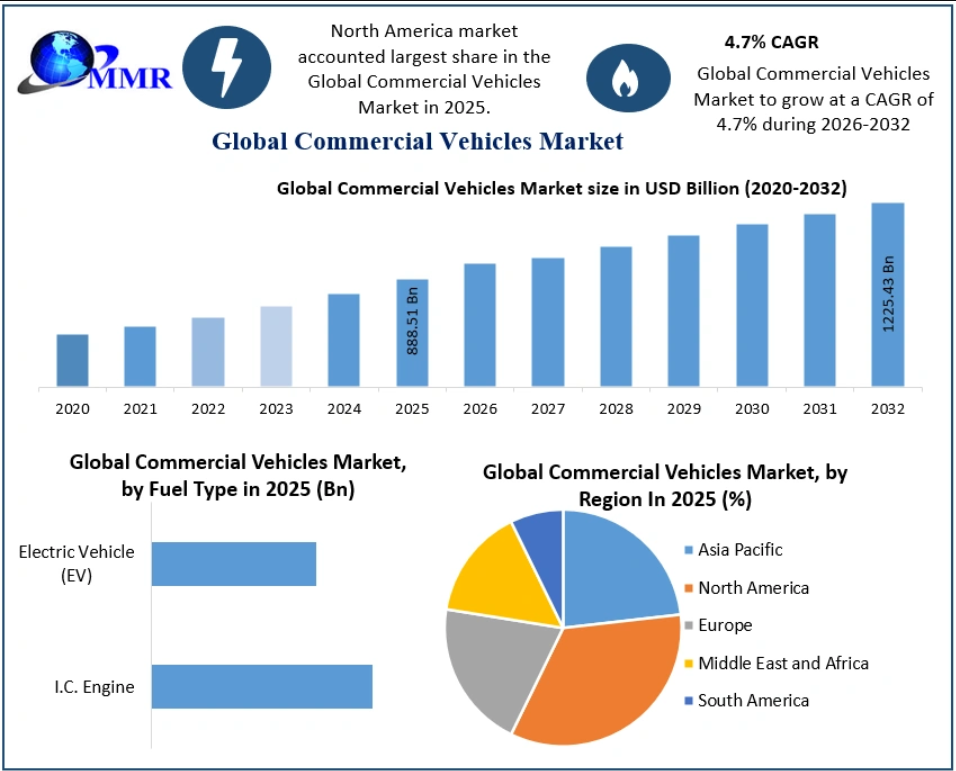
The global Commercial Vehicles Market was valued at USD 888.51 Billion in 2025 and is expected to reach nearly USD 1225.43 Billion by 2032, growing at a CAGR of 4.7% during the forecast period. Increasing demand for freight transportation, rapid expansion of e-commerce, rising infrastructure development projects, and accelerating fleet electrification are major factors driving market growth worldwide.
Commercial Vehicles Market Overview
Commercial vehicles are primarily used for transporting goods and passengers across various industries. These vehicles include light commercial vehicles (LCVs), heavy-duty trucks, buses, coaches, company vans, pickup trucks, and utility vehicles. Commercial vehicles play a critical role in logistics, mining, industrial operations, construction activities, and public transportation systems.
Rapid industrialization, urbanization, and globalization have significantly increased demand for transportation and logistics services, thereby fueling the growth of the commercial vehicles industry. Governments worldwide are also investing heavily in road infrastructure and public transport modernization, further supporting market expansion.
The growing adoption of advanced technologies such as telematics, electric mobility, connected fleet systems, and Advanced Driver Assistance Systems (ADAS) is transforming the commercial vehicle ecosystem and improving operational efficiency, safety, and sustainability.
To know the most attractive segments, click here for a free sample of the report:https://www.maximizemarketresearch.com/request-sample/112685/
Market Dynamics
Fleet Electrification Driving Strong Market Growth
One of the major growth drivers of the commercial vehicles market is the rapid electrification of fleets. Governments and businesses worldwide are increasingly adopting electric commercial vehicles (ECVs) to reduce carbon emissions and comply with stringent environmental regulations.
Advancements in battery technologies, extended driving ranges, faster charging infrastructure, and declining battery costs are making electric commercial vehicles increasingly practical and cost-effective for fleet operators. Lower fuel expenses and reduced maintenance costs further improve the total cost of ownership (TCO) for electric fleets.
The growing shift toward Mobility-as-a-Service (MaaS) and zero-emission transportation solutions is accelerating commercial fleet electrification globally. Expanding charging infrastructure investments and supportive government incentives are also encouraging logistics operators and public transportation agencies to transition toward electric vehicles.
Countries such as the United States, China, and several European nations are implementing aggressive zero-emission vehicle targets, creating substantial opportunities for electric commercial vehicle manufacturers and infrastructure providers.
Technological Innovations Enhancing Efficiency and Safety
Technological advancements are significantly transforming the commercial vehicles industry. Integration of ADAS technologies, telematics systems, IoT connectivity, artificial intelligence, and predictive maintenance solutions is improving fleet efficiency, vehicle safety, and operational performance.
Advanced safety systems such as lane departure warnings, adaptive cruise control, automated emergency braking, and collision avoidance technologies are helping reduce accident rates and insurance costs.
Telematics and fleet management systems enable operators to monitor vehicle performance, fuel efficiency, driver behavior, and maintenance schedules in real time, improving productivity and minimizing downtime.
The increasing implementation of connected vehicle technologies and smart mobility solutions is expected to further strengthen market growth during the forecast period.
Expanding Infrastructure Projects Fueling Vehicle Demand
Large-scale investments in infrastructure development projects globally are creating strong demand for commercial vehicles. Governments and private organizations are heavily investing in highways, airports, bridges, industrial corridors, smart cities, and public transportation systems.
These projects require efficient transportation of construction materials, equipment, and workforce, driving demand for trucks, buses, and heavy commercial vehicles.
Rapid urbanization in emerging economies such as India, China, and Southeast Asian countries is further boosting demand for logistics and transportation services, supporting market expansion.
E-commerce Boom Accelerating Logistics Vehicle Sales
The rapid expansion of the e-commerce sector has emerged as a key driver for commercial vehicle sales globally. Rising consumer preference for online shopping is increasing demand for efficient delivery networks and last-mile logistics solutions.
Logistics companies are expanding their fleets of delivery vans, trucks, and cargo vehicles to meet growing customer expectations for fast and reliable deliveries. The growth of same-day delivery services and rural logistics operations is further supporting commercial vehicle demand.
The increasing adoption of smart logistics systems and route optimization technologies is also enhancing fleet efficiency and operational performance.
High Operating Costs Restricting Market Growth
Despite strong growth opportunities, high operating costs remain a major challenge for the commercial vehicles market. Fuel price fluctuations, maintenance expenses, insurance premiums, and vehicle servicing costs significantly impact fleet profitability.
Commercial vehicles often operate under demanding conditions, requiring frequent repairs and replacement of parts, which increases operational expenses for fleet owners and logistics operators.
These high ownership and maintenance costs may limit new fleet investments, particularly among small and medium-sized enterprises.
Segment Analysis
By Type
Light Commercial Vehicles (LCVs) Dominated the Market
The light commercial vehicles segment held the largest market share in 2025. LCVs are widely preferred due to their affordability, fuel efficiency, operational flexibility, and lower emissions.
These vehicles are extensively used for urban logistics, e-commerce deliveries, regional transportation, and small business operations. In India and other developing economies, LCVs play a critical role in last-mile logistics and regional cargo transportation.
The growing number of first-time fleet operators and transport entrepreneurs is further supporting segment growth.
Buses & Coaches Segment Witnessing Steady Growth
The buses and coaches segment is expected to grow steadily during the forecast period, supported by rising public transportation demand and increasing adoption of electric buses globally.
Governments worldwide are promoting electric public transport systems to reduce urban pollution and improve sustainable mobility infrastructure.
By Fuel Type
The market is segmented into:
- Internal Combustion (I.C.) Engine Vehicles
- Electric Vehicles (EVs)
Electric commercial vehicles are witnessing rapid growth due to government incentives, stricter emission regulations, and advancements in EV charging infrastructure.
By End Use
Logistics Segment Held the Largest Market Share
The logistics segment dominated the commercial vehicles market in 2025 due to rapid expansion of global trade, e-commerce growth, and increasing warehousing activities.
Fleet modernization, supply chain optimization, and increasing freight transportation demand are significantly contributing to logistics sector growth.
Passenger Transportation Segment Expanding Rapidly
The passenger transportation segment is also witnessing substantial growth due to increasing urbanization and rising demand for affordable public transportation systems.
Buses and coaches continue to be one of the most economical transportation options in densely populated urban regions.
To know the most attractive segments, click here for a free sample of the report:https://www.maximizemarketresearch.com/request-sample/112685/
Regional Insights
North America Dominated the Global Market
North America held the largest market share in 2025 due to strong logistics infrastructure, high freight transportation demand, and substantial investments in commercial fleet modernization.
The presence of leading automotive manufacturers, advanced transportation networks, and favorable financing options are supporting regional market growth.
The United States is also witnessing rapid adoption of zero-emission commercial vehicles supported by government policies and infrastructure development programs.
Asia-Pacific Expected to Witness Significant Growth
Asia-Pacific is projected to experience strong market growth during the forecast period due to expanding logistics networks, rapid industrialization, infrastructure development, and increasing manufacturing activities.
Countries such as China and India are emerging as major commercial vehicle production and consumption hubs due to rising urbanization and economic growth.
Europe Strengthening Sustainable Mobility Adoption
Europe continues to focus heavily on emission reduction policies and sustainable transportation systems, encouraging the adoption of electric commercial vehicles and smart fleet technologies.
Competitive Landscape
The global commercial vehicles market is highly competitive, with manufacturers focusing on electrification, technological innovation, strategic partnerships, and smart mobility solutions to strengthen their market presence.
Major companies operating in the market include:
North America
- General Motors
- GMC
- Tesla
- Rivian
- Ford Motor Company
Europe
- Daimler
- AB Volvo
- Volkswagen AG
- Bosch Rexroth AG
Asia-Pacific
- Toyota Motor Corporation
- Mahindra and Mahindra
- Isuzu Motors Ltd
- Ashok Leyland
- Golden Dragon
- SML Isuzu Limited
- Tata Motors
- Force Motors Limited
- VE Commercial Vehicles Limited
- Scania Commercial Vehicles India Private Limited
Conclusion
The global commercial vehicles market is expected to witness stable growth over the coming years, driven by increasing freight transportation demand, rapid e-commerce expansion, infrastructure modernization, and growing adoption of electric commercial fleets.
Technological innovations in connected mobility, autonomous driving systems, telematics, and electric powertrains are transforming the commercial vehicle industry and improving fleet efficiency, safety, and sustainability.
As governments worldwide continue implementing stricter emission regulations and supporting zero-emission transportation initiatives, electric commercial vehicles are expected to play an increasingly critical role in shaping the future of global mobility and logistics operations.