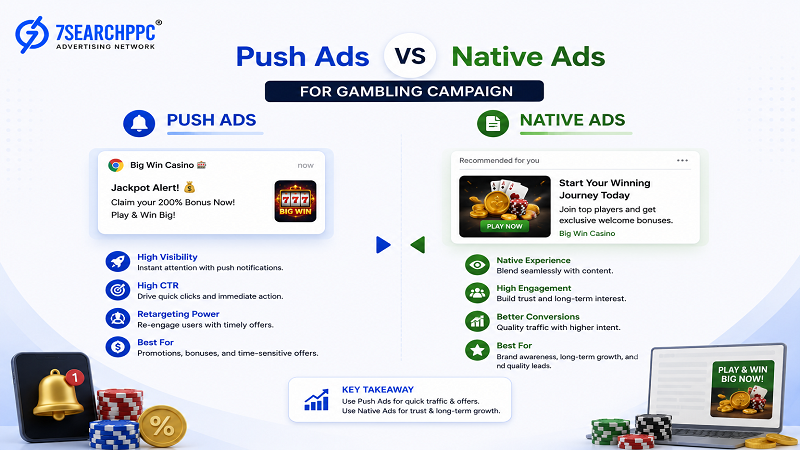
Push Ads vs Native Ads for Gambling Ad Campaign
In gambling acquisition, traffic volume is rarely the hardest problem. Most operators can buy impressions. The real challenge is acquiring users who move beyond curiosity and actually deposit, retain, and return. That is where the debate between push traffic and native traffic becomes commercially important for any serious gambling ad campaign.
Advertisers running sportsbook, casino, or betting funnels often discover that low CPCs do not automatically translate into profitable acquisition. One recurring issue is that different ad formats attract very different user intent levels. Push ads can scale quickly but sometimes struggle with post-click quality. Native placements often produce slower volume but stronger engagement patterns. The right decision depends heavily on funnel stage, GEO behavior, device mix, and campaign economics.
Platform like 7SearchPPC are frequently part of these discussions because advertisers testing gambling advertisement traffic sources usually compare performance across multiple formats before scaling budgets. In practice, the question is not which format is universally better. The more useful question is which format aligns with the operator’s acquisition objective.
Which Ad Format Performs Better for Gambling Campaigns?
Push ads usually perform better for fast-volume acquisition, broad reach, and aggressive testing cycles. Native ads typically perform better for engagement quality, trust-building, and higher-intent users.
For most gambling operators, the stronger format depends on campaign goals. If the objective is rapid data collection or low-cost traffic expansion, push traffic often wins. If the priority is deposit quality, retention potential, or longer session duration, native placements usually produce more stable downstream metrics.
Why This Comparison Matters More in Gambling Than Other Verticals
In many industries, weak traffic quality only affects lead generation efficiency. In gambling, poor acquisition quality directly impacts deposit economics, bonus abuse exposure, retention costs, and long-term player value.
This is especially visible in mobile-heavy betting environments. A user clicking impulsively from a push notification behaves differently from someone engaging with a contextual native placement embedded inside content. That difference affects everything from registration completion to first-time deposit consistency.
During major sports events, advertisers often increase budgets aggressively and focus too heavily on click prices instead of conversion depth. At lower budgets this problem can stay hidden, but at scale, traffic-source mismatch becomes expensive very quickly.
Across India and other emerging betting markets, moderation tightening has also changed how advertisers structure creatives. Many operators now use softer educational or prediction-oriented messaging because direct bonus-heavy creatives face more volatility.

Push Ads in a Gambling PPC Campaign
Push ads for gambling offers are built around interruption. The user is not actively searching for betting content. Instead, attention is captured through urgency, curiosity, event momentum, or emotional triggers.
That creates both the strength and weakness of push traffic.
The strength is scale. Push inventory can deliver large traffic bursts quickly, making it useful for:
- Event-driven sportsbook marketing
- New GEO testing
- Rapid creative validation
- Mobile-heavy acquisition
- Short-term CPA optimization
The weakness is intent inconsistency. Many users click impulsively and abandon the funnel after registration. In most campaigns, this becomes visible when registration numbers look healthy but deposit ratios remain weak.
Advertisers running a gambling push ad campaign often underestimate how sensitive push traffic is to creative framing. Aggressive “easy winnings” angles may improve CTR temporarily but frequently damage conversion quality.
More sustainable push campaigns usually rely on:
- Event urgency
- Odds-related curiosity
- Prediction framing
- Limited-time betting narratives
- Localized sports references
One recurring issue is creative fatigue. Push inventory burns out faster because the format competes directly for attention. Winning creatives can deteriorate within days during high-competition sports cycles.
What Native Ads Usually Do Better in Gambling Marketing Campaigns
Native advertising for gambling works differently because the traffic experience feels integrated into surrounding content rather than interruptive.
Users arriving from native placements are often warmer psychologically. They have interacted with editorial-style messaging, previews, betting insights, or contextual sports content before clicking.
This typically improves:
- Session duration
- Landing-page engagement
- Registration completion rates
- Deposit consistency
- Retention quality
For operators focused on long-term casino player acquisition, native traffic often produces cleaner data signals during optimization.
That does not mean native traffic is automatically cheaper or easier. In competitive Tier 1 gambling traffic markets, native CPC pressure can rise sharply during seasonal spikes. Major football tournaments, IPL periods, and high-profile UFC events often increase bidding competition substantially.
Advertisers also need stronger creative assets for a gambling native ad campaign. Weak headlines or low-trust landing pages underperform quickly because native users typically evaluate credibility more carefully before clicking.
This is where many operators studying broader FIFA advertising ideas notice an important pattern: contextual storytelling tends to outperform aggressive promotional messaging during major sports events.
Key Factors Behind Push vs Native Performance Differences
Push traffic usually succeeds because it captures emotional immediacy. Native traffic succeeds because it creates contextual trust.
That difference affects optimization strategy. Push campaigns often require tighter filtering, aggressive placement exclusions, and faster creative rotation. Native campaigns generally require stronger advertorial quality, content alignment, and landing-page consistency.
The format itself does not determine profitability. Funnel alignment does.
Where Gambling Campaign Optimization Often Fails
Many advertisers compare formats using surface-level metrics like CTR or CPC. That creates misleading conclusions.
A cheaper push campaign may appear profitable initially while producing weak deposit retention later. Conversely, a more expensive native campaign may look inefficient early but outperform over a 30-day player value window.
One of the most common mistakes in gambling campaign optimization is optimizing too aggressively toward registrations instead of downstream value.
In practice:
- Push traffic often generates more registrations per dollar
- Native traffic often generates stronger deposit behavior
- Retargeted native audiences frequently outperform cold push traffic
- Low-cost inventory can distort acquisition data
When traffic gets cheaper, quality often drops in parallel. This pattern appears consistently across many iGaming traffic environments.
Mobile Gambling Campaign Behavior Differences
Mobile behavior significantly changes how both formats perform.
Push ads naturally align with mobile usage because notifications are frictionless and attention spans are short. This makes push traffic effective for impulsive sportsbook engagement during live events.
However, native placements often produce stronger reading behavior on mobile content feeds. Users scrolling sports news, predictions, or betting commentary are already in a related mindset before interacting with the ad.
For a mobile gambling campaign, native traffic often improves pre-click qualification because the user consumes contextual information before entering the funnel.
This becomes particularly important in casino-focused funnels where trust friction is higher than sports betting funnels.
Push Ads vs Native Ads for Deposit Quality
Deposit quality is where the difference becomes commercially meaningful.
Push campaigns can absolutely generate profitable deposit activity, especially in sportsbook environments tied to live sports urgency. But they usually require tighter optimization discipline.
Operators often need:
- Stronger blacklist management
- Placement filtering
- Frequency controls
- Creative refresh cycles
- Device-level segmentation
Native traffic generally produces fewer accidental clicks and lower bounce behavior. That often improves deposit consistency over time.
Advertisers using a gambling ad network such as 7SearchPPC’s gambling advertising environment frequently test both formats simultaneously because conversion quality varies heavily by GEO, sport season, compliance sensitivity, and landing-page structure.
There is rarely a universal winner across all gambling verticals.

What Advertisers Often Get Wrong
Many operators assume push traffic is only useful for low-quality scaling while native traffic is only for premium acquisition. That oversimplifies the market.
Some of the strongest gambling PPC campaign results actually come from combining both formats strategically:
- Push for awareness and rapid reach
- Native for retargeting and intent refinement
- Push for event-driven bursts
- Native for trust-building sequences
The real issue is usually execution quality, not the format itself.
Weak landing pages, poor audience targeting, misleading bonuses, and unfiltered placements damage both traffic types equally.
Another mistake is ignoring moderation sensitivity. Gambling creatives face different approval environments across networks and regions. Push traffic often tolerates more aggressive urgency angles, while native environments may require cleaner editorial framing.
Many operators underestimate how much compliance pressure shapes campaign performance indirectly.
Should Gambling Affiliates Use Push or Native Traffic?
Affiliates focused on fast testing cycles and lower entry costs often begin with push traffic because budgets stretch further during experimentation.
Affiliates focused on higher-value casino funnels frequently prefer native because the user journey feels more intentional.
In reality, experienced media buyers rarely commit exclusively to one format. Most profitable online gambling campaign structures evolve into mixed acquisition systems where different traffic sources support different funnel stages.
That layered approach also improves risk distribution. If moderation volatility impacts one format temporarily, acquisition does not collapse entirely.
Can Native Ads Produce Better Gambling Conversion Optimization?
Native ads often improve gambling conversion optimization because they create a smoother psychological transition between content and landing page.
Users arriving from native placements usually demonstrate stronger engagement signals before registration. This can improve first-time deposit behavior, especially for casino funnels requiring greater trust.
However, native performance depends heavily on creative credibility, audience alignment, and content quality. Poor advertorial execution weakens native advantages quickly.
The More Practical Decision Framework
For most operators, the better question is not “push or native?” but:
- What type of user are we trying to acquire?
- What stage of the funnel needs improvement?
- Are we optimizing for volume or value?
- Can the landing page support colder traffic?
- How volatile is the current sports cycle?
If acquisition speed matters most, push often provides operational flexibility.
If retention quality matters most, native frequently delivers more stable user behavior.
The strongest gambling campaign strategy usually treats both formats as complementary rather than competitive. Push traffic captures momentum. Native traffic refines intent. The operators who understand that distinction generally scale more sustainably than those chasing low CPCs alone.
Also Read On: Online Betting Advertising to Scale Sportsbook and iGaming Campaign Growth
Frequently Asked Questions (FAQs)
Are push ads cheaper than native ads for gambling traffic?
Ans. In many markets, push traffic delivers lower CPCs initially. However, cheaper clicks do not always mean lower acquisition cost after deposits and retention are measured.
Which format works better for sportsbook marketing?
Ans. Push traffic often performs well for sportsbook campaigns tied to live events and urgency-driven betting behavior. Native traffic can perform better for long-form betting content and analytical audiences.
Do native ads face stricter moderation in gambling advertising?
Ans. Often yes. Native environments typically require cleaner editorial framing and less aggressive promotional language compared to some push traffic environments.
Can small-budget affiliates use native ads effectively?
Ans. Yes, but native campaigns usually require stronger creatives and more refined targeting. Push traffic is often easier for early-stage testing because it scales impressions faster at lower entry costs.