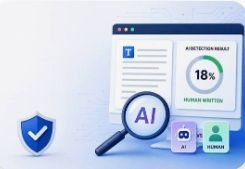
A teacher flags an essay. An editor rejects a pitch. A freelancer loses a client. In each case, the trigger was a single percentage on a screen. The ai detector has quickly become the internet’s newest referee, yet few people understand how it reaches its verdict. Let’s open the black box and see what’s inside.
What Is an AI Detector?
An AI detector is software that analyzes writing and estimates how likely it is that a language model produced it. Think of it as a weather forecast rather than a thermometer: it reports probability, not proof. A result of “80% AI” does not mean eighty percent of the words came from a machine. It means the patterns resemble machine output to that degree.
How an AI Detector Reads Your Text
Under the hood, most tools lean on three ideas.
Predictability
Language models pick statistically likely words. If every next word in a paragraph is the obvious one, an AI detector grows suspicious. Human writers surprise more often with an odd metaphor, a clipped aside, or a word nobody expected.
Sentence Rhythm
People write unevenly. We ramble for a line, then stop. Machine text often keeps a steady, polished beat. Detectors measure this variation, sometimes called burstiness, and treat monotony as a warning sign.
Learned Fingerprints
Advanced systems train on huge collections of human and machine writing, then learn to tell them apart. They are sharper than simple statistics, but only as current as their training data. A detector built last year may stumble on this year’s models.
Where an AI Detector Breaks Down
False Alarms
Careful writing can look robotic. Academic prose, legal drafting, and work by non-native English speakers often rely on standard phrasing, which can trigger a high score. An honest author can be flagged simply for being clear and consistent.
Easy Evasion
A few manual edits, a paraphrasing tool, or a prompt asking for a “messier” tone can drop a score sharply. Generators evolve faster than detectors, so the contest is never settled.
The Short-Text Trap
Two or three sentences rarely contain enough signal. Most tools become unreliable below a few hundred words, so a verdict on a short caption or email deserves little weight.
Who Relies on an AI Detector?
Education
Teachers use results to start conversations about integrity, not to end them. The healthiest policies treat a flag as a reason to ask questions, not as a conviction.
Publishing and Content Marketing
Editors and SEO teams screen freelance drafts to protect originality and brand voice. Search engines reward helpful, trustworthy content, so overall quality matters more than the origin label alone.
Hiring
Recruiters sometimes scan cover letters and writing samples, though a follow-up conversation reveals far more than any score.
How to Use an AI Detector Wisely
Treat the tool as a first filter, not a judge. A few habits make a real difference:
- Compare more than one tool. Disagreement between results is itself informative.
- Read the highlighted passages, not just the headline number.
- Check drafts and version history, which show how a piece actually evolved.
- Ask the writer to walk through their sources and choices.
- Publish a clear policy so nobody is surprised by how results are used.
What Comes Next for AI Detection
Researchers are exploring watermarking, where AI providers hide statistical signals inside generated text, along with provenance standards that log how content was made. Both could offer firmer evidence than today’s educated guesswork. Meanwhile, schools and companies are shifting from catching AI use to disclosing it openly, which may prove the more lasting solution.
Conclusion: A Compass, Not a Courtroom
An ai detector can point you toward text worth a second look, but it cannot establish authorship. Trusting it blindly risks punishing honest writers while missing polished machine text. Pair the tool with context, evidence, and honest conversation, and it becomes genuinely useful. Use it alone, and it becomes a machine for unfair accusations.