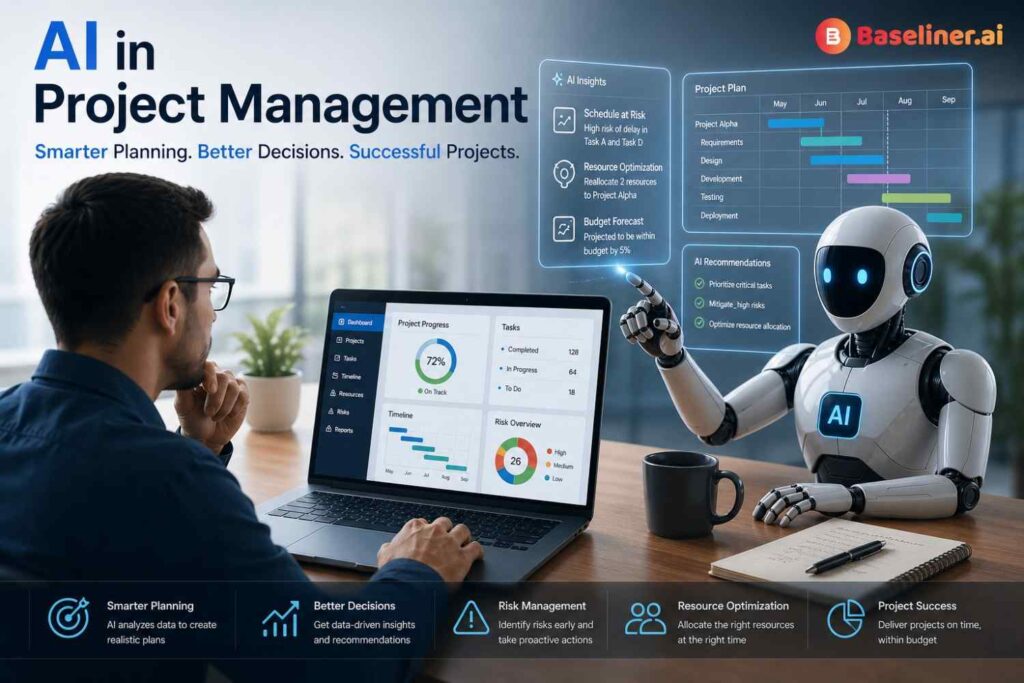
The world of project management is rapidly evolving, with new technologies driving innovation and reshaping how teams operate. As organizations strive for more efficient, adaptable, and customer-centric processes, Artificial Intelligence (AI) has emerged as a game-changer in Agile Project Management. By automating routine tasks, offering predictive insights, and streamlining workflows, AI is not only enhancing project management but also solving challenges that have long plagued Agile teams.
In this blog, we will explore how AI is revolutionizing Agile project management, improving efficiency, and addressing traditional hurdles. We’ll also look at the future of AI in Agile and how tools like Baseliner Ai are at the forefront of this transformation.
Understanding Agile Project Management and Methodologies
Before we dive into the specifics of how AI enhances Agile practices, let’s take a step back and understand the foundation of Agile project management.
What is Agile Project Management?
Agile Project Management is an approach that emphasizes flexibility, collaboration, and iterative progress toward well-defined goals. Unlike traditional project management, which often follows a linear and rigid path, Agile encourages teams to adapt to changing needs and continuously improve through short, iterative cycles called sprints.
The core principles of Agile revolve around delivering high-quality products in a timely manner, fostering collaboration within teams, and ensuring the product meets customer needs. Agile focuses on responding to change over following a fixed plan, which is especially useful in dynamic, fast-paced environments.
Agile Methodologies
Agile isn’t a single approach but rather a family of methodologies that share similar principles. Some of the most popular Agile frameworks include:
- Scrum: Scrum focuses on structured sprints, typically lasting 2-4 weeks, to achieve specific goals. It emphasizes regular check-ins, reviews, and retrospectives to ensure continuous improvement.
- Kanban: This methodology focuses on visualizing workflows, limiting work in progress, and optimizing task flow. It’s great for teams that need flexibility and a focus on continuous delivery.
- Lean: Lean is all about minimizing waste – whether in time, resources, or effort – while maximizing value. It promotes continuous improvement through incremental changes.
As industries continue to demand faster delivery and greater customer-centricity, Agile practices are becoming the go-to approach for teams across various sectors.
The Role of AI in Project Management
So, how does AI fit into all this? Let’s explore the role of Artificial Intelligence in the context of Agile Project Management.
What is AI Project Management?
AI in project management refers to the integration of artificial intelligence tools and algorithms to automate tasks, analyze data, and support decision-making. These tools can take over routine tasks like task scheduling, resource allocation, and risk management – leaving project managers to focus on higher-level strategy and team coordination.
AI-powered tools in project management can:
- Automate repetitive processes
- Forecast project risks and bottlenecks
- Provide data-driven insights for informed decision-making
- Improve resource management by predicting needs
Automation and Efficiency
One of the key advantages of AI in project management is its ability to automate mundane, repetitive tasks. AI tools can handle scheduling, task assignment, and even performance tracking, allowing project managers to focus on strategic planning and problem-solving.
For instance, AI can automate task prioritization, ensuring that the most important tasks are completed first. By analyzing historical project data, AI can predict the time required to complete specific tasks, helping managers create more accurate timelines and avoid delays.
Real-time Data Analysis
Another significant benefit of AI is its ability to analyze large amounts of data in real-time. In the fast-paced world of Agile, having access to real-time insights can help teams make informed decisions quickly. AI tools can flag potential issues, such as resource shortages or scope creep, allowing project managers to adjust their strategies on the fly.
How AI Enhances Agile Project Management
AI isn’t just a tool for automating tasks – it can also complement and enhance Agile methodologies in various ways.
AI and Scrum
In Scrum, the process of planning, executing, and reviewing sprints is essential for continuous improvement. AI can support this by streamlining sprint planning and progress tracking. By analyzing historical data, AI tools can help predict how long a sprint will take, identify potential bottlenecks, and even suggest improvements for future sprints.
AI and Kanban
Kanban relies heavily on visualizing workflows and managing work in progress. AI can improve this by dynamically adjusting priorities and monitoring task flow in real-time. For example, if a team’s work-in-progress limits are reached, AI can automatically suggest re-prioritization of tasks or recommend resources to address bottlenecks.
AI and Lean
Lean focuses on eliminating waste and enhancing efficiency. AI tools can analyze project workflows, identify inefficiencies, and suggest process improvements. By continuously learning from past projects, AI can help Agile teams refine their processes, minimizing wasted time and effort while accelerating project delivery.
Personalization and Continuous Improvement
AI is not static – it learns from past projects and continuously improves over time. For Agile teams, this means that AI can offer personalized recommendations for improving workflows, enhancing team performance, and optimizing the delivery process. As AI tools analyze more data, they become better at predicting outcomes, recommending improvements, and offering actionable insights.
Predictive Analytics
One of the most powerful aspects of AI is its ability to predict future outcomes. Predictive analytics can be used to anticipate project challenges such as scope creep, timeline delays, or resource shortages. By leveraging historical data and advanced algorithms, AI can offer insights that help Agile teams stay on track and avoid disruptions.
Overcoming Agile Project Management Challenges with AI
Agile teams often face several challenges that can hinder their success. Let’s look at how AI can help address these issues.
Common Agile Project Management Challenges
- Resource Management: Allocating resources efficiently can be difficult, especially in complex projects.
- Maintaining Alignment: Keeping the entire team aligned on project goals and progress is crucial for Agile success.
- Adapting to Change: Agile teams need to constantly adapt to shifting priorities, which can be a logistical challenge.
How AI Solves These Challenges
- Resource Optimization: AI can suggest the most efficient allocation of resources, ensuring that the right people are working on the right tasks at the right time.
- Enhanced Communication: AI tools can track communication patterns and identify potential misunderstandings or gaps in communication.
- Adapting to Change: With real-time data analysis, AI can help teams quickly adapt to changes, adjusting timelines and resources as needed.
Overcoming these challenges leads to better team collaboration and improved productivity. For a deeper dive into Agile Project Management Challenges, check out our other resources on the topic.
The Future of AI in Agile Project Management
AI is already making waves in project management, and its potential continues to grow. As more tools like Baseliner Ai emerge, the capabilities of AI in Agile Project Management will only expand. In the future, we may see AI-driven continuous delivery pipelines, smarter decision-making algorithms, and more advanced collaboration tools.
While AI offers immense potential, it’s important to remember that the human element remains essential in Agile project management. AI should be seen as a tool to support and enhance human decision-making, not replace it.
Conclusion
AI is undeniably transforming the landscape of Agile project management. From automating tasks to providing real-time data analysis, AI tools are improving efficiency, reducing risks, and helping Agile teams navigate challenges more effectively. By adopting AI-driven solutions like Baseliner Ai, teams can unlock the full potential of Agile methodologies and achieve faster, more successful project deliveries.
Are you ready to see how AI can optimize your Agile project management? Explore Baseliner Ai today and take your project management to the next level.
The future of Agile project management is bright – and AI is leading the way.