There is a quiet infrastructure revolution happening above our heads. Unmanned aerial platforms are threading through agricultural fields, scanning critical infrastructure, and patrolling sensitive border zones — all without a single human foot on the ground. The companies making this possible are not defence giants or foreign multinationals. They are India’s own drone manufacturers, building sovereign aerial capability from the ground up and rapidly setting global benchmarks in the process.
At the centre of this movement stands AVPL International — a company that has spent over nine years transforming the idea of what an Indian UAV firm can achieve. From precision agriculture to tactical defence systems, AVPL’s footprint across sixteen states and three Union Territories tells the story of a drone manufacturer that thinks in ecosystems, not just products.
The Industrial Shift That Made Drone Manufacturing a National Priority
A decade ago, the conversation around unmanned aerial systems in India was dominated by import catalogues and foreign partnerships. Domestic UAV production was limited, regulatory frameworks were unclear, and the commercial market was largely untapped. That era is definitively over.
The liberalisation of India’s drone regulations and the introduction of the Production Linked Incentive scheme fundamentally altered the trajectory of the sector. Drone manufacturers gained the policy clarity they needed to invest in indigenous research, build local supply chains, and develop platforms calibrated specifically for Indian operational conditions. What emerged was not just an industry — it was a sovereign aerial capability that India had never possessed before.
Today the demand pipeline for drone manufacturers runs across virtually every critical sector of the economy. State agriculture departments are deploying fleets for crop monitoring and input management. Power utilities are using unmanned platforms for transmission line inspection. Smart city programmes are integrating aerial surveillance into urban management frameworks. And the defence establishment is accelerating its transition toward indigenous unmanned systems with an urgency that reflects the realities of modern conflict.
Engineering for India Means Engineering for Extremes
One dimension that sets Indian drone manufacturers apart from their global counterparts is the sheer operational diversity their platforms must handle. A UAV platform that performs flawlessly in a European testing facility may struggle profoundly when deployed across the conditions that define India’s geography.
Consider the range of environments that a commercially deployed platform must navigate — the salt-laden coastal humidity of Tamil Nadu’s delta farmlands, the dense agricultural terrain of Uttar Pradesh, the extreme thermal fluctuations of Rajasthan’s desert plains, and the oxygen-thin high-altitude corridors along the Himalayan frontier. Engineering a platform that performs reliably across all of these environments requires a depth of field-testing and iterative development that only companies with genuine indigenous R&D capability can achieve.
This is precisely where serious drone manufacturers distinguish themselves from assemblers. Companies like AVPL International do not simply configure imported components — they develop proprietary flight architectures, test battery management systems under real thermal stress, and validate sensor fusion algorithms across terrain types that no overseas competitor has ever encountered. The result is a generation of platforms that are genuinely built for India rather than adapted to it.
AVPL International — An Ecosystem That Goes Beyond Manufacturing
Describing AVPL International purely as one of India’s leading drone manufacturers understates the scope of what the company has built. AVPL operates across the full value chain of India’s aerial economy — from hardware engineering and indigenous UAV production to nationwide pilot certification, Drone-as-a-Service deployment, and grassroots entrepreneurship development.
Transforming Agriculture Through Intelligent Aerial Systems
Indian agriculture is one of the most consequential deployment environments for unmanned aerial technology in the world. With over 140 million farming households managing fragmented landholdings across diverse agro-climatic zones, the need for precision, efficiency, and accessibility in farm management is acute.
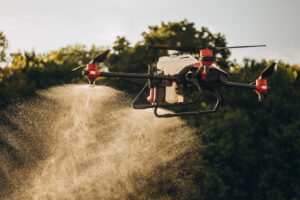
AVPL International’s Viraj series addresses this need with engineering precision. The Viraj 1.0 carries a ten-litre payload across twenty minutes of sustained flight, delivering targeted crop spraying that eliminates the chemical drift and uneven coverage that plague ground-based application methods. The Viraj 2.0 and Viraj 3.0 extend this capability to sixteen-litre payloads with flight endurance of up to twenty-five minutes — configurations that make complete field coverage viable for medium and large landholdings within a single operational window.
Beyond spraying, AVPL’s agricultural platforms carry multispectral imaging systems that generate real-time vegetation health data. Farmers gain early visibility into moisture stress, pest pressure, and nutrient deficiency — intelligence that allows intervention before crop losses become irreversible. The documented outcomes from AVPL deployments across India’s farming states include forty to sixty percent reductions in farm management time, thirty to fifty percent savings in labour and resource expenditure, and measurable improvements in seasonal yield consistency.
The Strategic Significance of AVPL as a Defence Drone Manufacturer
No assessment of India’s UAV sector is complete without a serious examination of the defence drone manufacturer landscape. As geopolitical pressures intensify and modern conflict increasingly plays out in the unmanned domain, India’s ability to source tactical aerial systems from domestic defence drone manufacturers has become a strategic imperative that transcends commercial considerations.
AVPL International has built its defence drone manufacturing programme around this imperative. The ARGUS V1.0 surveillance platform represents the flagship of AVPL’s tactical UAV portfolio — a heavy-payload system capable of carrying twenty kilograms of sensor equipment through thirty minutes of sustained operational flight. Designed for perimeter intelligence, border surveillance, and real-time situational awareness, the ARGUS series meets the demanding reliability standards that military deployment environments demand from any defence drone manufacturer.
The Kamikaze series occupies a different and equally critical niche in AVPL’s defence drone portfolio. The KZ-1 and KZ-2 platforms are precision loitering systems engineered for covert surveillance and targeted engagement in complex operational environments. The KZ-3 LM advances this capability further with a one-kilogram payload capacity and thirty minutes of operational endurance — a specification that reflects the maturity of AVPL’s position as a defence drone manufacturer operating at the frontier of unmanned tactical systems.
The policy environment surrounding defence drone manufacturers in India has never been more favourable. The Ministry of Defence’s positive indigenisation mandate explicitly restricts import of several UAV categories, directing procurement agencies to source exclusively from certified domestic defence drone manufacturers. For a company like AVPL International that has invested consistently in indigenous defence drone manufacturing infrastructure, this policy shift represents both validation and opportunity.
Beyond the commercial dimension, every tactical UAV produced by an Indian defence drone manufacturer reduces a critical national vulnerability. Dependence on foreign aerial platforms for defence-critical operations creates supply chain exposure that no sovereign military strategy can tolerate. Domestic defence drone manufacturers eliminate this exposure entirely — keeping design, production, maintenance, and operational intelligence within national boundaries.
Skilling the Workforce That Will Operate Tomorrow’s Aerial Economy
AVPL International’s investment in human capital development may ultimately prove to be its most enduring contribution to India’s aerial ecosystem. Operating over seventy DGCA-approved remote pilot training centres across the country, AVPL has certified more than one hundred thousand professionals in unmanned systems operation, maintenance, and application-specific deployment.
Through AeroVision Labs established in partnership with AICTE across forty-seven technical institutions, and through its Global Incubation and Skill Hubs, AVPL delivers structured pathways that take students from foundational aviation theory through advanced specialisations in artificial intelligence integration, GIS mapping, and precision agricultural application. The Drone Planet Suvidha Kendra programme, launched in collaboration with the Uttar Pradesh government under the CM Yuva Udhami scheme, extends this skilling reach into rural village networks — creating entrepreneurship opportunities for young people in communities that have historically been left outside India’s technology economy.
Drone as a Service — Removing the Barrier Between Technology and Adoption
Capital cost has historically been the primary obstacle preventing small and medium enterprises from accessing the operational benefits of aerial technology. AVPL International’s Drone-as-a-Service framework dissolves this barrier by delivering precision aerial intelligence as a managed service rather than a hardware investment.
Enterprises across oil and gas, power infrastructure, mining, logistics, and healthcare engage AVPL’s DaaS platform to access aerial survey data, infrastructure inspection reports, and real-time monitoring streams without the complexity of fleet ownership. This model reflects a broader evolution among sophisticated drone manufacturers — from hardware vendors into intelligence infrastructure providers whose value is measured in the quality of decisions their data enables.
What the Next Generation of Drone Manufacturing Looks Like
The competitive frontier for drone manufacturers is shifting rapidly toward autonomous systems capable of operating beyond visual line of sight, coordinating in swarm configurations, and integrating edge computing for real-time decision-making without ground station dependency. India’s leading drone manufacturers are already investing in these capabilities — and AVPL International’s research partnerships with IIT Kanpur and IIT Ropar position it at the forefront of this next-generation development curve.
The company’s commitment of twelve million dollars toward expanded training and manufacturing infrastructure signals a long-term strategic vision that goes beyond current market demands — anticipating the scale at which India’s aerial economy will operate in the years ahead.
Conclusion
The transformation of India’s industrial, agricultural, and defence landscape through unmanned aerial technology is not a future scenario — it is a present reality being built every day by the drone manufacturers who have chosen to invest in indigenous capability over imported convenience.
AVPL International represents the full depth of what that investment can produce. As an agricultural UAV innovator, a certified defence drone manufacturer, a national skilling institution, and a Drone-as-a-Service pioneer, AVPL is not simply one of India’s leading drone manufacturers — it is the blueprint for what the industry’s most complete players will look like as the aerial economy matures.