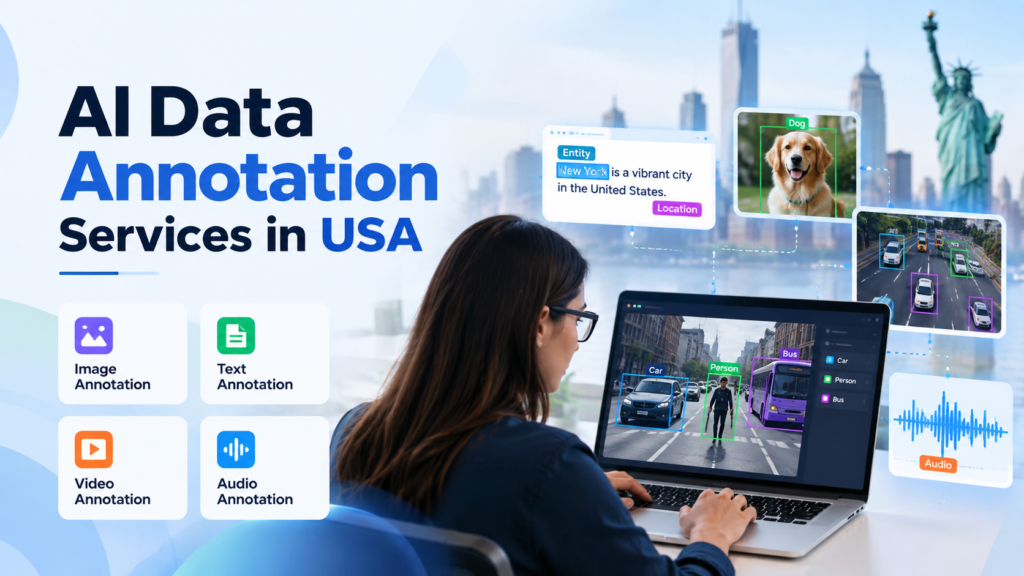
Artificial intelligence is becoming part of everyday business operations, from customer support and fraud detection to computer vision, recommendation systems, and predictive analytics. However, an AI system is only as reliable as the data used to train it. Raw business data often contains inconsistencies, missing information, irrelevant records, and unstructured content that machine learning models cannot understand properly. This is where AI Data Annotation Services in USA can help businesses prepare high-quality datasets for AI development.
Data annotation adds meaningful labels, tags, categories, or other information to raw data so that machine learning models can identify patterns and understand what they are being trained to recognize. Whether the data includes images, videos, text, audio, documents, or other formats, proper annotation can make it more useful for machine learning.
For businesses investing in AI, the goal is not simply to collect a large amount of data. The real objective is to build a dataset that is accurate, consistent, relevant, and ready for model training. With the right approach, AI Data Annotation Services in USA can help organizations turn raw information into structured training data while supporting better data quality and more dependable AI development.
What Is an AI-Ready Dataset?
An AI-ready dataset is a collection of data that has been prepared in a format suitable for training, validating, or testing an artificial intelligence or machine learning model. Simply having thousands or millions of records does not automatically make a dataset useful for AI.
For example, imagine a retail company wants to develop an image recognition system that identifies products on store shelves. A collection of shelf photographs may contain hundreds of different products, but the model needs to know which objects represent specific products. Images may therefore need bounding boxes, product labels, categories, or other annotations.
Similarly, a business developing a customer sentiment analysis system may have thousands of customer reviews. The text needs meaningful labels such as positive, negative, neutral, or specific issue categories before it can become useful training data.
AI Data Annotation Services help create this structure by transforming unorganized information into labeled datasets that machine learning systems can learn from.
Why Does Data Annotation Matter for AI Development?
Machine learning models learn patterns from examples. If the examples are incorrectly labeled, incomplete, or inconsistent, the model may learn the wrong patterns.
Consider a healthcare technology company developing an image-based system for identifying specific findings in medical images. If similar findings are labeled differently by different annotators, the resulting dataset can create confusion during model training. Consistent annotation becomes essential for maintaining dataset quality.
Businesses can use AI Data Annotation Services in USA to establish annotation workflows, define labeling guidelines, review datasets, and maintain consistency across large volumes of information.
High-quality annotation can support several important areas of AI development:
Better Training Data Quality
Accurate labels give machine learning models clearer examples to learn from. Quality control can also help identify incorrect, incomplete, or ambiguous annotations before the data reaches the training stage.
Improved Dataset Consistency
A large project may involve multiple annotators. Without clear guidelines, different people may interpret the same information differently. Standardized instructions and review processes help maintain consistency.
Support for Different Data Types
AI projects use many types of information. Depending on the project, annotation may involve images, videos, text, speech, documents, or combinations of these formats.
Easier Model Development
When data is properly structured and labeled, development teams can spend less time manually preparing datasets and more time working on model development, testing, and improvement.
How Can AI Data Annotation Services in USA Build AI-Ready Datasets?
Building an AI-ready dataset involves more than placing labels on files. It requires a structured process that connects business objectives with data preparation.
Understanding the AI Project Requirements
The first step is understanding what the AI model is expected to do. Annotation requirements differ depending on the use case.
For example, an autonomous vehicle project may require object detection and segmentation, while a customer service application may require text classification and intent labeling.
Before annotation begins, businesses should define:
- What the model needs to recognize
- Which data sources will be used
- What type of annotation is required
- How accurate the labels need to be
- How the completed dataset will be validated
A clear project definition reduces confusion during the annotation process.
Preparing and Cleaning Raw Data
Raw data may contain duplicate records, irrelevant files, poor-quality images, incomplete information, or inconsistent formatting.
Before annotation, businesses can organize and clean the data. This helps annotators work with relevant information and reduces unnecessary annotation effort.
For instance, an ecommerce company preparing product images for computer vision may first remove duplicate images and files that do not meet the required resolution.
Creating Clear Annotation Guidelines
Annotation guidelines explain how data should be labeled. They should be specific enough that different annotators can follow the same rules.
Suppose a business wants to classify customer messages into billing, technical support, sales, and general inquiries. The guidelines should explain how to classify messages that contain multiple topics or unclear intent.
Strong guidelines create a common standard and help improve labeling consistency.
Applying the Right Annotation Method
Different AI applications require different annotation techniques.
For image-based systems, teams may use bounding boxes, polygons, segmentation masks, keypoints, or image classification. Text projects may involve sentiment labeling, entity recognition, intent classification, or document categorization.
Video annotation can involve tracking objects across multiple frames, while audio projects may require transcription, speaker identification, or speech classification.
Choosing the appropriate annotation method is an important part of creating useful training data.
How Does Quality Control Improve Dataset Reliability?
Quality assurance is one of the most important parts of the annotation process. A dataset can contain thousands of annotations and still be unsuitable for AI training if many labels are incorrect.
AI Data Annotation Services in USA can incorporate quality checks at different stages of the workflow. Samples can be reviewed to identify labeling errors, inconsistent decisions, or problems with the annotation guidelines.
Multiple-Level Review
A project may use multiple levels of review. Initial annotations can be checked by quality reviewers, while complex or disputed cases can receive additional attention.
This process is especially useful for large projects where maintaining consistency across thousands of records can become difficult.
Handling Ambiguous Data
Not every data point is straightforward. An image may contain an object that is partially hidden, or a customer message may belong to more than one category.
Rather than forcing every case into an uncertain label, annotation teams can establish rules for handling ambiguous data. These decisions can then be documented and applied consistently.
Measuring Annotation Accuracy
Businesses can establish quality benchmarks before the project begins. These benchmarks may cover accuracy, consistency, completeness, and other project-specific requirements.
Regular measurement helps identify whether the annotation process is meeting the expected standard.
Can Annotation Help Different Industries Prepare AI Data?
Yes. The requirements change by industry, but the basic need for structured and reliable data remains similar.
In healthcare, annotated images and documents can support AI applications involving medical research, image analysis, and document processing.
In retail and ecommerce, product images, customer reviews, and purchase-related information can be labeled for recommendation engines, product recognition, and customer experience applications.
In automotive, annotated images and video can support computer vision systems designed to identify vehicles, pedestrians, road signs, lanes, and other objects.
In financial services, text and document annotation can help organize financial records, classify documents, and support AI-based analysis.
In manufacturing, visual datasets can be annotated to identify defects, components, and production-related conditions.
These examples show why AI Data Annotation Services in USA are relevant across multiple AI use cases rather than being limited to one specific industry.
What Are the Benefits of Outsourcing Data Annotation?
Managing annotation internally may appear straightforward at the beginning of an AI project. However, large datasets can quickly create challenges related to staffing, quality control, training, tools, and project management.
Working with experienced AI Data Annotation Services providers can give businesses access to established annotation workflows and specialized resources.
One advantage is scalability. Annotation requirements may increase significantly as an AI project moves from experimentation to production.
Another benefit is process consistency. A dedicated annotation team can follow defined guidelines and quality procedures across large datasets.
Outsourcing can also allow internal AI and technical teams to focus on model architecture, application development, testing, and deployment instead of spending most of their time preparing training data.
What Should Businesses Consider Before Starting an Annotation Project?
Businesses should define their requirements before sending large datasets for annotation.
First, identify the AI use case and the type of output the model needs to produce. Next, determine the required annotation format and establish clear labeling rules.
Data security should also receive attention, especially when datasets contain confidential business information or sensitive customer records. Access controls, secure workflows, confidentiality requirements, and appropriate data handling practices should be discussed before the project begins.
Businesses should also consider scalability. A small proof-of-concept may require a limited dataset, while a production AI application could eventually require millions of labeled records.
Clear communication between the business, data team, and annotation provider can make the process more manageable.
Why Choose Vision Infotech for AI Data Annotation?
Vision Infotech understands that successful AI development begins with dependable data. Our approach focuses on helping businesses organize, label, review, and prepare datasets according to their specific AI requirements.
With AI Data Annotation Services in USA, businesses can work toward creating structured datasets that are better aligned with their machine learning objectives. Vision Infotech can support annotation requirements across different data formats while emphasizing consistency, accuracy, and project-specific guidelines.
Project-Specific Annotation Approach
Every AI project has different requirements. Vision Infotech can structure annotation workflows around the intended use case instead of relying on a one-size-fits-all process.
Focus on Data Quality
Quality checks are important because inaccurate labels can affect the usefulness of training data. Annotation workflows can include review processes designed to identify inconsistencies and improve dataset reliability.
Support for Scalable Projects
AI projects can grow quickly as businesses move from testing to production. Vision Infotech can support evolving annotation requirements and help businesses manage larger datasets as project needs change.
Business and Technical Understanding
Annotation is most useful when it is connected to the purpose of the AI model. Vision Infotech focuses on understanding the business requirement behind the dataset so the annotation process can be aligned with the intended AI application.
What Does the Future of AI-Ready Data Look Like?
As businesses adopt more AI applications, the demand for reliable training data is expected to remain important. New AI systems require increasingly diverse datasets, and businesses need structured processes for preparing that information.
The future of AI Data Annotation Services in USA is likely to involve greater use of automation alongside human review. Automated tools can help process large amounts of data, while human expertise remains valuable for complex, ambiguous, or quality-sensitive cases.
The focus will also continue moving beyond the quantity of labeled data toward its relevance, accuracy, consistency, and usefulness for a specific AI application.
For businesses, this means data preparation should be treated as an important part of the AI development lifecycle rather than an afterthought.
Conclusion
Building an AI system requires more than collecting large volumes of information. Machine learning models need structured, relevant, and accurately labeled examples that allow them to identify meaningful patterns. This makes high-quality data preparation an important part of any successful AI initiative.
AI Data Annotation Services in USA can help businesses transform raw images, text, videos, audio, and documents into organized datasets suitable for machine learning workflows. From defining annotation guidelines and cleaning source data to applying labels and performing quality checks, a structured annotation process can improve the foundation on which AI models are developed.
For businesses planning new AI applications, investing in reliable annotation processes can help create datasets that are easier to manage, validate, and use throughout the development lifecycle. With its focus on customized workflows, data quality, scalability, and business requirements, Vision Infotech can support organizations looking to prepare dependable datasets for their AI initiatives.