What if you could enter the garment processing industry without setting up an entire washing and finishing plant?
Garment manufacturers handle several production stages before clothes reach retail stores. Depending on the product, these may include washing, dyeing, drying, finishing, quality inspection, and packaging.
While some factories maintain complete in-house facilities, others may need additional drying capacity during large production runs or seasonal demand.
This creates a potential business opportunity for entrepreneurs who want to offer specialised drying services using an industrial tumble dryer.
Instead of washing garments or manufacturing clothes, your business would focus on drying approved garments after wet processing, following the manufacturer’s required specifications.
But is a drying-only business practical, and what should you consider before investing?
Why Do Garment Manufacturers Need Industrial Drying Services?
Drying is an important stage in many garment washing and finishing operations.
After washing, rinsing, or certain treatment processes, garments may contain moisture that must be reduced before subsequent operations.
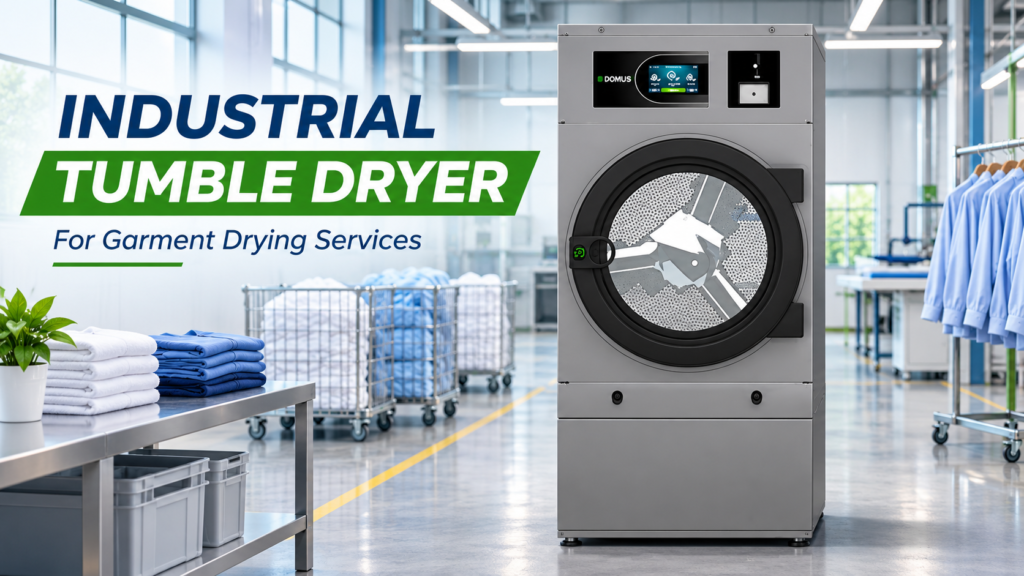
An industrial tumble dryer circulates heated air through a rotating drum to remove moisture from suitable garments.
Controlled tumble drying may also contribute to the intended fabric feel or dimensional characteristics when it forms part of an approved finishing process.
Garment factories can require additional drying capacity when production volumes increase or existing dryers become a bottleneck.
A specialist contractor could potentially support these businesses by providing extra drying capacity without requiring the manufacturer to purchase additional equipment.
However, this opportunity depends on genuine outsourcing demand. Many garment processors already have integrated drying facilities, so customer research is essential.
Which Businesses Could Become Your Customers?
A contract garment drying business should target customers whose production processes actually require tumble drying.
1. Garment Washing Units
Commercial garment washing facilities process garments according to different washing and finishing requirements.
When their washing capacity exceeds drying capacity, a separate drying contractor may help manage the additional workload.
2. Denim Processing Businesses
Selected denim garments undergo industrial washing and finishing treatments to achieve specific appearances and fabric characteristics.
Some processes incorporate tumble drying under controlled conditions.
Drying requirements must be confirmed carefully because temperature, garment construction, and finishing specifications can affect the final result.
3. Workwear and Uniform Manufacturers
Manufacturers producing suitable industrial uniforms and workwear may require controlled drying after approved washing processes.
These customers may have specific expectations concerning shrinkage, appearance, and fabric performance.
4. Garment Finishing Contractors
Businesses already providing washing, dyeing, or garment finishing services may need additional drying capacity during peak production periods.
Working with established processors could provide a more direct route to potential orders than approaching every garment manufacturer independently.
Can You Start This Business With One Industrial Tumble Dryer?
Yes, a specialised drying operation may begin with one suitable machine if enough customer demand exists and the workloads are compatible.
However, a dryer cannot process every fabric or garment safely.
Some garments require flat drying, controlled air drying, specialised finishing equipment, or alternative drying methods.
Before accepting an order, check garment specifications, approved drying temperatures, load compatibility, and required moisture levels.
Starting with one machine also means a breakdown could interrupt the entire service.
Entrepreneurs should plan maintenance and contingency arrangements before committing to strict delivery schedules.
How to Choose the Right Industrial Tumble Dryer
Choosing a dryer based only on price or maximum capacity can create problems.
Consider the following factors.
Machine capacity: Select a machine that can accommodate expected batch sizes without overloading.
Heating system: Electric, gas, and steam-heated options have different infrastructure and operating requirements.
Drying programmes: Suitable controls help operators manage drying time and temperature according to garment specifications.
Airflow and ventilation: Proper airflow is essential for drying performance and safe machine operation.
Maintenance support: Reliable servicing and spare-parts availability help reduce unplanned downtime.
The right equipment should match actual processing contracts rather than projected demand alone.
How Much Garment Drying Capacity Do You Need?
Suppose you are considering a 30 kg industrial tumble dryer.
Assume a suitable garment batch requires approximately 60 minutes for drying, cooling, loading, and unloading.
During an eight-hour shift, the theoretical output would be:
| Production Factor | Illustrative Value |
| Dryer capacity | 30 kg |
| Complete cycle time | 60 minutes |
| Operating shift | 8 hours |
| Theoretical cycles | 8 |
| Theoretical daily output | 240 kg |
However, a realistic business plan should account for garment separation, cleaning, quality inspection, maintenance, and scheduling delays.
If you assume 75% practical utilisation:
Estimated daily output = 240 × 75% = 180 kg
This is an illustrative calculation, not a manufacturer-certified production capacity.
Actual output depends on load weight, moisture content, fabric properties, dryer specifications, and the approved programme.
Entrepreneurs should use supplier performance data and trial batches when calculating practical capacity.
How to Start a Contract Garment Drying Business
Step 1: Research Nearby Garment Manufacturing Clusters
Begin by identifying garment factories, washing units, and textile processing businesses within a practical service radius.
Approach production managers and finishing supervisors to understand their existing drying arrangements.
Ask whether they experience capacity shortages and whether they would consider outsourcing compatible batches.
Step 2: Secure Potential Orders Before Investing
Instead of purchasing equipment immediately, try to obtain realistic volume estimates or conditional service commitments.
Discuss fabric categories, batch sizes, acceptable drying methods, turnaround expectations, and pricing.
This reduces the risk of purchasing a machine without sufficient demand.
Step 3: Choose a Suitable Processing Location
An industrial drying facility requires adequate space, electrical or heating infrastructure, ventilation, and safe garment handling.
The site should allow separate handling of incoming damp garments and finished dry garments.
Check applicable business, environmental, fire-safety, and factory requirements before installation.
Step 4: Establish a Controlled Drying Process
Every customer batch should have clear processing instructions.
Record the garment category, fabric composition, allowable drying conditions, batch weight, and expected final condition.
Operators should follow approved procedures and inspect garments after drying.
Do not mix incompatible colours, treatments, or garment categories.
Step 5: Plan Collection and Delivery
Transport can be a major challenge for drying-only operations.
Moving wet garments between factories may increase handling costs, create delays, and introduce quality risks.
For this reason, on-site contracted drying or serving nearby garment processors may be more practical than transporting damp loads over long distances.
Compare both models before finalising your investment.
How Much Investment Is Required?
The startup cost depends on the selected industrial tumble dryer, heating technology, facility infrastructure, and customer requirements.
Major expenses may include:
- Industrial tumble dryer
- Equipment installation and transport
- Electrical, gas, or steam infrastructure
- Ventilation and exhaust arrangements
- Garment handling trolleys and sorting tables
- Facility rent and deposits
- Staff salaries
- Maintenance and working capital
A drying-only operation may need fewer equipment categories than a complete garment washing plant.
However, industrial drying machinery and supporting infrastructure can still require substantial investment.
Obtain detailed quotations and confirm the installation requirements before committing funds.
How Can You Calculate Profitability?
A contract drying business may charge per kilogram or according to agreed batch-processing rates.
Consider the following hypothetical example:
| Business Factor | Illustrative Amount |
| Garments dried daily | 180 kg |
| Service charge | ₹12/kg |
| Working days monthly | 26 |
| Monthly processing volume | 4,680 kg |
| Monthly revenue | ₹56,160 |
| Monthly operating expenses | ₹38,000 |
| Operating surplus | ₹18,160 |
These figures are purely illustrative, not verified market prices or guaranteed profits.
The stated surplus excludes financing, taxes, depreciation, and any expenses not included in the operating estimate.
Actual earnings depend heavily on the drying charge customers are willing to pay, energy costs, machine utilisation, labour, transportation, and maintenance.
Before investing, calculate your cost per kilogram and compare it with actual contract quotations.
What Challenges Should You Consider?
A garment drying service may face several operational risks.
Fabric damage: Excessive temperature or mechanical action can cause shrinkage, deformation, or finishing defects.
Inconsistent workloads: Factory production schedules may change, leading to unpredictable drying volumes.
Transportation delays: Moving damp garments between facilities can complicate turnaround commitments.
Quality requirements: Different manufacturers may require specific drying conditions and documented results.
Equipment downtime: A single machine failure can delay customer orders.
Lint accumulation, inadequate ventilation, and unsuitable materials can also create serious fire risks.
Regular cleaning, approved drying procedures, equipment maintenance, and staff training are essential.
How Orgaearth Can Help You Choose an Industrial Tumble Dryer
Selecting suitable drying equipment is an important step when planning a garment drying or commercial laundry business.
Orgaearth Laundry Solutions supplies industrial tumble dryers in India for commercial laundries, garment processing facilities, hotels, and other professional applications.
Its equipment portfolio includes Domus industrial tumble dryers available in different capacities and heating configurations.
Depending on the selected model, options include programmable controls, efficient airflow systems, and energy-management features.
Orgaearth also assists businesses with equipment selection, installation planning, and technical support.
Entrepreneurs can evaluate suitable machines based on expected garment volume, fabric requirements, available utilities, and daily operating hours.
Conclusion
Starting a contract drying service for garment manufacturers can be a specialised business opportunity within the textile and laundry industry.
An industrial tumble dryer can provide drying capacity for suitable garments after washing or approved wet processing.
However, success depends on securing genuine customer demand, selecting appropriate equipment, managing transportation, and maintaining consistent garment quality.
Before investing, speak with nearby garment processors, estimate realistic daily volumes, obtain equipment quotations, and calculate expected operating costs.
A carefully planned drying service can support garment manufacturers while creating opportunities for future business expansion.
Frequently Asked Questions
1. Can I start a garment drying business with one industrial tumble dryer?
Yes, if you have enough compatible garment-processing demand and suitable operating arrangements. One machine may support a limited operation, but downtime and capacity restrictions must be considered.
2. What is an industrial tumble dryer used for in garment manufacturing?
It removes moisture from suitable garments after washing and certain wet treatments. Controlled tumble drying may also be part of specific garment finishing processes.
3. How much capacity is required for a garment drying business?
Capacity depends on expected daily garment weight, fabric type, residual moisture, drying cycle duration, and operating hours.
4. Can all garments be dried in an industrial tumble dryer?
No. Some fabrics and garment constructions are unsuitable for tumble drying. Always follow approved textile specifications and test unfamiliar garments before accepting production batches.
5. Is a garment drying service profitable?
Profitability depends on confirmed customer demand, drying charges, machine utilisation, energy expenses, labour, and transportation. A realistic break-even calculation is necessary before investing.
6. Which heating option is suitable for an industrial tumble dryer?
Electric, gas, and steam-heated dryers have different utility and installation requirements. The most suitable option depends on local energy availability, expected usage, and operating costs.
7. Where can I buy an industrial tumble dryer in India?
Professional laundry equipment suppliers such as OrgaEarth offer industrial tumble dryers in different capacities. Compare technical specifications, garment compatibility, installation requirements, and service support before purchasing.
Contact Us:
Orgaearth Laundry Solutions
Plot no. 774, Udyog Vihar, Phase 5, Gurugram, Haryana, India-122016
Email: marketing@orgaearth.com
Contact No. +91 7042912777