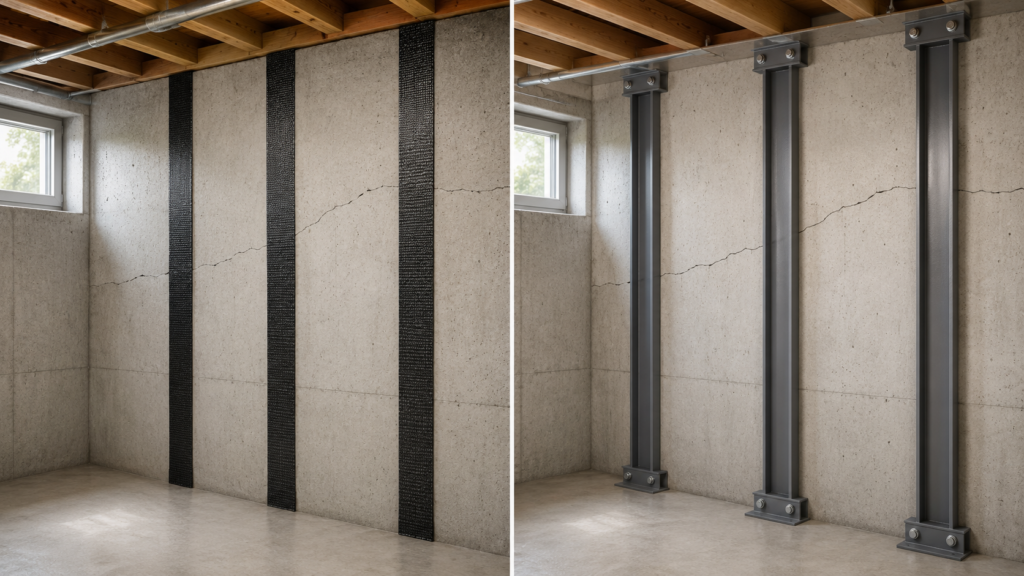
A horizontal crack, inward curve, or stair-step pattern in a basement wall can be more than a cosmetic problem. These signs often appear when soil pressure outside the foundation becomes greater than the wall can resist. Once movement begins, homeowners may hear two common repair recommendations: carbon fiber straps or steel beams.
Both systems can stabilize foundation walls, but they work differently. Carbon fiber creates a thin, high-strength reinforcement bonded directly to the wall. Steel beams form a rigid support system secured at the top and bottom. The right choice depends on the amount of movement, wall material, moisture conditions, basement layout, and whether the wall needs stabilization alone or more extensive correction.
Why Foundation Walls Bow or Crack
Basement walls hold back a large amount of soil. That soil changes with rain, snowmelt, frost, drought, and drainage conditions. Poor grading, blocked foundation drains, short downspouts, expansive clay, and water collecting beside the home can increase pressure against the exterior wall.
When soil becomes saturated, it grows heavier and creates hydrostatic pressure. Over time, a concrete block wall may develop a horizontal crack along a mortar joint. A poured concrete wall may crack, lean, or bow inward.
A contractor must identify why the wall moved. Reinforcing the inside without correcting drainage can leave the original source of pressure in place.
What Are Carbon Fiber Straps?
Carbon fiber straps are narrow strips of high-strength composite material installed vertically along the interior face of a foundation wall. The installer prepares the surface, applies structural epoxy, and bonds the strap from near the footing to the upper framing area.
Carbon fiber is valued for its tensile strength. In simple terms, it resists stretching when the wall tries to bend farther inward. Once bonded to a sound surface and properly connected, the strap becomes part of the wall reinforcement system.
Because the material is thin, it adds little bulk to the basement. It does not create the projecting profile associated with steel beams, and it can often be covered or painted after installation.
Carbon fiber is mainly used to stop additional movement. It is not normally intended to push a badly displaced wall back into position. The wall must also be suitable for bonding. Loose paint, crumbling masonry, active seepage, or weak block faces may require repair first.
Homeowners researching this method can review how specialists approach carbon fiber foundation reinforcement, including wall preparation, structural support, and water management.
What Are Steel Beams?
Steel beams, often called steel I-beams, are installed vertically against the inside of a bowed wall. The lower end is secured near or into the basement floor, while the upper end is attached to the floor framing.
Unlike a bonded strap, a steel beam acts as a rigid brace. It physically resists inward movement and transfers force to its upper and lower supports. This makes steel useful when bowing is more noticeable, when the masonry surface is unsuitable for bonded reinforcement, or when the repair plan calls for a heavier structural response.
Steel beams project farther into the room. They may affect insulation, framing, shelving, and the layout of a finished basement.
Carbon Fiber Straps vs Steel Beams: Key Differences
Amount of Wall Movement
The severity of displacement is one of the first decision points.
Carbon fiber is often considered when bowing is limited, the wall remains structurally sound, and the goal is to stop further movement. It works best when the surface can provide a reliable bond and the damage falls within the system’s design limits.
Steel beams are more likely to be considered when movement is greater, the wall needs a rigid brace, or the substrate is too damaged for a bonded system. Still, wall height, crack pattern, construction type, soil load, and framing connections also matter.
Stabilization Versus Straightening
Homeowners should ask whether the proposed work is meant to stabilize the wall or move it back.
Carbon fiber straps generally hold a wall in its current position and limit additional movement. They do not exert the force needed to straighten a badly bowed wall.
Steel may be included in a plan involving controlled realignment, but straightening is a separate and more complex process. Soil may need to be excavated outside the foundation before pressure is released. Forcing a wall outward without reducing the exterior load can cause further damage.
Basement Space and Appearance
Carbon fiber has a clear advantage when preserving space is important. The straps sit close to the wall and interfere less with framing or finished surfaces.
Steel beams extend into the basement. A row of beams can complicate finishing plans because a stud wall may need to be built in front of them.
Carbon fiber usually produces a flatter finish and may be easier to incorporate into a renovated basement. Steel beams can still be concealed, but the framing required around them may reduce usable floor space.
Installation Disruption
Carbon fiber installation is usually less invasive because the work is completed at the wall surface. Cracks or damaged mortar may need repair, but heavy steel handling and floor alterations are often avoided.
Steel beam installation can require more labor and room. Contractors may need to open the slab at the base, fit each beam tightly, build a lower connection, and secure the top to the floor framing.
The lower-disruption option is not automatically the better option. It must still match the wall condition.
Wall Material and Surface Condition
Carbon fiber depends on adhesion. The wall must be stable enough to accept the epoxy. Dust, paint, efflorescence, seepage, deteriorated block, or poor earlier repairs can weaken the bond if not corrected.
Steel beams do not depend on bonding across the wall face. That can make them suitable for some uneven or questionable masonry surfaces. Even then, each beam needs proper contact and secure anchoring.
Poured concrete, concrete block, stone, and mixed-material foundations behave differently. The repair must suit the actual wall rather than a general preference for one product.
Moisture and Corrosion
Carbon fiber does not rust, which is useful below grade. However, active water entry must still be addressed. Moisture can damage the wall surface and surrounding materials even when the reinforcement is corrosion-resistant.
Steel requires protection from ongoing dampness. Coatings help, but they do not replace waterproofing or drainage. Water collecting near the floor line can also hide new cracking behind completed walls.
For either method, the repair plan should consider grading, downspout discharge, foundation drains, sump pump operation, and exterior or interior waterproofing where needed.
Strength and Load Resistance
Both materials can provide strong foundation wall reinforcement when they are properly designed and installed. The way they manage the load, however, is different.
Carbon fiber works as part of the wall surface. Its tensile strength helps resist further bending, but its performance depends on the quality of the wall, epoxy bond, strap spacing, and upper and lower connections.
Steel beams create a separate rigid bracing structure. Their performance depends on beam size, spacing, contact with the wall, and the strength of the floor and framing connections.
Comparing the raw strength of steel and carbon fiber does not provide a complete answer. A repair system is only as reliable as its weakest connection.
Maintenance Requirements
Carbon fiber normally requires little maintenance once it has been properly installed and protected. The wall should still be inspected occasionally, especially after major storms or noticeable changes in basement moisture.
Steel beams should be checked for rust, movement at the connections, and moisture collecting near the base. Any framing built around the beams should not make future inspection impossible.
Regardless of the material, homeowners should monitor existing cracks and look for new movement in nearby walls, floors, windows, and doors.
Cost and Long-Term Value
Carbon fiber often involves less material handling and fewer changes to the basement, which may reduce labor and finishing costs. Steel can cost more when slab work, access problems, framing changes, or corrosion protection are involved.
Price alone is a poor way to choose. A cheaper carbon fiber proposal has little value if the wall has moved beyond the system’s limits. Steel may also be unnecessary for limited movement that can be handled with a properly designed bonded system.
A useful estimate should explain the cause of movement, measured displacement, reinforcement spacing, connection details, drainage work, finishing restrictions, and warranty terms.
When Carbon Fiber May Be the Better Choice
Carbon fiber may be appropriate when:
- Wall movement is limited and suitable for stabilization.
- The foundation wall remains structurally sound.
- The surface can provide a dependable epoxy bond.
- Preserving basement floor space is important.
- The homeowner wants a lower-profile repair.
- Major wall straightening or rebuilding is not required.
- Water and drainage problems can be addressed separately.
Carbon fiber should not be selected only because it is less visible. The wall must fall within the technical limits of the reinforcement system.
When Steel Beams May Be the Better Choice
Steel beams may be more suitable when:
- The wall has more advanced inward movement.
- A rigid bracing system is required.
- The wall face is unsuitable for bonded straps.
- The basement layout can accommodate projecting supports.
- The repair plan involves excavation or controlled realignment.
- An engineer specifies steel based on the wall loads.
Severe damage may require more than beams. A wall with major displacement, widespread deterioration, failing footings, or reduced structural capacity may need partial or complete rebuilding.
Do Not Ignore the Water Problem
A bowed wall is structural damage, but water often contributes to the pressure behind it. Saturated soil can continue pushing against the wall after interior reinforcement is installed.
Check the slope around the home, downspout extensions, window wells, surface drainage, plumbing leaks, sump discharge, and the foundation drainage system. Exterior excavation and waterproofing may be needed where water is entering through cracks or collecting beside the wall.
This is why a professional structural foundation repair assessment should examine more than the visible crack. The repair plan should connect the reinforcement method with the condition of the wall, footing, surrounding soil, and drainage system.
Questions to Ask Before Choosing a Repair
Before signing a contract, ask:
- How far has the wall moved, and how was it measured?
- Is the work intended to stabilize or straighten it?
- What caused the cracking or bowing?
- Why is carbon fiber or steel better for this wall?
- How will the system connect at the top and bottom?
- Will water pressure or drainage problems also be addressed?
- Is engineering review or a building permit required?
- What warranty and project records will be provided?
Final Verdict
There is no universal winner in the carbon fiber straps vs steel beams comparison. Carbon fiber offers strong, low-profile reinforcement with less impact on basement space. Steel provides rigid support and may suit walls with more advanced movement or surfaces that cannot accept a bonded system.
The better repair is the one selected after the wall has been measured, the cause of pressure has been identified, and the full structure has been reviewed. Be cautious of anyone who recommends a method from a photograph alone or treats every horizontal crack the same way.
Foundation wall stabilization is not only about attaching a strong material to concrete or block. It is about matching the repair to the wall, creating reliable connections, managing moisture, and reducing the conditions that caused the movement.