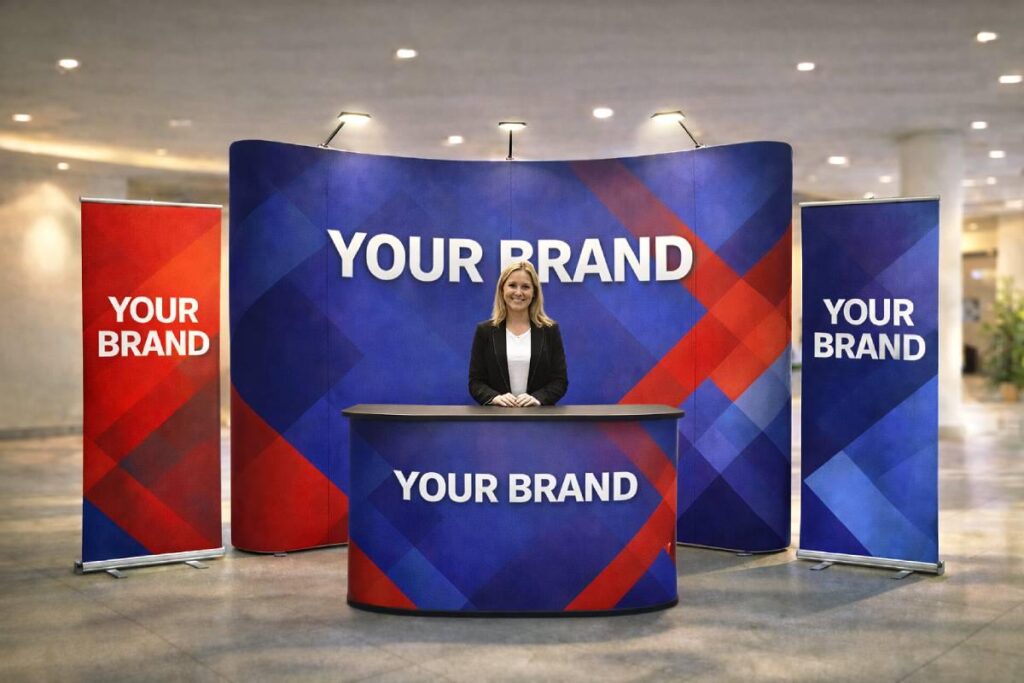
A backdrop stand can make a business event look organised, provide a clear space for branding, and create a suitable background for photographs. From exhibitions and product launches to conferences and corporate gatherings, the right display helps businesses present their message without taking up unnecessary space.
However, not every backdrop stand is suitable for every event. The best option depends on the venue, available floor space, audience size, installation time, transport requirements, and type of graphics being displayed. In Dubai, where businesses regularly participate in exhibitions, trade shows, networking events, and promotional activities, choosing the right setup can make event planning easier.
Understanding the main backdrop types and their practical uses helps businesses select a display that fits both the occasion and the venue.
1. Consider the Purpose of the Event
Before comparing backdrop stands, identify what the display needs to achieve. A backdrop designed for a press conference may have different requirements from one used at a retail activation or exhibition booth.
Common purposes include:
- Brand visibility: Displaying a company name, logo, or campaign message.
- Photography: Creating a consistent background for photographs, interviews, and social media content.
- Product promotion: Highlighting a product, service, or new launch.
- Visitor engagement: Making an exhibition stand or promotional area easier to recognise.
- Professional presentation: Providing a suitable background for presentations, panels, and corporate meetings.
For example, a company hosting a product launch may need a large branded background that appears clearly in photographs. A business attending a small networking event might need a compact stand that can be assembled quickly.
Defining the main purpose first prevents unnecessary spending on features that the event does not require.
2. Choose a Backdrop Stand That Fits the Venue
The available space should influence the size and shape of the backdrop. A large display may attract attention in an exhibition hall but become difficult to position in a small meeting room.
Exhibition halls and trade shows
Exhibition spaces often benefit from wider backdrops that make a booth recognisable from nearby aisles. The design should remain readable from a distance, with the company name and primary message clearly visible.
Businesses planning an exhibition can explore different explore different backdrop stand options in Dubai to compare display sizes, structures, and graphic formats for their intended setup.
Conferences and corporate events
Conferences often require a clean background for speakers, panel discussions, interviews, and photographs. A straight fabric backdrop or step-and-repeat design may be suitable, depending on the stage size and camera angles.
Retail promotions and product launches
Retail activations may need a backdrop that complements product displays, counters, or demonstration areas. The structure should leave enough room for visitors to move around safely without blocking entrances or walkways.
Before confirming the dimensions, measure the available width and height. Also check ceiling restrictions, nearby lighting, electrical equipment, and any venue rules about attaching or positioning displays.
3. Compare the Main Types of Backdrop Stands
Different structures serve different purposes. Understanding their features helps businesses choose an option that suits the event rather than relying on appearance alone.
Pop-up backdrop stands
Pop-up backdrops use a collapsible frame that expands to support a printed graphic. They are commonly used at exhibitions, promotional events, and conferences where a larger branded background is needed.
Some designs are straight, while others are curved. A curved structure can create a more enclosed visual area, whereas a straight display may suit venues where a flat background is preferred.
When choosing a pop-up stand, check its assembled dimensions, frame mechanism, graphic attachment method, and packed size. These details affect setup, storage, and transport.
Fabric backdrop stands
Fabric backdrops use printed textile graphics supported by a frame. Depending on the design, the fabric may stretch over the structure or attach to it using a specified fastening system.
They can be useful for corporate events, photography areas, exhibition booths, and branded interview spaces. Fabric graphics can also be convenient to transport when the system is designed to pack into a compact carrying case.
Before ordering, ask how the fabric is installed, whether it can be removed for cleaning, and whether replacement graphics are available for future campaigns.
Roll-up banner stands
A roll-up banner stores its printed graphic inside a base and extends upwards when needed. It is generally more compact than a full-width backdrop, making it suitable for reception areas, seminars, small exhibition booths, and presentations.
Roll-up banners work well when the goal is to communicate a focused message rather than create a large photographic background. They can also be positioned beside a registration desk or product display.
Check the banner’s width, height, base stability, and graphic replacement options before selecting a model.
Step-and-repeat backdrops
A step-and-repeat backdrop features a repeated pattern of logos or brand marks. It is often used at award ceremonies, press events, product launches, and corporate celebrations.
The repeated layout helps maintain brand visibility across photographs taken from different positions. To achieve this, logos should have consistent spacing and sufficient contrast against the background.
The final design should be tested at the expected camera distance. Logos that appear clear on a computer screen may become too small when the backdrop is photographed from farther away.
4. Select Materials and Printing Carefully
The printed graphic contributes significantly to the overall appearance of the display. Material selection should consider the event environment, lighting, transportation, and frequency of use.
Fabric graphics may suit displays that need to be transported regularly, while other printed materials may be appropriate for particular frame systems. The correct option depends on the manufacturer’s specifications and the intended application.
Before approving production, consider these points:
- Colour accuracy: Check that the printed colours are consistent with the approved artwork.
- Image resolution: Use high-resolution logos and images to prevent visible pixelation.
- Surface appearance: Consider how the material will look under exhibition lighting and camera flashes.
- Durability: Check whether the graphic and frame are suitable for repeated assembly.
- Maintenance: Understand how the material should be cleaned and stored.
In Dubai’s exhibition venues, artificial lighting can affect how colours appear in photographs. Reviewing a sample or proof under similar lighting conditions can help identify issues before the event.
5. Make Branding Clear and Easy to Read
A backdrop should communicate its main message quickly. Filling every available space with text, logos, and decorative elements can make the design difficult to understand.
Start with the most important visual element, such as a company name, event title, or campaign message. Supporting information should be secondary and limited to what the audience needs.
For example, a conference backdrop may require only the event name and organiser’s logo. A product launch might include the product name and a short tagline.
Use strong contrast between text and background, leave enough empty space around key elements, and avoid placing important content near frame edges or areas that may be hidden.
For photography-focused displays, review a full-size mock-up and check how the graphic appears in a camera preview. This can reveal issues that are not obvious when viewing the artwork on a monitor.
6. Plan for Assembly, Transport, and Storage
A backdrop that looks suitable in a design preview may still create logistical problems if it is difficult to transport or assemble.
Businesses attending several events should consider the packed dimensions, total weight, number of components, and time needed for installation. A compact system may be more practical for teams travelling between venues, while a larger structure may be appropriate when transport and setup support are available.
Before the event, confirm:
- Whether assembly requires tools.
- How many people are needed to set up the display.
- Whether the frame fits through venue doors and lifts.
- How the components should be packed and stored.
- Whether replacement parts or graphics can be obtained.
A trial assembly before the event is useful, especially when the stand will be used for the first time. It allows the team to identify missing components and check that the graphic fits correctly.
7. Match the Budget to Long-Term Use
The lowest initial cost does not always represent the lowest overall cost. A backdrop intended for a single event has different requirements from one that will be reused across several exhibitions.
For occasional use, a simple roll-up banner may provide enough display space. Businesses attending regular trade shows may benefit from a reusable frame with replaceable graphics, allowing the visual message to change without replacing the entire structure.
When comparing options, consider the frame, printed graphic, carrying case, installation requirements, maintenance, and potential replacement costs together.
Conclusion
Choosing the right backdrop stand starts with the event’s purpose, venue dimensions, and expected frequency of use. Pop-up stands can provide a broad exhibition background, fabric displays can suit reusable branded setups, roll-up banners work well in compact spaces, and step-and-repeat backdrops support photography-focused events.
By checking materials, artwork readability, transport requirements, and assembly needs before ordering, businesses can select a display that fits the event and remains practical beyond the initial setup.