Clean-in-Place Market to Reach USD 24.71 Billion by 2032 as Automation and Hygiene Standards Accelerate Demand
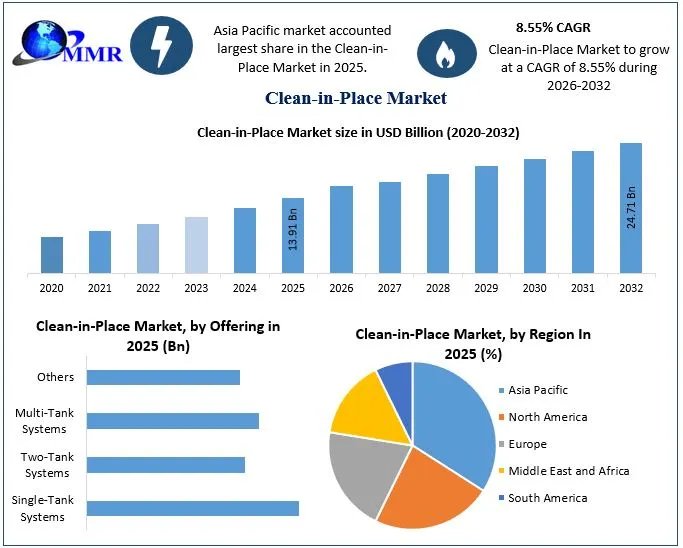
The Clean-in-Place Market is expanding as food, dairy, beverage, pharmaceutical, and biotechnology manufacturers invest in automated sanitation and efficiency. According to Maximize Market Research, the market was valued at USD 13.91 billion in 2025 and is projected to grow at a CAGR of 8.55% from 2026 to 2032, reaching USD 24.71 billion by 2032.
Market Estimation, Growth Drivers and Opportunities
Clean-in-Place technology enables internal surfaces of pipes, tanks, vessels, filters, and process equipment to be cleaned without dismantling production systems. It reduces labor, downtime, and cleaning variability across high-hygiene industries. Demand is reinforced by the growth of processed foods, dairy products, beverages, pharmaceuticals, and automated manufacturing.
A major growth driver is the tightening focus on food safety, contamination prevention, hygiene validation, and manufacturing compliance. Manufacturers are also seeking to reduce water, chemicals, energy consumption, and wastewater costs. This creates opportunities for intelligent CIP systems, automated dosing, sensor-based monitoring, data-driven cleaning validation, water recovery, and resource-efficient equipment. Automation and high-hygiene facility expansion should create additional opportunities.
U.S. Market: 2025 Trends and Investment
The U.S. market is benefiting from investment in food technology, dairy processing, alternative proteins, and advanced manufacturing. In July 2025, GEA opened a USD 20 million New Food Application and Technology Center in Janesville, Wisconsin, strengthening its North American food-processing footprint. The facility supports pilot-scale processing for precision fermentation, cell cultivation, plant-based foods, thermal processing, and filtration.
Cayuga Milk Ingredients also opened an expanded consumer-goods plant in New York as part of a two-phase, multimillion-dollar expansion totaling USD 270 million, with Tetra Pak involved in processing and packaging solutions. U.S. sanitation requirements are also supporting demand; in 2025, the FDA reopened comments on sanitation guidance for low-moisture ready-to-eat foods.
Request a Sample PDF of the Market Report : https://www.maximizemarketresearch.com/request-sample/27293/
Largest Market Segments
Reuse CIP Systems are expected to hold the leading position among system types because they can recirculate cleaning solutions and water, lowering chemical consumption, freshwater intake, and wastewater costs. The Food Industry represents a leading end-user segment because frequent cleaning of pipes, vessels, processing lines, and equipment is essential for hygiene and contamination prevention between production batches.
Competitive Analysis
Tetra Pak International remains a force through integrated food-processing, dairy, beverage, and cleaning technologies. Its CIP portfolio emphasizes automated control, liquid tracking, flexible dosing, conductivity management, and program management. Tetra Pak is also advancing lower-resource cleaning, including Air Jet Cleaning for powder applications.
GEA Group is strengthening its position through automation, hygienic process engineering, and sustainability-focused technologies. Its USD 20 million U.S. technology-center investment in 2025 expands capabilities around next-generation food production. GEA also promotes CIP concepts designed to combine vessel and pipe cleaning and reduce resource consumption, supporting efficient brewery and food-processing operations.
Sani-Matic is a leading specialist in automated sanitary cleaning systems for food, beverage, dairy, pharmaceutical, and biotechnology manufacturers. Its automated CIP and sanitary equipment supports repeatable cleaning and reduced operator intervention.
Alfa Laval is expanding the value proposition of CIP through water- and energy-efficient hygienic equipment. In 2025, its rotary jet-head technology helped a large ice-cream producer save 10,000 cubic meters of CIP water, 650,000 kWh of energy, and about 500 tonnes of carbon emissions, with the installation paying back in less than six months. This demonstrates the financial and sustainability value of CIP optimization.
SPX FLOW is advancing sanitary processing through APV technologies and expanded testing capabilities. Its 2025 collaboration with SIG included a new two-line APV CIP station and fermentation infrastructure at a Dubai innovation center, enabling customers to test dairy and plant-based processes under representative conditions. This can accelerate efficient CIP adoption across emerging food categories.
Regional Analysis
The United States is a major market supported by strict food-safety expectations, sophisticated food and beverage manufacturing, pharmaceutical production, and high automation levels. The UK benefits from strong hygiene requirements and established dairy, beverage, and pharmaceutical industries. Germany remains important because of process engineering, food manufacturing, and industrial automation. France is supported by large food, dairy, beverage, and pharmaceutical sectors. Japan offers opportunities through advanced automation and high-quality manufacturing standards. China is a high-growth market as food, dairy, beverage, and pharmaceutical production expands.
Key Players
Key companies include Tetra Pak International, GEA Group, Sani-Matic, Alfa Laval, SPX FLOW, Krones AG, KHS GmbH, Melegari Manghi, Centec GmbH, Millitec Food Systems, Filamatic, Sysbiotech, Bionet, Solaris Biotech USA, Handtmann Armaturenfabrik, E. Bachiller B, Axomatic, and Scanjet Systems.
Why This Market Matters Now
CIP is moving from basic sanitation to a strategic smart-manufacturing function. Rising hygiene expectations, labor constraints, production complexity, sustainability targets, and demand for continuous operations are encouraging manufacturers to modernize cleaning infrastructure. Technologies combining automation, sensors, data analytics, intelligent chemical dosing, water recovery, and efficient mechanical cleaning can reduce operating costs while improving consistency and compliance. As production becomes more automated and resource-conscious, advanced CIP investment is increasingly linked to productivity, quality, safety, and environmental performance.
Explore More Related Reports:
Agricultural Films Market https://www.maximizemarketresearch.com/market-report/agricultural-films-market-global/42869/
Global Biosolids Market https://www.maximizemarketresearch.com/market-report/global-biosolids-market/27955/
About Maximize Market Research
Maximize Market Research Pvt. Ltd. (MMR) is a global market research and consulting company that provides reliable, data-focused, and practical business insights. The firm serves healthcare, pharmaceuticals, technology, automotive, electronics, chemicals, personal care, and consumer goods. Through market forecasts, competitive analysis, and strategic consulting, MMR helps organizations understand market conditions, identify opportunities, and make informed decisions.
Contact Us
2nd Floor, Navale IT Park Phase 3
Pune Banglore Highway, Narhe
Pune, Maharashtra 411041, India
+91 9607365656
sales@maximizemarketresearch.com