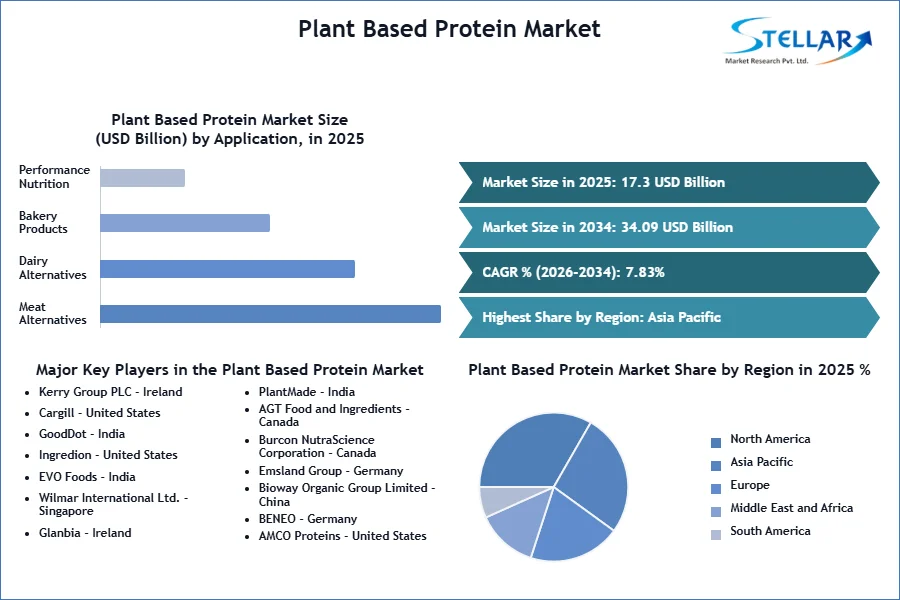
The Plant Based Protein Market industry analysis, finding that global market value stood at USD 17.3 billion in 2025 and is on track to reach USD 34.09 billion by 2034 (7.83% CAGR from 2026 to 2034). The shift matters strategically as food processors, supplement formulators, and retail leaders recalibrate capital away from speculative alt-meat novelties toward scalable, allergen-friendly, and nutritionally dense protein inputs.
The global protein economy is moving past its first-wave novelty phase into an era defined by formulation pragmatism, supply resilience, and everyday nutritional fortification. Rather than positioning plant proteins strictly as one-for-one replacements for conventional meat patties, ingredient suppliers and consumer packaged goods (CPG) brands are embedding plant isolates, concentrates, and textured matrices across mainstream bakery, dairy-alternative beverages, sports nutrition, and hybrid meat-plant blends.
Key Findings from the Report
-
Market Trajectory: According to Stellar Market Research (Report ID: 2011; base year 2025; forecast period 2026–2034), the global Plant Based Protein Market expands from USD 17.3 billion in 2025 to nearly USD 34.09 billion by 2034 at a 7.83% CAGR.
-
Dominant & Growth Crop Dynamics: Soy remains a foundational incumbent backed by established global crushing and processing scale, while pea protein isolates are gaining rapid momentum in high-protein nutritional formulations due to lower allergenicity and versatile functional profiles.
-
Application & Form Factor Shifts: Demand is expanding fastest in functional foods, beverages, and nutritional supplements where consumers seek higher protein density, gut comfort, and clean-label ingredient lists.
-
Regional Leadership & Velocity: Asia-Pacific is emerging as a major growth engine—led in scale by China and pacing regional growth through India—alongside mature retail and R&D hubs in North America and Europe.
-
Supply & Margin Reality: Tighter capital discipline across food-tech and alternative proteins is rewarding established agricultural ingredient processors and vertically integrated supply chains over cash-intensive greenfield startups.
-
Investor & Buyer Takeaway: Buyers and investors are prioritizing ingredient suppliers with proven extrusion/texturization scale, multi-crop sourcing resilience, and verified functional claims.
For further information, click the following link:https://www.stellarmr.com/report/req_sample/Plant-Based-Protein-Market/2011
Market Drivers and Restraints
Key Drivers
-
Mainstream Protein Fortification & Dietary Shifts: Rising consumer focus on daily protein intake, active nutrition, weight management, and flexitarian eating patterns is pulling plant proteins into everyday food and beverage SKUs.
-
Digestive Tolerance & Allergen-Friendly Formulations: Growing awareness of lactose intolerance and dairy sensitivities—combined with demand for non-GMO and allergen-conscious ingredients—continues to lift plant-based dairy and beverage alternatives.
-
Advancements in Texturization & Fractionation: Improved dry/wet fractionation, enzymatic debittering, and high-moisture extrusion are enabling cleaner sensory profiles and more reliable performance in processed foods.
Key Restraints
-
Processing Costs & Sensory Formulation Hurdles: Advanced extraction, purification, and off-note masking still add cost and formulation complexity compared with conventional animal proteins, pressuring margins in price-sensitive categories.
-
Agricultural & Supply Chain Volatility: Weather variability, crop yield fluctuations, and regional trade or logistics bottlenecks for crops such as peas, soy, and grains can create input price swings and uneven supply availability.
Technology, Regulation, and Sustainability Trends
-
Technology Innovation: High-moisture extrusion, precision and biomass fermentation, and targeted protein blending are helping manufacturers overcome beany off-notes, improve amino acid balance, and tailor functionality (gelling, emulsification, and water/oil binding) for existing processing lines.
-
Regulatory & Labeling Scrutiny: Evolving food safety standards, stricter front-of-pack and ingredient naming rules, and tighter substantiation requirements for nutrition and sustainability claims are prompting brands to tighten quality assurance and labeling compliance.
-
Sustainability & ESG Alignment: Lower land and water footprints per kilogram of protein remain central to corporate Scope 3 decarbonization targets, though buyers increasingly demand verifiable lifecycle and regenerative sourcing metrics rather than generic green claims.
Regional Insights
-
Asia-Pacific (Leading Scale & Fastest Growth Momentum): Anchored by China as the largest regional market in volume/scale and India as a fast-growing market driven by expanding urban middle-class nutrition demand, strong pulse/legume familiarity, and rising functional food adoption.
-
North America & Europe (Mature Innovation & Clean-Label Hubs): The United States, Canada, and key European markets continue to anchor R&D, sports and clinical nutrition demand, and high-value specialty ingredient adoption, even as retail alt-meat growth faces stiffer competition on price and repeat purchase.
Recent Industry Developments
-
ADM (2026): Expanded its plant protein portfolio in May 2026 with eight new soy and pea protein solutions across North America and Europe—including Arcon-branded textured and concentrated soy offerings—supporting clean-label positioning, meat extension, and broader formulation flexibility.
-
Roquette (2026): Launched NUTRALYS® Pea 850F in February 2026 as a clean-tasting pea protein isolate aimed at reducing off-notes in plant-based formulations, following its June 2025 expansion into textured wheat (NUTRALYS T WHEAT 600L) and textured pea (NUTRALYS T PEA 700XC) ingredients.
-
Danone (2026): Completed its acquisition of MADE Group in November 2026, expanding its presence across high-protein, gut-health, and plant-based consumer brands.
-
Protein Industries Canada (2025): Launched a C$48.7 million pea protein pilot project in July 2025 to advance domestic processing scale and value-added plant protein commercialization.
-
SunOpta (2025): Increased organic protein processing capacity in 2025 to support dairy-alternative beverage and ingredient demand.
Competitive Landscape
Competition in the Plant Based Protein Market spans global agricultural processors, specialty ingredient houses, and consumer food brands. Leading players—including ADM, Cargill, Roquette, Ingredion, Kerry Group, Tate & Lyle, and Glanbia—compete on upstream crop sourcing, isolate/concentrate purity, texturization technology, and application support for food and beverage manufacturers. Rather than relying solely on standalone plant-meat substitutes, incumbents are leveraging global distribution networks, clean-label ingredient toolkits, and co-development partnerships to capture share across high-growth fortified foods, beverages, and nutrition categories.
Analyst Commentary
“The plant-based protein sector is maturing from a category defined by novelty substitution into a core ingredient pillar for mainstream nutrition,” said a Senior Research Analyst at Stellar Market Research. “Winners over the forecast period through 2034 will be suppliers and brands that solve taste, texture, and unit-economics challenges at scale while aligning with tighter labeling rules and measurable sustainability standards.”
Future Outlook
Through 2034, demand for plant-based proteins is expected to expand steadily across functional beverages, fortified snacks, bakery, clinical/sports nutrition, and hybrid food formulations. Capital investment will increasingly favor process efficiency, crop diversification, and fermentation-enabled functionality over speculative capacity bets, while clearer regulatory standards and stronger traceability requirements separate credible, margin-resilient operators from laggards.
For further information, click the following link:https://www.stellarmr.com/report/req_sample/Plant-Based-Protein-Market/2011
About Stellar Market Research
Stellar Market Research is a multifaceted market research and consulting company with professionals from several industries. Some of the industries we cover include medical devices, pharmaceutical manufacturers, science and engineering, electronic components, industrial equipment, technology and communication, cars and automobiles, chemical products and substances, general merchandise, beverages, personal care, and automated systems. To mention a few, we provide market-verified industry estimations, technical trend analysis, crucial market research, strategic advice, competition analysis, production and demand analysis, and client impact studies.
Address
Phase 3, Navale IT Zone, S.No. 51/2A/2, Office No. 202, 2nd floor, Near, Navale Brg, Narhe, Pune, Maharashtra 411041
Email
sales@stellarmr.com
Mobile
+91 9607365656