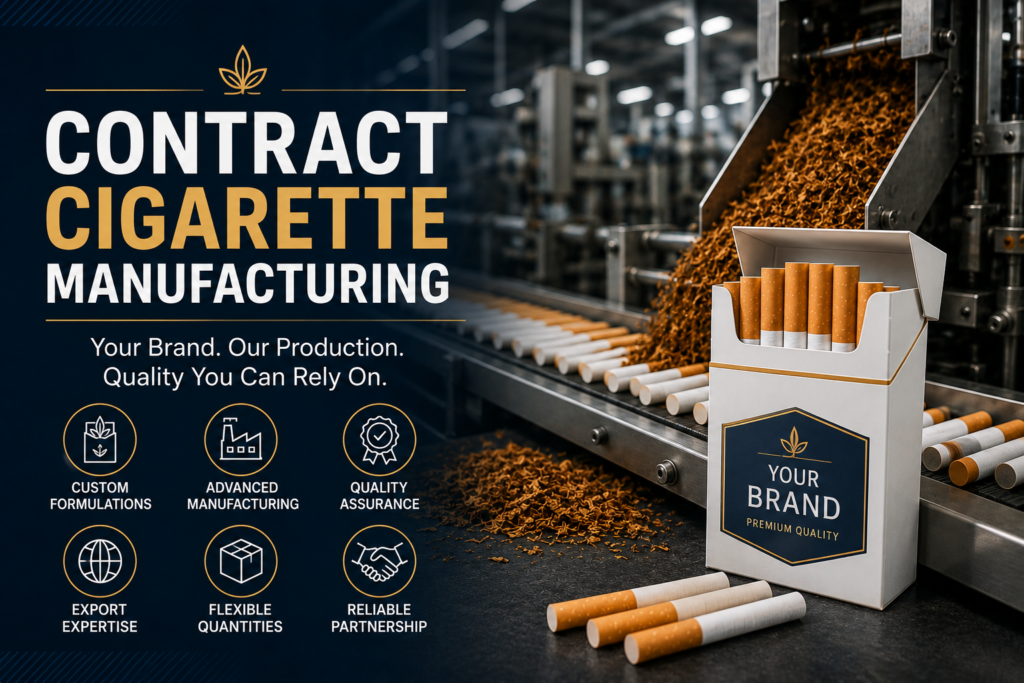
Contract Cigarette Manufacturing Explained
Building a tobacco brand doesn’t require building a factory. For most brand owners and distributors, partnering with a contract cigarette manufacturer is the practical route into production — but understanding what that arrangement actually involves, and what separates a strong manufacturing partner from a weak one, matters before you sign anything.
This guide explains how contract manufacturing works, what it typically includes, and how to evaluate a potential manufacturing partner.
What Contract Manufacturing Actually Means
Contract manufacturing is an arrangement where a factory produces cigarettes on behalf of a brand owner, under a formal agreement covering specifications, volume, quality standards, and delivery. It’s a broad umbrella term — it can range from producing a brand’s existing formulation at scale, to full OEM manufacturing where the product is built to entirely custom specifications.
What defines it isn’t the level of customization, but the structure: the brand owner sets the requirements and owns the brand, while the manufacturing partner owns the production process, equipment, and compliance.
How a Contract Manufacturing Arrangement Typically Works
- Specification — the brand owner defines what’s needed: blend profile, format, packaging, target markets, and volume.
- Sourcing and quoting — the manufacturer confirms feasibility, provides pricing, minimum order quantities, and lead times.
- Sampling — production samples are developed and reviewed before committing to a full run, giving the brand owner a chance to request adjustments.
- Production run — the agreed volume is manufactured under the factory’s quality-control process.
- Compliance and documentation — export paperwork, product testing (where required), and labeling compliance are handled in parallel with production.
- Shipping and delivery — finished product is packed, cased, and shipped according to the agreed terms.
A dependable manufacturing partner should be able to walk through each of these stages clearly, with realistic timelines attached to each one.
Why Brand Owners Choose Contract Manufacturing
No capital investment in production infrastructure. Building and licensing a cigarette factory is a significant undertaking; contract manufacturing avoids that entirely.
Access to established compliance systems. An experienced tobacco manufacturer already has the licensing, export registration, and quality-control processes in place — infrastructure that would otherwise take years to build independently.
Scalability. A brand can start with a smaller production run and scale volume as demand grows, without the fixed overhead of owning a factory.
Speed to market. Working with an existing cigarette supplier that already has functioning production lines is almost always faster than building manufacturing capability from scratch.
Contract Manufacturing vs. OEM vs. Private Label
These terms overlap, and it’s worth being precise about which one you’re actually looking for:
- Contract manufacturing is the broadest term — any arrangement where a factory produces on your behalf, whether from an existing formulation or a fully custom one.
- OEM manufacturing sits inside that umbrella and specifically means the product is built to your exact custom specifications from the ground up.
- Private label also sits inside the umbrella, but starts from an existing formulation that’s rebranded rather than built from zero.
If you’re not sure which of these fits your project, the manufacturer you’re talking to should be able to help you figure that out based on your budget, timeline, and how differentiated you want the final product to be.
What Separates a Strong Manufacturing Partner From a Weak One
- Transparency on capacity and lead times. A manufacturer that gives specific, consistent numbers rather than vague reassurances.
- Willingness to share compliance documentation. Licensing, export registration, and quality certifications should be available on request, not treated as confidential.
- A real sampling process. You should see and approve a sample before a full production run begins, not be asked to commit sight-unseen.
- Export track record in your target markets. A manufacturing partner with genuine experience shipping to your specific region will know the documentation and customs process in detail.
- Clear communication throughout. How a factory communicates during the sales process is usually a preview of what working together will be like once you’re in production.
Questions to Ask a Potential Manufacturing Partner
- What’s your production capacity, and how do you handle larger or repeat orders?
- Can you walk me through your quality-control process?
- What’s a realistic timeline from specification to first shipment?
- Which markets have you exported to, and can you share documentation examples?
- What happens if a production run doesn’t meet the agreed specification?
Frequently Asked Questions
Is contract manufacturing the same as OEM manufacturing?
Not exactly — contract manufacturing is the broader category, and OEM is a specific type of contract manufacturing arrangement built entirely to custom specifications.
How long does it take to start production with a contract manufacturer?
This depends on the complexity of the order, but expect the process — specification, sampling, and setup — to take longer for a fully custom product than for one based on an existing formulation.
What documentation should a contract manufacturer provide?
At minimum, manufacturing licensing, export registration, and compliance documentation for your target market. A manufacturer that can’t produce these on request is a significant red flag.
Can a contract manufacturer handle packaging and branding too?
Many can, either in-house or through established packaging partners — worth confirming directly, since it affects both cost and lead time.
Final Thoughts
Contract manufacturing gives brand owners and distributors a practical path into cigarette production without the cost and complexity of building a factory. The partnership works best when the manufacturer is transparent about capacity, compliance, and process from the first conversation — vagueness on any of those fronts is worth treating as a warning sign.
Orchid Cigarettes Dubai provides contract cigarette manufacturing from its Jebel Ali Free Zone facility, covering everything from specification through to export-ready shipment for brand owners and distributors worldwide.
Ready to Talk to a Manufacturer?
Tell Orchid Cigarettes Dubai about your brand, your target market, and the format you have in mind. Their team will come back with formats, quantities, and realistic timing — no obligation.
note: This article is intended for informational purposes for brand owners, distributors, and industry professionals evaluating manufacturing partners. It does not promote or encourage tobacco use. Tobacco products carry significant health risks, and readers should refer to public health guidance regarding those risks.