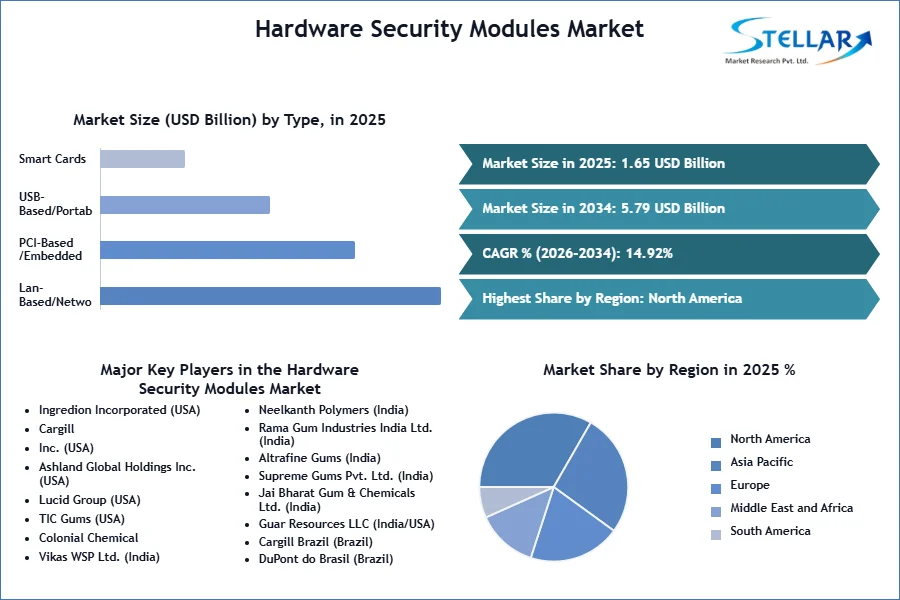
The global Hardware Security Modules (HSMs) Market at USD 1.65 billion in 2025 and forecasts a remarkable expansion to USD 5.79 billion by 2034, registering a compound annual growth rate (CAGR) of 14.92%. As enterprise digital transformation deepens, rising cybersecurity threats, complex zero-trust requirements, and the impending transition to post-quantum cryptography (PQC) are catapulting cryptographic hardware security to the core of enterprise risk mitigation.
The modern threat landscape has shifted from perimeter-based defense to data-centric security, rendering traditional software-based key storage vulnerable to advanced persistent threats. Enterprises across banking, financial services, and insurance (BFSI), government, cloud infrastructure, and automotive sectors are rapidly overhauling their trust architectures. Hardware security modules act as the uncompromised physical root of trust, safely generating, managing, and storing cryptographic keys.
Key Findings from the Report
-
Valuation & Growth Trajectory: The global Hardware Security Modules market is valued at USD 1.65 billion in 2025, surging to a projected USD 5.79 billion by 2034 at a 14.92% CAGR.
-
Deployment Dynamics: On-premise deployments continue to anchor the market due to stringent regulatory compliance and defense-grade isolation needs, while cloud-based and managed HSM services represent the fastest-growing delivery paradigm.
-
Application Leadership: Payment processing and transaction security retain the largest application share, propelled by non-negotiable PCI DSS standards and explosive instant-payment volumes.
-
Regional Dominance: North America captured the leading revenue share of approximately 37.4% in 2025, anchored by extensive zero-trust enterprise rollouts and federal cybersecurity mandates.
-
Emerging Growth Hub: The Asia-Pacific region exhibits the fastest-growing regional CAGR, stimulated by national digital identity initiatives, sovereign data localization laws, and rapid fintech expansion in India, China, and ASEAN nations.
-
End-Use Vertical Breakdown: The BFSI sector remains the dominant end-use consumer of hardware security modules, closely followed by government defense agencies and fast-scaling cloud service providers.
-
Investment Relevance: Venture capital and corporate investments are increasingly targeting vendors offering hybrid classical/post-quantum firmware compatibility and AI-augmented cryptographic orchestration layers.
For further information, click the following link:https://www.stellarmr.com/report/req_sample/hardware-security-modules-market/2829
Market Drivers and Restraints
Drivers
-
Proliferation of Zero-Trust Architectures: As enterprises embrace zero-trust frameworks, verifying every user, device, and API call requires robust cryptographic signing and validation, fueling continuous demand for dedicated hardware cryptographic anchors.
-
Explosion of Digital Payments & E-Signatures: The rapid shift toward cashless economies, instant payment rails (such as UPI and Pix), and legally binding electronic signatures demands fault-tolerant transaction security managed exclusively through certified HSM modules.
-
Sovereign Data Protection Mandates: Governments worldwide are enforcing strict data residency laws, compelling multinational corporations and local financial institutions to deploy localized hardware modules to retain absolute ownership of encryption keys.
Restraints
-
High Initial Capital Expenditure (CapEx) and Integration Friction: Deploying enterprise-grade on-premise hardware security appliances entails substantial upfront hardware expenses and specialized engineering expertise, posing budgeting hurdles for mid-market firms.
-
Shortage of Specialized Cryptographic Talent: Managing advanced Public Key Infrastructure (PKI) and complex HSM clusters requires specialized DevSecOps professionals, and a widening cybersecurity skills gap can delay project deployments.
Technology, Regulation, and Sustainability Trends
The HSM ecosystem is undergoing a generational tech-stack evolution. Post-Quantum Cryptography (PQC) readiness has transitioned from a theoretical concept to an immediate roadmap requirement; vendors are deploying hybrid crypto algorithms that support both legacy RSA/ECC and quantum-resistant lattice-based cryptography. On the regulatory front, frameworks like the Digital Operational Resilience Act (DORA) in Europe and evolving PCI SSC standards hold financial entities directly accountable for cryptographic resilience.
From an operational and ESG perspective, next-generation hardware designs prioritize energy-efficient silicon processing and modular consolidation. This reduces the power footprint of dense data center racks while extending hardware lifecycles through secure firmware update channels.
Regional Insights
-
North America: Leading the global market with a 37.4% revenue share in 2025, North America’s growth is sustained by aggressive federal compliance requirements (such as FIPS 140-3 standards), widespread cloud adoption, and heavy enterprise investment in proactive threat intelligence.
-
Asia-Pacific: Poised as the fastest-growing regional market, Asia-Pacific benefits from massive domestic digitization programs. China’s enforcement of indigenous cryptographic standards (SM2/SM3/SM4) alongside India’s high-velocity digital payment ecosystem creates continuous, localized demand for certified HSM appliances.
-
Europe, Middle East & Africa (EMEA): Driven by stringent compliance directives like eIDAS 2.0 and the Digital Operational Resilience Act (DORA), European enterprises are aggressively modernizing legacy key management systems to secure cross-border financial transactions and sovereign cloud workloads.
Recent Industry Developments
-
Thales (2025): Launched an advanced cloud-native hardware security module integration layer, enabling a 35% reduction in multi-tenant deployment times for tier-1 financial institutions migrating workloads to sovereign clouds.
-
Utimaco (2025): Expanded its APAC operational footprint via a strategic partnership with regional cybersecurity distributors, boosting localized delivery capacity for quantum-safe enterprise HSM appliances by 40%.
-
Fortanix (2025): Unveiled an AI-driven cryptographic orchestration platform integrated with hardware-anchored confidential computing enclaves, securing a 50% efficiency gain in enterprise machine learning model protection.
-
Yubico & Hardware Security Collaboration (2026): Announced a major joint cryptographic integration initiative aimed at bridging portable hardware authenticators with enterprise-grade cloud HSMs, streamlining zero-trust login security for over 2,000 global enterprises.
-
Atos / Eviden (2026): Secured a major European government defense contract for high-assurance network encryption modules, providing a quantified boost to its sovereign security division’s regional deployment capacity.
Competitive Landscape
The global Hardware Security Modules market features a consolidated yet intensely competitive landscape dominated by established technology leaders such as Thales Group, Utimaco IS GmbH, Atos (Eviden), Futurex, Securosys, IBM Corporation, and Marvell Technology. Leading players are aggressively pursuing mergers, acquisitions, and strategic technology partnerships to integrate cloud-native SaaS capabilities into traditional hardware portfolios. Competitors are heavily differentiating through FIPS 140-3 Level 3/4 compliance certifications, crypto-agile software development kits (SDKs), and specialized firmware tailored for blockchain asset custody and AI data protection.
Analyst Commentary
“The hardware security module is no longer a back-office utility reserved exclusively for banking ledgers; it is the fundamental anchor of digital trust in an interconnected economy,” said a Senior Research Analyst at Stellar Market Research. “As enterprises race toward multi-cloud integration, artificial intelligence deployment, and post-quantum transitions, the organizations that successfully bridge physical root-of-trust hardware with agile cloud orchestration will dominate the next decade of digital resilience.”
Future Outlook
Through the forecast period to 2034, the Hardware Security Modules market is expected to transition decisively toward hybrid deployment models, where centralized physical hardware anchors coordinate seamlessly with decentralized edge and cloud-native micro-services. Driven by the mandatory migration to post-quantum standards and the explosive adoption of automated IoT and AI workloads, demand will increasingly favor crypto-agile appliances capable of adapting to emerging cryptographic algorithms without physical hardware replacement. Competition will hinge on API-first developer usability, frictionless compliance reporting, and turnkey integration with digital asset and sovereign cloud infrastructures.
For further information, click the following link:https://www.stellarmr.com/report/req_sample/hardware-security-modules-market/2829
About Stellar Market Research
Stellar Market Research is a multifaceted market research and consulting company with professionals from several industries. Some of the industries we cover include medical devices, pharmaceutical manufacturers, science and engineering, electronic components, industrial equipment, technology and communication, cars and automobiles, chemical products and substances, general merchandise, beverages, personal care, and automated systems. To mention a few, we provide market-verified industry estimations, technical trend analysis, crucial market research, strategic advice, competition analysis, production and demand analysis, and client impact studies.
Address
Phase 3, Navale IT Zone, S.No. 51/2A/2, Office No. 202, 2nd floor, Near, Navale Brg, Narhe, Pune, Maharashtra 411041
Email
sales@stellarmr.com
Mobile
+91 9607365656