Skin cancer is one of the most prevalent forms of cancer globally, yet it is also one of the most preventable and treatable when identified in its infancy. Because our skin is completely visible, it gives us a unique advantage: the ability to spot warning signs long before the disease advances.
However, many people mistake early malignant lesions for harmless freckles, pimples, or age spots. Recognizing the subtle, early warnings of skin cancer is an essential skill that can quite literally save your life.
In this comprehensive, evidence-based guide, you will discover the exact visual markers and physical symptoms that warrant immediate medical evaluation, how to conduct a proper self-examination, and the best practices for clinical prevention.
What is Skin Cancer?
Skin cancer is the abnormal, uncontrolled growth of skin cells, most commonly triggered by DNA damage from ultraviolet (UV) radiation emitted by the sun or indoor tanning beds. This cellular mutation disrupts the natural life cycle of the skin, causing cells to multiply rapidly and form malignant tumors.
The three primary types of skin malignancies include:
- Basal Cell Carcinoma (BCC): The most common and least aggressive form, typically presenting as a pearly or waxy bump.
- Squamous Cell Carcinoma (SCC): A fast-growing variant that often manifests as a firm, red nodule or a rough, scaly patch.
- Melanoma: The most aggressive and dangerous form of skin cancer, which develops in the pigment-producing cells (melanocytes) and can rapidly metastasize to other organs if left untreated.
7 Early Warning Signs You Must Watch For
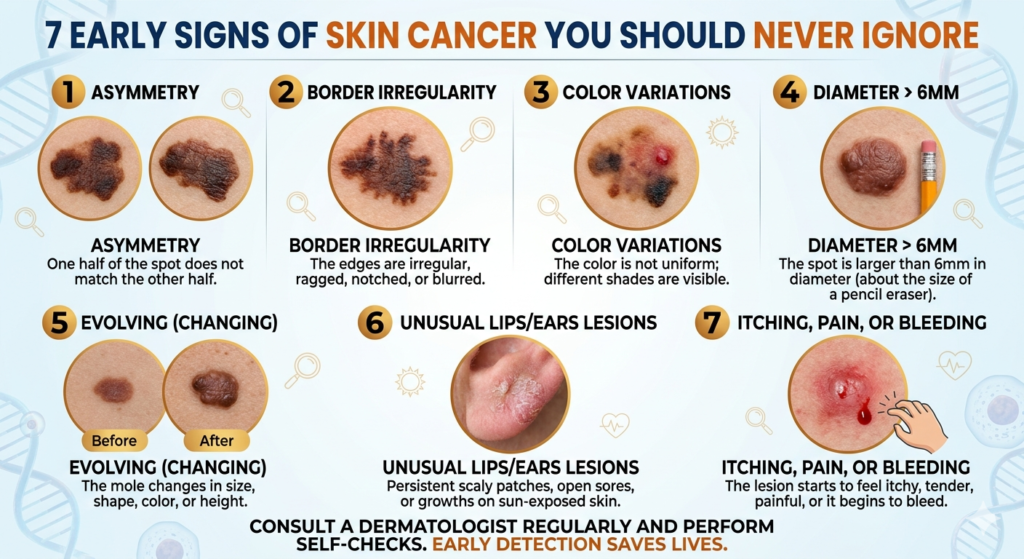
To help catch anomalies early, medical professionals rely on specific clinical indicators. Here are the seven most critical symptoms to monitor during your monthly self-exams.
1. Asymmetry in Moles (The “A” of Melanoma)
Healthy, benign moles are typically symmetrical. If you were to draw an imaginary line directly through the center of a normal spot, both halves would perfectly mirror each other. A key warning sign of melanoma is asymmetry, where one half of the lesion looks distinctly different in shape, thickness, or structure from the other half.
2. Irregular or Jagged Borders (The “B”)
Pay close attention to the perimeter of your skin markings. Benign moles possess smooth, well-defined, and even borders. If a spot displays edges that are ragged, notched, blurred, scalloped, or poorly defined, it indicates uneven cellular growth pushing outward into the surrounding tissue.
3. Multiple or Shifting Colors (The “C”)
A safe freckle or mole is usually a uniform shade of tan, brown, or black. A primary indicator of skin cancer is color variation. A single suspicious lesion may feature a blotchy mix of different shades, or exhibit patches of unexpected colors like red, pink, white, blue, or slate grey.
4. Expanding Diameter (The “D”)
Historically, guidelines emphasized checking spots larger than 6 millimeters across (roughly the size of a pencil eraser). While most melanomas exceed this size by the time they are diagnosed, modern dermatological standards note that skin malignancies can be smaller when they first emerge. The modern “D” rule focuses heavily on diameter changes; any spot that is actively expanding should be looked at immediately.
5. An Evolving or Changing Spot (The “E”)
Evolution is widely considered the most critical warning sign of all. A mole that has remained stable for decades but suddenly begins to change in size, shape, color, or elevation requires rapid clinical checking. This includes the development of new physical sensations like localized itching, tingling, tenderness, or pain.
6. A Sore That Fails to Heal
Your body’s skin cells regenerate quickly. If you have an open sore, cut, or lesion that continuously bleeds, oozes, crusts over, and scabs but fails to completely heal within three to four weeks, it could be a basal or squamous cell carcinoma. These lesions often seem to heal temporarily, only to break open and bleed again in the exact same spot.
7. The “Ugly Duckling” Sign
Most benign moles on an individual’s body tend to look similar to one another, sharing a common pattern. The “ugly duckling” sign is a clinical concept describing a standalone lesion that completely deviates from your body’s typical pattern. Whether it is darker, lighter, larger, or more raised than all your other spots, a lesion that stands out as unique demands an expert evaluation.
Frequently Asked Questions
What does the early stage of skin cancer feel like?
In most cases, early-stage skin cancer is entirely painless and cannot be felt. However, as the lesion alters the surrounding skin tissue, it may begin to itch, hurt, crust over, or feel unusually tender and rough to the touch.
Can you get skin cancer in areas not exposed to the sun?
Yes. While UV exposure is the primary driver, skin malignancies can develop on areas completely hidden from sunlight, including the soles of the feet, the palms of the hands, under the fingernails, the scalp, and the genital regions. This is why comprehensive, head-to-toe self-exams are vital.
How fast does melanoma grow and spread?
The growth rate depends heavily on the subtype. For instance, superficial spreading melanoma grows horizontally across the skin surface over months or years before penetrating deeper. Conversely, nodular melanoma is a highly aggressive variant that grows vertically into the deeper layers of the skin within a matter of weeks, appearing as a firm, dome-shaped bump.
Is a bleeding mole always a sign of cancer?
Not necessarily. A healthy mole can bleed if it is scratched, irritated by clothing, or caught on jewelry. However, a mole that begins bleeding spontaneously without any physical trauma or friction is a major red flag that requires a professional assessment.
Conclusion
When dealing with skin cancer, time is your most valuable asset. Memorizing the ABCDE framework and watching for persistent, unhealing sores or “ugly duckling” spots empowers you to intercept dangerous cell changes before they become life-threatening.