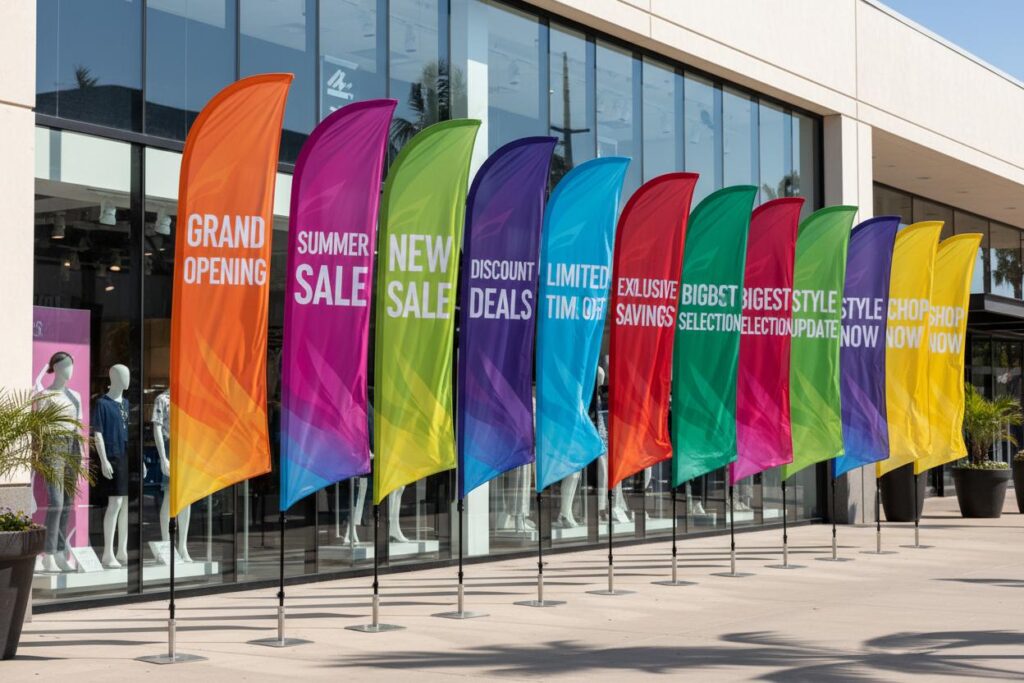
Custom flags are used by businesses, event organisers, retailers, sports clubs, and community groups to communicate messages in a simple, visible format. They can mark an entrance, guide visitors towards a stand, display a company logo, or help people identify a location from a distance. The right flag depends on where it will be placed, how often it will be used, and the message it needs to communicate.
In Dubai, flags are common at exhibitions, outdoor promotions, shopping areas, sporting events, and corporate gatherings. Choosing a suitable design involves more than selecting colours and adding a logo. Material, shape, printing method, stand type, and weather conditions all influence how well a flag performs.
What Is a Flag Store?
A flag store is a business or supplier that offers flags for personal, commercial, promotional, or event use. Depending on its services, it may provide ready-made flags, custom-printed designs, display poles, bases, and related accessories.
A custom flag allows the design to reflect a specific purpose. A business may display its logo and brand colours, while an event organiser might use directional messages or sponsor graphics. Before ordering, buyers should identify the intended use and ask which flag styles, materials, and display systems are available.
Searching for a flag store that offers different flag formats can help buyers compare options for exhibitions, storefronts, outdoor advertising, and other business applications. The important step is to match the product to the setting rather than choosing a style based on appearance alone.
Common Types of Custom Flags
Different flag shapes are designed for different display conditions. Understanding their features helps businesses select a practical option.
1. Feather Flags
Feather flags have a tall, curved shape that resembles a feather. They are often used outside shops, restaurants, car dealerships, event venues, and temporary promotional spaces.
Their vertical layout provides space for a logo, short message, or simple graphic. Because the available printing area is relatively narrow, large text and clear visual elements usually work better than detailed paragraphs.
Feather flags can be useful when a business needs to attract attention near an entrance or along a pedestrian route.
2. Sail Flags
Sail flags have a curved, sail-like outline and are commonly used for outdoor promotions, trade shows, and roadside displays. Their shape creates a distinctive silhouette that can help a display stand out among nearby signs.
They work well with concise branding, product imagery, and short promotional messages. Buyers should check the overall height, base options, and installation requirements before placing an order.
3. Teardrop Flags
Teardrop flags have a rounded upper section and a narrower lower end. Their tensioned shape can help maintain a recognisable outline when displayed correctly.
They are frequently considered for sporting events, exhibitions, outdoor campaigns, and temporary promotional areas. As with other tall flags, the available base should suit the surface where the flag will be installed.
4. L-Shape Flags
L-shape flags use a frame that supports the fabric in an L-like form. This structure can provide a different visual layout from conventional vertical flags and may suit certain event displays or branded spaces.
The frame design, dimensions, and mounting system should be checked before ordering to ensure the finished flag suits its intended location.
5. Traditional and Custom-Shaped Flags
Rectangular flags remain useful for company identities, national displays where permitted, indoor decoration, and event branding. Some projects may also require special dimensions or shapes to fit a particular structure.
For custom designs, buyers should confirm whether the supplier can produce the requested dimensions and whether the artwork will be printed on one side or both sides.
Where Are Custom Flags Used?
Custom flags serve several purposes across different industries.
- Retail stores: Flags can identify entrances, highlight seasonal promotions, or direct customers towards a temporary display.
- Exhibitions and trade shows: Branded flags help visitors recognise a company’s stand from a distance.
- Outdoor events: Organisers can use flags to mark registration areas, activity zones, or sponsor locations.
- Restaurants and cafés: Flags may draw attention to a storefront or communicate a simple offer.
- Real estate: Property teams may use flags to identify sales offices, open-house locations, or development launches.
- Sports and community activities: Clubs and organisers can use flags for team identity, event information, or wayfinding.
In busy commercial areas of Dubai, visibility depends on the surroundings. A flag positioned among many signs may need stronger contrast and a simpler message than one displayed in an open space.
How to Choose the Right Flag
Consider the Display Location
Start by deciding whether the flag will be used indoors or outdoors. Indoor flags may prioritise appearance and fit, while outdoor flags need suitable fabric, a stable support, and a base appropriate for the surface.
For outdoor use, consider wind exposure, nearby pedestrian movement, and available space. A flag that fits comfortably outside a building may be unsuitable for a narrow walkway or crowded entrance.
Select Suitable Materials
Flag fabric should be chosen according to the display environment and expected frequency of use. Lightweight polyester is commonly used for many promotional flag applications because it can support printed graphics and is easy to handle.
For outdoor displays in Dubai, ask about fabric durability, colour retention, stitching, and the supplier’s recommendations for sun and wind exposure. No fabric should be assumed to remain unchanged indefinitely under harsh conditions.
Check the Printing Method
The printing method influences colour appearance, design detail, and suitability for the selected material. Dye-sublimation is commonly used for polyester flags, while other processes may be suitable for different fabrics or production requirements.
Ask for a proof before production. Check logo proportions, text spelling, colour contrast, and how the artwork will appear on the finished flag. If the design will be visible from both sides, clarify whether the flag will use single-sided printing, a blockout layer, or another construction method.
Choose the Correct Size and Base
A tall flag may be visible from farther away, but it also needs adequate clearance and a suitable support system. Smaller flags may be more practical in confined spaces or near tables and indoor displays.
Base selection is equally important. Ground spikes, cross bases, and weighted bases serve different purposes and are not interchangeable in every setting. Follow the supplier’s installation guidance, especially for exposed outdoor locations.
Common Mistakes to Avoid When Ordering Flags
Several simple checks can prevent problems after delivery.
- Using too much text: Keep the message short enough to read while walking or driving past.
- Ignoring viewing distance: Small details and thin fonts may disappear when viewed from far away.
- Choosing a base too late: Confirm the installation surface before selecting the display system.
- Overlooking artwork requirements: Ask about file formats, resolution, bleed, and safe margins.
- Ordering without checking dimensions: Review the complete height, including the pole and base, rather than the fabric alone.
- Ignoring maintenance: Follow cleaning and storage instructions, and inspect poles, stitching, and fittings regularly.
Businesses comparing printing and display options can also review the range of printing services available from Zahrat Al Madina Printing when planning branded materials for a campaign or event.
Conclusion
Choosing a custom flag begins with a clear understanding of its purpose, location, and expected use. Feather, sail, teardrop, L-shape, and traditional flags each offer different design possibilities, while material, printing quality, size, and base selection affect the final result.
For businesses and event organisers in Dubai, a short, readable message and a flag suited to the display environment are usually more useful than an overly complicated design. By checking artwork, dimensions, installation requirements, and material suitability before ordering, buyers can make a more informed choice and get greater practical value from their flags.