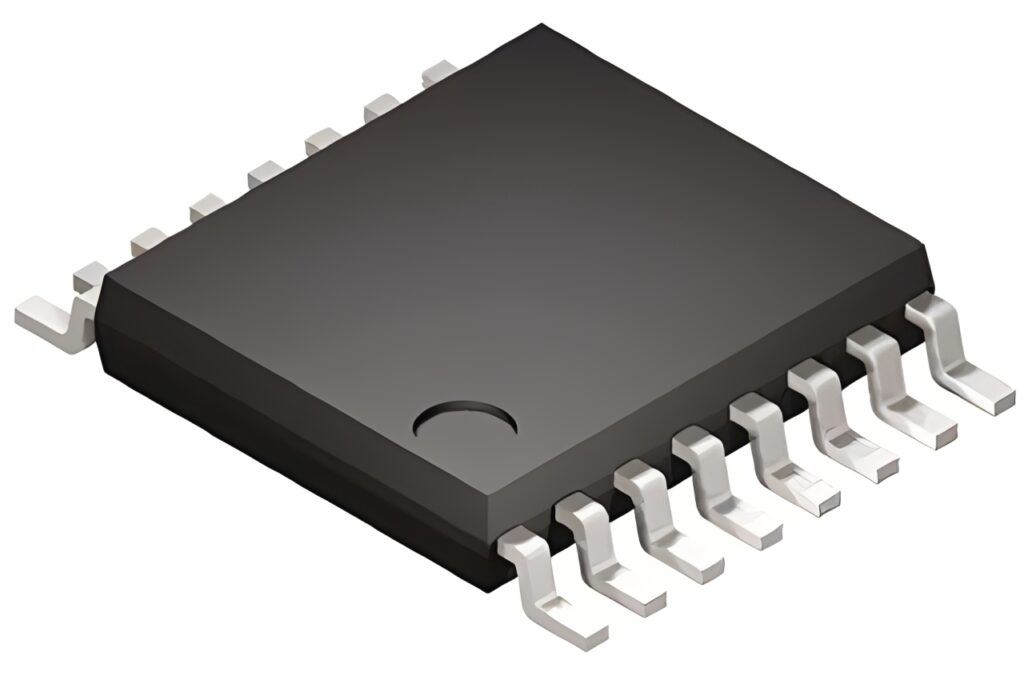
General Purpose DACs
Electronic systems increasingly depend on digital processing, yet the physical world still operates through continuously changing quantities such as voltage, current, temperature, pressure, sound, speed and position. General Purpose DACs provide one of the most important links between these two environments by converting digital information into controlled analogue signals.
A General Purpose Digital-to-Analogue Converter takes numerical data from a processor, microcontroller, FPGA or control system and produces a corresponding electrical output. That output may be used to adjust a reference voltage, control an actuator, regulate a power stage, create a test signal or influence another analogue circuit.
Unlike specialised converters designed exclusively for high-end audio, ultra-fast communications or scientific instrumentation, General Purpose DACs are intended to deliver a balanced combination of accuracy, flexibility, speed, integration and cost. This makes them useful across an enormous range of industrial, commercial and embedded electronic applications.
Understanding how these devices operate, which specifications matter and where they add value can help engineers select a suitable DAC for reliable and efficient system design.
What Role Do General Purpose DACs Play in Electronic Systems?
Digital processors are designed to manipulate discrete numerical values. They can calculate, store, compare and communicate data with impressive speed, but many electrical devices cannot operate from binary information alone.
A variable-speed actuator, for example, may need a continuously adjustable control voltage. A calibration instrument may require an accurately programmed reference level. A power supply may need its output changed dynamically according to software instructions.
General Purpose DACs solve this problem.
They receive digital codes and translate them into analogue outputs that external circuits can understand.
Their role can therefore be described as a bridge between digital intelligence and analogue action.
Typical functions include:
- Generating programmable voltage references
- Adjusting current levels
- Controlling analogue amplifiers
- Setting thresholds
- Simulating sensor signals
- Regulating industrial process equipment
- Creating low-frequency waveforms
- Controlling bias conditions
- Adjusting programmable power stages
- Supporting automated testing
This broad functionality explains why DACs appear in everything from compact embedded products to sophisticated industrial control platforms.
How Does a General Purpose DAC Perform Digital-to-Analogue Conversion?
A DAC receives a binary number and maps that value to an analogue output range.
Suppose a converter operates from zero volts to a defined full-scale voltage. A low digital value produces an output near the bottom of that range, while a higher code produces a larger output.
The converter divides the available analogue span into many individual levels.
The number of levels depends primarily on resolution.
Internally, different DAC architectures may use resistor networks, switched current sources, capacitor arrays or other circuit techniques. Although the implementation can vary considerably, the basic objective remains consistent: produce an analogue value that accurately corresponds to the incoming digital code.
A processor can therefore update the DAC repeatedly and create an analogue output that changes under software control.
This makes DACs especially valuable when a design needs repeatability and programmability rather than manual adjustment.
Why Is Resolution Important in General Purpose DACs?
Resolution is one of the first specifications engineers examine.
It describes how many unique output levels the DAC can represent.
Common resolutions include:
- 8-bit
- 10-bit
- 12-bit
- 14-bit
- 16-bit
- 18-bit and above for more specialised requirements
An 8-bit DAC has 256 possible digital codes, while a 12-bit converter offers 4,096. A 16-bit device provides 65,536 possible values.
Higher resolution allows smaller changes between neighbouring output levels.
This can be useful in systems that require fine adjustment, such as precision control, calibration or programmable instrumentation.
However, resolution should never be treated as a complete measure of quality.
A converter may provide a high bit count but still deliver limited practical performance if noise, linearity, offset or reference instability is significant.
The right choice depends on how much usable precision the application actually needs.
What Is the Difference Between Resolution, Accuracy and Precision?
These terms are often used together, but they describe different aspects of DAC performance.
Resolution defines how small a theoretical output step can be.
Accuracy describes how close the actual analogue output is to the expected value.
Precision relates to the consistency and repeatability of the output.
A high-resolution converter does not automatically guarantee high accuracy.
For example, a 16-bit DAC may be capable of extremely small digital steps, but if its offset error, gain error or reference drift is large, the real output may not match the ideal value closely.
Engineers therefore need to evaluate several specifications together.
Important accuracy-related parameters include:
- Offset error
- Gain error
- Integral non-linearity
- Differential non-linearity
- Temperature drift
- Reference accuracy
- Output noise
These factors help determine the real-world performance of the converter.
Why Does Integral Non-Linearity Matter?
Integral non-linearity, commonly abbreviated as INL, describes how far the actual DAC transfer curve deviates from an ideal straight line.
In a perfect DAC, every digital code would produce exactly the expected analogue level.
Real devices always exhibit some deviation.
Low INL is particularly important in systems where the absolute relationship between digital code and analogue output must remain predictable.
This can matter in:
- Calibration systems
- Precision instrumentation
- Automated test equipment
- Measurement electronics
- Process-control systems
In simpler applications, such as basic brightness adjustment or general-purpose control, extremely low INL may be less important.
What Does Differential Non-Linearity Tell Engineers?
Differential non-linearity, or DNL, describes the difference between an actual output step and the ideal step size.
If the output increments vary too much, the converter may not behave smoothly across its range.
Poor DNL can also affect monotonicity.
A monotonic DAC always changes output in the expected direction as the digital code changes. If the digital input increases, the output should never unexpectedly decrease.
Monotonic behaviour is especially important in feedback and control applications where an incorrect output direction could disturb system stability.
How Do General Purpose DACs Support Embedded Electronics?
Embedded systems often need to control analogue functions even though their main processor works digitally.
Some microcontrollers include internal DACs, but external General Purpose DACs are often chosen when the system requires:
- Higher resolution
- More output channels
- Better accuracy
- Greater voltage flexibility
- Lower noise
- Improved temperature performance
- Specific communication interfaces
An external converter can significantly expand the capabilities of an embedded platform.
Possible uses include:
- Adjusting sensor excitation
- Setting comparator thresholds
- Controlling amplifier gain
- Varying LED current
- Generating reference voltages
- Tuning analogue filters
- Controlling motor drivers
- Programming power supply outputs
The result is a more flexible system that can change analogue behaviour through firmware rather than hardware modification.
Where Are General Purpose DACs Used in Industrial Automation?
Industrial systems are heavily dependent on controlled analogue signals.
A programmable controller may need to operate a valve, variable-speed drive, actuator or other process device using a continuously variable command.
General Purpose DACs can generate the required electrical level based on digital instructions from the control system.
They may be used in:
- Factory automation
- Process control
- Motion systems
- Equipment monitoring
- Robotics
- Material handling
- Laboratory automation
- Production test platforms
The key advantage is programmability.
Instead of relying on fixed analogue circuits, the control system can adjust outputs dynamically in response to sensors, schedules, operating modes or user settings.
How Are DACs Used in Programmable Power Supplies?
Programmable power systems are another important application.
A DAC can provide a control voltage to a regulator or feedback circuit, allowing the output voltage or current to be changed digitally.
This approach is useful in:
- Bench power supplies
- Battery chargers
- Battery test systems
- Electronic loads
- Automated manufacturing equipment
- Laboratory power platforms
Software can command a new operating point, and the DAC updates the control signal accordingly.
This makes the power system easier to automate, monitor and integrate into larger test environments.
In precision designs, the stability of the DAC and voltage reference can directly influence the quality of the regulated output.
Why Are General Purpose DACs Valuable in Test and Measurement?
Test equipment often needs to generate known electrical conditions.
A General Purpose DAC can create programmable voltage levels for evaluating other circuits.
This can help engineers simulate:
- Sensor outputs
- Control voltages
- Reference signals
- Threshold levels
- Bias conditions
- Equipment operating points
Automated test systems can cycle through many DAC values without manual adjustment.
That improves repeatability and allows large numbers of measurements to be performed consistently.
DACs are therefore useful in development laboratories, manufacturing test stations and calibration systems.
How Can DACs Simulate Sensors?
Many sensors output analogue voltages representing physical conditions.
During development or testing, using a real sensor may not always be practical.
A DAC can imitate the sensor by generating controlled voltages that correspond to different operating conditions.
For example, a test system could produce a series of analogue levels representing low, normal and high sensor readings.
The equipment under test can then be checked to confirm that it responds correctly.
This method is useful because it allows engineers to reproduce exact conditions whenever needed.
What Is the Importance of the DAC Reference Voltage?
Many DACs use a reference voltage to determine their analogue output scale.
The quality of this reference can strongly affect overall performance.
If the reference changes with temperature, load or electrical noise, the DAC output may change as well.
Some General Purpose DACs contain an internal reference, while others rely on an external device.
Internal references offer advantages such as:
- Simpler circuit design
- Fewer external components
- Smaller PCB area
- Easier system integration
External references may provide:
- Better accuracy
- Lower noise
- Improved temperature stability
- Greater control over the full-scale output range
The appropriate choice depends on the precision requirements of the application.
Why Does Settling Time Matter?
When a new digital value is written to a DAC, the output requires a small amount of time to reach its final level.
This period is known as settling time.
A short settling time is important when the DAC must change values rapidly.
Applications that may require faster settling include:
- Automated testing
- Dynamic signal generation
- Closed-loop control
- Rapid calibration
- Scanning systems
- Multi-channel control
By contrast, a system that adjusts a reference voltage only occasionally may tolerate a slower converter.
Choosing an unnecessarily fast DAC can increase cost or power consumption without providing useful benefit.
What Is Glitch Energy in DAC Performance?
When the digital input transitions between certain codes, several internal switching elements may change state simultaneously.
This can briefly produce an unwanted output transient.
The resulting disturbance is commonly associated with DAC glitch energy.
Glitches may not matter in slowly changing control applications, but they can become important when the output feeds sensitive circuits or changes frequently.
Designers working with waveform generation, precision control or sensitive analogue systems may therefore examine glitch specifications carefully.
Why Are SPI and I²C Interfaces So Common?
General Purpose DACs frequently communicate with processors using serial interfaces.
SPI is popular because it supports relatively fast transfers and straightforward communication.
It is often chosen when:
- High update rates are needed
- Several control bytes must be transferred quickly
- Dedicated chip-select lines are available
I²C is attractive when designers want to minimise the number of signal lines.
It allows multiple devices to share a common bus, which can simplify compact embedded systems.
I²C may be useful when:
- PCB space is limited
- Update speed is moderate
- Multiple peripherals need to share the same bus
- Processor I/O availability is restricted
The correct interface depends on the surrounding system architecture rather than the DAC alone.
When Are Parallel-Interface DACs Useful?
Although serial interfaces dominate many modern designs, parallel DACs remain useful in certain applications.
A parallel interface transfers several bits simultaneously, which can reduce communication latency.
This may be useful in systems where extremely rapid updates are required.
Potential applications include:
- High-speed control
- Specialised instrumentation
- Legacy equipment
- Real-time waveform systems
- Direct processor or FPGA interfacing
The disadvantage is that parallel devices require more PCB traces and processor pins.
Designers must therefore balance speed against hardware complexity.
Why Are Multi-Channel DACs Popular?
Many systems need several independently adjustable analogue signals.
Using one DAC per signal may consume excessive board space and increase component count.
Multi-channel DACs integrate several outputs into one device.
They can simplify:
- Industrial controllers
- Multi-axis control systems
- Test equipment
- Programmable bias circuits
- Sensor platforms
- Power management systems
Benefits may include:
- Reduced PCB area
- Lower component count
- Shared communication interfaces
- Easier software management
- Better synchronisation between outputs
Some devices also allow multiple channels to update simultaneously, which can be valuable in coordinated control applications.
How Does Output Drive Capability Affect DAC Selection?
A DAC may produce the correct voltage but still be unable to supply enough current to the connected load.
Output drive capability therefore needs to be considered carefully.
If the load is demanding, engineers may add a buffer amplifier.
A buffer can provide:
- Greater current capability
- Electrical isolation
- Improved load stability
- Output scaling
- Signal filtering
- Bipolar output generation
However, the buffer itself can introduce noise, offset and bandwidth limitations.
The entire signal chain should therefore be evaluated rather than considering the DAC in isolation.
How Can PCB Layout Improve DAC Performance?
Even a high-quality DAC can perform poorly if the PCB design allows excessive noise into sensitive analogue signals.
Good layout practices can make a significant difference.
Useful approaches include:
- Place decoupling capacitors close to power pins
- Keep analogue traces away from high-speed digital lines
- Reduce long signal paths
- Protect reference-voltage connections
- Use suitable grounding techniques
- Separate high-current switching paths from precision circuitry
- Follow manufacturer layout recommendations
- Use clean power rails where practical
These measures become increasingly important as resolution and accuracy requirements increase.
A low-resolution control DAC may tolerate some noise, while a precision 16-bit design may reveal problems that would otherwise go unnoticed.
What Role Does Power Consumption Play?
Power consumption matters particularly in portable, battery-powered and remotely installed systems.
Many General Purpose DACs are available with low-power operating modes.
Some devices can enter shutdown or power-down states when their outputs are not required.
This can benefit:
- Portable instruments
- Wireless sensors
- Battery-operated equipment
- Remote monitoring devices
- Compact embedded controllers
- Internet of Things platforms
Low-power operation should still be evaluated alongside output performance because reducing power may affect settling behaviour or drive capability in certain designs.
What Should Engineers Consider When Selecting General Purpose DACs?
Choosing the right DAC requires looking at the entire application rather than one headline specification.
Important criteria include:
- Resolution
- Accuracy
- Linearity
- Number of channels
- Output voltage range
- Current drive capability
- Reference type
- Settling time
- Update rate
- Glitch performance
- Digital interface
- Supply voltage
- Power consumption
- Temperature range
- Package type
- PCB space
- Cost
The most expensive or highest-resolution converter is not always the best choice.
A well-selected DAC provides enough performance for the application without introducing unnecessary complexity or cost.
How Can General Purpose DACs Improve Product Flexibility?
One of the biggest advantages of DACs is their ability to replace fixed analogue settings with software-controlled values.
This allows products to behave differently without changing the underlying hardware.
A single electronic design may support several operating modes simply by programming different analogue outputs.
Benefits include:
- Easier calibration
- Remote configuration
- Software-defined behaviour
- Reduced manual adjustment
- Improved repeatability
- Faster production testing
- Greater product customisation
This flexibility can also simplify future firmware updates because analogue operating points can sometimes be adjusted without modifying the PCB.
Why Are General Purpose DACs Important for Smart and Connected Devices?
Smart devices often combine digital intelligence with physical control.
A processor may receive information from sensors, communicate over a network and then adjust hardware based on the data.
DACs help complete this control loop by translating digital decisions into analogue outputs.
In connected systems, this can support:
- Remote equipment adjustment
- Adaptive control
- Automatic calibration
- Energy management
- Condition-based operation
- Smart instrumentation
- Programmable industrial equipment
As devices become more intelligent, the need for reliable digital-to-analogue conversion remains strong.
What Are the Advantages of Using General Purpose DACs?
The popularity of General Purpose DACs comes from their balanced combination of features.
Key advantages include:
- Flexible analogue output generation
- Easy integration with microcontrollers
- Multiple resolution choices
- Single and multi-channel options
- Compact packaging
- Programmable control
- Support for industrial and embedded applications
- Availability of low-power devices
- Compatibility with common digital interfaces
- Reduced need for manual analogue adjustment
These benefits allow engineers to build adaptable systems without designing every analogue function from discrete components.
What Challenges Should Designers Keep in Mind?
DAC-based circuits also require careful engineering.
Potential challenges include:
- Electrical noise
- Reference instability
- Output loading
- Temperature drift
- Power supply interference
- Incorrect grounding
- Limited output range
- Interface timing problems
None of these issues necessarily make DACs difficult to use, but ignoring them can reduce performance.
Reviewing datasheets, reference designs and layout recommendations early in the design process can help avoid many common problems.
How Are General Purpose DACs Shaping Future Electronic Design?
Electronics continues to move toward software-defined operation.
Functions that were once controlled through physical adjustments are increasingly managed by processors.
General Purpose DACs support this transition because they allow software to change analogue conditions dynamically.
Future applications are likely to include increasingly intelligent:
- Factory equipment
- Smart sensors
- Energy systems
- Laboratory instruments
- Robotics
- Autonomous equipment
- Connected control systems
- Programmable electronics
Even as digital processing becomes more powerful, real-world hardware will continue to rely on analogue voltages and currents.
That ensures an ongoing role for reliable DAC technology.
Conclusion
General Purpose DACs are fundamental components for converting digital information into usable analogue outputs. They allow microcontrollers, processors and programmable systems to control voltages, currents, references, actuators and other analogue functions with accuracy and repeatability.
Their versatility makes them suitable for industrial automation, test and measurement equipment, programmable power systems, embedded electronics, sensor simulation and many other applications.
Selecting the right device involves more than checking bit resolution. Accuracy, linearity, settling time, reference stability, communication interface, output capability, power consumption and PCB design all contribute to overall performance.
When these factors are considered carefully, General Purpose DACs provide an efficient way to create flexible, programmable and dependable electronic systems. As digital control continues to expand across modern technology, these converters will remain an essential connection between digital processing and the analogue world.