Introduction
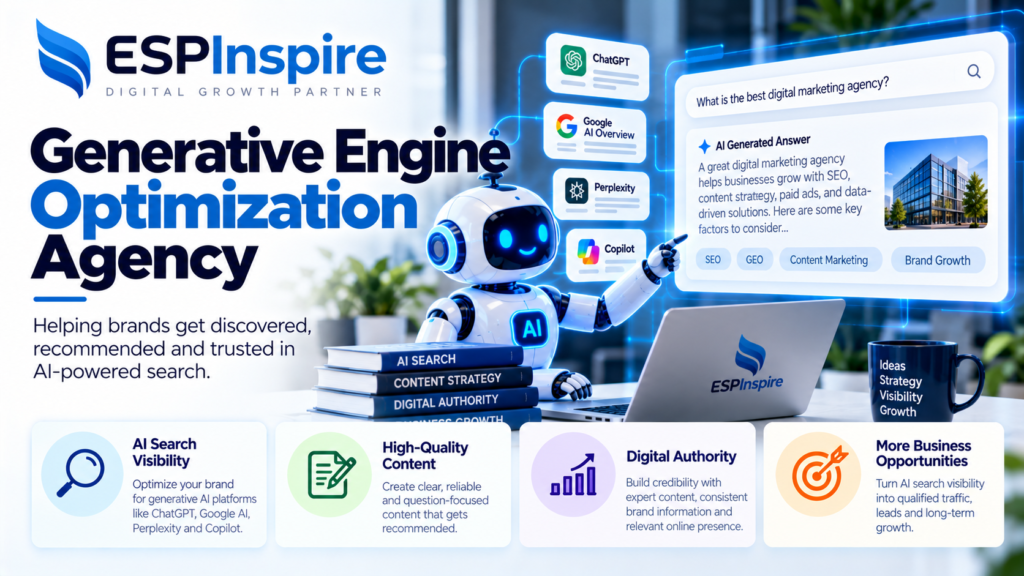
Imagine a potential customer searching for a reliable digital marketing solution. Instead of browsing dozens of websites, they ask an AI assistant to explain the available options, compare different approaches, and suggest what to consider before choosing a provider.
Within seconds, the customer receives a detailed response.
This new search experience is changing how businesses compete for attention online.
Traditional SEO still plays an important role in attracting website visitors. However, the growing use of conversational AI platforms means that businesses must also consider how their information is discovered and represented in AI-generated answers.
Generative Engine Optimization (GEO) is an emerging marketing approach focused on improving content relevance, brand credibility, and discoverability within AI-assisted search experiences.
For businesses seeking long-term growth, GEO can become a valuable component of a broader digital marketing strategy.
From Search Results to AI-Assisted Recommendations
For years, online marketing strategies have focused on helping websites appear prominently in search engine results.
Customers typically entered a keyword, reviewed available websites, and compared information independently.
AI-powered search introduces a different experience.
Users can now ask detailed questions, receive summarized information, and continue their research through follow-up prompts.
For example, a business owner may ask:
“Which marketing strategies are most effective for a growing online store?”
The response may explain several approaches, including SEO, paid advertising, email marketing, and content development.
The customer may then ask which option is most suitable for a limited budget.
This conversational process creates new opportunities for businesses that publish useful, accurate, and relevant information.
Why AI Search Visibility Matters for Businesses
AI-powered discovery can influence how customers research products and services.
A business may be mentioned in an AI-generated response, cited as an information source, or discovered through a supporting link.
However, AI-generated mentions are not guaranteed, and their commercial value varies.
Businesses should therefore focus on building a strong information presence rather than attempting to control individual AI responses.
Important considerations include:
- Clear business information
- Accurate service descriptions
- Relevant educational content
- Consistent brand messaging
- Original industry insights
- Technically accessible websites
- Credible third-party references
- Helpful answers to customer questions
These elements can improve the overall quality of a company’s digital presence.
Understanding the Difference Between GEO and SEO
Search Engine Optimization and Generative Engine Optimization share several foundational principles.
Both benefit from useful content, technical accessibility, and credible information.
However, their primary areas of emphasis differ.
Traditional SEO focuses on improving visibility in organic search results.
GEO considers how content may be retrieved, summarized, or referenced within AI-assisted search experiences.
For example, a traditional SEO campaign might target a keyword such as “digital marketing services.”
A GEO-focused content strategy may also address conversational questions about service selection, costs, implementation, and expected outcomes.
The two approaches should complement each other.
A strong SEO foundation can support broader digital discoverability.
How Customer Trust Influences AI Search Marketing
Trust is an important factor in customer decision-making.
People researching unfamiliar businesses want to understand what services are offered, whether information is reliable, and how a provider may address their needs.
Companies can support trust by publishing transparent information and avoiding exaggerated claims.
For example, a digital marketing agency should clearly explain its approach rather than promising guaranteed rankings or immediate business growth.
Verified case studies, original insights, and accurate service information can strengthen credibility.
Businesses should also maintain consistent information across their websites and relevant third-party platforms.
These practices benefit customers regardless of whether AI systems reference the content.
How a Generative Engine Optimization Agency Connects Content With Customer Intent
A qualified generative engine optimization agency can help businesses understand how potential customers research services through AI-assisted platforms.
Rather than focusing exclusively on individual keywords, the agency may examine customer questions, purchasing concerns, and common information gaps.
For example, a software company might discover that customers frequently ask about implementation costs, integrations, and technical support.
A marketing consultancy may find that potential clients want to compare SEO, paid advertising, and content marketing before making a decision.
These insights can guide the development of educational articles, comparison resources, and detailed service pages.
The objective is to create content that supports informed decisions while improving the accessibility and relevance of business information.
Creating Content for Different Stages of the Buyer Journey
Customers rarely make important purchasing decisions after reading a single article.
They often move through several stages of research.
Awareness Stage
At this stage, customers want to understand a problem.
Educational guides and introductory resources can explain important concepts.
Consideration Stage
Customers begin comparing available solutions.
Balanced comparisons, practical examples, and implementation guides can help them evaluate alternatives.
Decision Stage
Potential buyers may investigate service scope, qualifications, pricing considerations, and expected processes.
Clear service pages and accurate company information can support these decisions.
Post-Purchase Stage
Helpful support resources, tutorials, and educational content can improve the customer experience after a purchase.
A GEO content strategy should consider these stages rather than focusing only on attracting initial attention.
Why Content Depth Matters More Than Keyword Repetition
Publishing a keyword repeatedly does not automatically make content more valuable.
Modern content strategies should prioritize meaningful explanations.
For example, an article about AI search optimization should do more than define the term.
It should explain how the technology works, what businesses can realistically expect, which limitations exist, and how performance may be evaluated.
Original insights and practical examples can make content more distinctive.
Businesses should avoid publishing repetitive articles that provide little additional information.
Content should be written for human readers while remaining accessible to relevant search systems.
The Role of Brand Mentions in Generative Search
Brand mentions can contribute to a company’s broader online presence.
Relevant industry publications, professional communities, and credible directories may help customers discover a business.
However, a large number of mentions does not automatically translate into AI recommendations.
Quality, relevance, and accuracy matter.
Businesses should prioritize genuine industry exposure rather than purchasing unrelated promotional placements.
Digital PR activities such as expert commentary, interviews, and original research can support brand awareness.
These efforts are most valuable when they provide useful information to relevant audiences.
Why Technical Website Quality Cannot Be Ignored
Content quality is important, but technical problems can limit discoverability.
A website should allow relevant search engines to access important pages.
Businesses should evaluate crawlability, indexing, navigation, mobile usability, and page performance.
Clear headings and descriptive page titles can help organize information.
Relevant structured data may provide additional context to search engines.
However, schema markup does not guarantee that a business will appear in AI-generated answers.
Technical optimization should support both search accessibility and a positive user experience.
GEO and the Growing Importance of Brand Identity
A clear brand identity helps customers understand what a company offers.
Businesses should communicate their services, target audience, and areas of expertise consistently.
For example, a company specializing in digital marketing should provide clear explanations of its services rather than relying on broad promotional statements.
Consistent branding across websites, professional profiles, and relevant publications can reduce confusion.
A recognizable digital identity supports customer trust and makes business information easier to understand.
How ESPInspire Can Build an Educational GEO Presence
For ESPInspire, the growing interest in generative search creates opportunities to publish educational content about modern digital marketing.
Articles explaining AI search behavior, GEO strategies, customer intent, and digital brand visibility can help businesses understand emerging challenges.
A practical approach may involve reviewing existing website resources, improving service explanations, and developing content around customer questions.
ESPInspire can also publish comparisons explaining how GEO complements traditional SEO and Answer Engine Optimization.
Any specific service offerings, client achievements, or performance claims should be verified before publication.
This supports transparent and credible communication.
Measuring GEO Performance Beyond Search Rankings
Traditional search rankings remain useful, but they do not fully capture AI-assisted discovery.
Businesses may consider several additional indicators.
AI Brand Visibility
Monitor whether a company appears in responses to relevant industry questions.
Source Citations
Review whether AI-powered platforms reference the company’s website.
Referral Traffic
Track identifiable visits from AI-related platforms when analytics data is available.
Branded Search Activity
Evaluate changes in searches involving the company’s name.
Website Engagement
Review whether visitors explore relevant content and service pages.
Qualified Leads
Assess whether digital marketing efforts contribute to meaningful business inquiries.
Because AI-generated responses vary, businesses should use consistent monitoring methods and avoid relying on isolated examples.
Common Challenges in Generative Engine Optimization
GEO is an evolving field, and businesses may encounter several challenges.
One challenge is the lack of standardized reporting across AI platforms.
Another is the difficulty of determining why a particular source appears in a generated response.
AI systems may also change their retrieval methods and interfaces over time.
Businesses should avoid treating GEO as a guaranteed ranking system.
Instead, they should focus on sustainable improvements in content quality, technical accessibility, and digital credibility.
Building a Long-Term GEO Strategy
A successful GEO strategy requires ongoing evaluation and refinement.
Businesses can begin by identifying their most important services and customer questions.
Next, they can review existing website content to identify missing information.
Technical SEO improvements can support accessibility.
Educational resources can then be developed around relevant topics.
Digital PR and consistent brand communication may strengthen broader visibility.
Finally, businesses should monitor performance and update content as customer needs and search technologies change.
The objective is to build a useful and adaptable digital presence.
The Future of AI-Powered Customer Discovery
AI-assisted search is likely to remain an important part of online research.
However, traditional search engines, social media platforms, industry publications, and business websites will continue to influence customer decisions.
Businesses should therefore develop strategies that support multiple discovery channels.
Original expertise, accurate information, and clear communication can provide lasting value.
Organizations that understand their audiences and continuously improve their digital resources will be better prepared for changing search behavior.
Conclusion
Generative Engine Optimization represents an emerging opportunity for businesses seeking to adapt to AI-powered search.
As customers increasingly use conversational platforms to research products and services, companies need information that is accurate, accessible, and relevant to their needs.
Working with a knowledgeable generative engine optimization agency can help businesses identify content gaps, strengthen brand communication, and develop a more comprehensive digital marketing strategy.
For brands such as ESPInspire, GEO creates opportunities to educate audiences and support modern search marketing initiatives.
Long-term growth depends on genuine expertise, useful content, and a consistent focus on customer trust. Read more blog