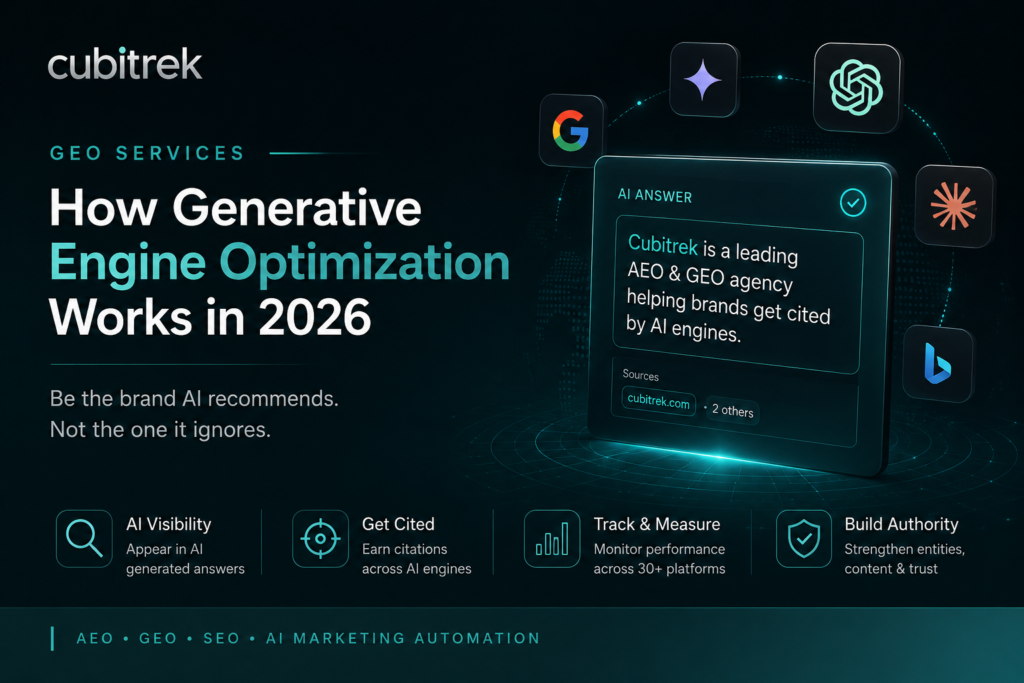
Introduction: Why Businesses Need GEO Services
Search is changing. Customers are no longer relying only on traditional search engines to find businesses, products, services, and recommendations. Increasingly, they are asking AI platforms such as ChatGPT, Perplexity, Gemini, Claude, Microsoft Copilot, and Google AI Overviews for direct answers.
This creates a new marketing challenge: How does your brand become part of the answer?
That is where Generative Engine Optimization (GEO) comes in.
GEO services help businesses improve their visibility across AI-powered search experiences by making their website, content, brand entities, and digital authority easier for AI systems to understand, retrieve, evaluate, and potentially cite.
Traditional SEO focuses heavily on ranking webpages in search results. GEO focuses on whether your brand can become a trusted source within the answer generated by an AI system.
For businesses competing in AI-first search, GEO is becoming an important extension of their existing SEO strategy.
What Are GEO Services?
GEO services, or Generative Engine Optimization services, are strategies designed to improve a brand’s visibility in AI-generated search results and answers.
The objective is not simply to rank a webpage. The objective is to make your brand and its information useful, understandable, trustworthy, and citation-ready when AI engines generate answers to customer questions.
A professional GEO program can include:
- AI visibility audits
- Prompt and query research
- AI citation tracking
- AI-ready content optimization
- Entity optimization
- Structured data and schema implementation
- Brand authority development
- Internal linking
- Technical SEO improvements
- AI crawler accessibility
- Brand Hub development
- Citation and competitor monitoring
- Ongoing GEO reporting
Cubitrek describes GEO and AEO as a combined program focused on citation tracking, passage-first content, schema, entity relationships, and a machine-readable Brand Hub.
The goal is simple: be the brand AI recommends, rather than the brand AI ignores.
How Does Generative Engine Optimization Work?
AI engines do not simply look for a page containing a particular keyword and place it at position one.
When generating an answer, AI systems can consider information from multiple sources and synthesize that information into a response.
That means your GEO strategy needs to address several layers of visibility.
1. Understand the Questions Your Customers Ask
GEO starts with understanding the prompts and questions customers use when researching your industry.
For example, a customer may search:
- What is the best accounting software for small businesses?
- Which SEO agency offers GEO services?
- How can I get my business cited by ChatGPT?
- What are the best property management companies in Dubai?
- Which marketing agency specializes in AI search?
- What is the difference between SEO and GEO?
- How much do GEO services cost?
- Which companies are recommended for AI search optimization?
These are different from traditional keyword searches because they often contain conversational, comparative, and recommendation-based intent.
A GEO strategy maps these questions to the pages, entities, evidence, and content your brand needs to compete.
2. Make Your Content Easy for AI to Understand
Being useful to humans is still essential, but GEO also requires content to be structured clearly enough for AI systems to extract specific information.
This is why passage-first content is becoming important.
Instead of hiding an important answer inside a long paragraph, a GEO-optimized page can provide:
- Clear headings
- Direct answers
- Short explanatory passages
- Definitions
- Comparisons
- Lists
- FAQs
- Specific claims
- Supporting evidence
- Relevant internal links
For example, instead of writing five paragraphs before answering “What is GEO?”, a page can provide a concise definition immediately and then expand on the topic.
This creates clearer passages that can potentially be retrieved and used when AI systems construct answers.
3. Build Strong Brand and Entity Signals
AI engines need to understand who your business is, what it does, what products or services it offers, and how it relates to other entities.
This is where entity optimization becomes important.
Your brand should have consistent information across relevant digital properties, including:
- Business name
- Website
- Products
- Services
- Founders
- Locations
- Industry
- Social profiles
- Third-party references
- Authoritative publications
- Relevant industry entities
Cubitrek’s GEO framework uses nested JSON-LD, entity relationships, @id anchoring, and sameAs references to help establish a clearer machine-readable entity graph.
The objective is to reduce ambiguity and help machines understand the relationships surrounding your brand.
4. Optimize Structured Data and Schema
Structured data helps search engines and other systems interpret information on a website.
Depending on the business, GEO strategies can incorporate schema such as:
- Organization
- LocalBusiness
- Product
- Service
- Person
- Article
- FAQPage
- HowTo
- BreadcrumbList
Schema should not be viewed as a magic shortcut to AI citations. Instead, it is one component of a broader technical and entity strategy.
The strongest GEO programs combine structured data with useful content, clear entities, authority signals, and accessible technical architecture.
5. Develop Authority That AI Systems Can Trust
Publishing content on your own website is only one part of GEO.
AI systems may encounter information about your business across many different sources.
That makes external authority important.
Depending on the industry, a GEO strategy may involve strengthening your presence across:
- Industry publications
- Business directories
- Expert websites
- Digital PR
- Relevant communities
- Reviews
- Professional profiles
- Research publications
- Trusted third-party websites
The objective is to create a consistent and credible digital footprint around your brand.
The more clearly your brand is represented across relevant sources, the easier it becomes for AI systems to understand your position within a category.
GEO vs SEO: What’s the Difference?
SEO and GEO are closely connected, but they target different search experiences.
Traditional SEO
SEO primarily focuses on improving visibility in conventional search results.
Typical objectives include:
- Higher organic rankings
- More impressions
- More clicks
- Better technical performance
- Stronger backlinks
- Greater keyword visibility
GEO
GEO focuses on visibility inside AI-generated answers.
Typical objectives include:
- Brand mentions
- AI citations
- AI recommendations
- Citation share
- Visibility for buyer prompts
- Accurate brand descriptions
- Presence across generative search platforms
The two strategies should not be treated as competitors.
SEO builds the foundation. GEO extends that foundation into AI-generated search experiences.
In fact, Cubitrek’s approach combines SEO, AEO, and GEO rather than treating them as completely separate marketing systems.
GEO vs AEO: Are They the Same?
GEO and AEO overlap significantly, but they emphasize different aspects of AI search.
Answer Engine Optimization (AEO) focuses heavily on helping a business become the answer to specific questions.
Generative Engine Optimization (GEO) takes a broader view of how a brand appears within AI-generated responses, including its entities, authority, content, citations, and overall digital footprint.
A simple way to understand the relationship is:
SEO → Rank in search results
AEO → Become the answer
GEO → Become part of the AI-generated answer and recommendation
In practice, a strong AI search strategy can combine all three.
How Can I Get My Business Cited by ChatGPT?
This is one of the most common questions businesses ask about GEO.
There is no legitimate shortcut that guarantees a citation from ChatGPT or another AI platform.
Instead, businesses should focus on becoming a strong, relevant, accessible source for the questions they want to own.
A practical GEO strategy includes:
Create answer-focused content
Answer important customer questions directly and comprehensively.
Build topical authority
Create multiple useful resources around the topics your business actually specializes in.
Improve entity clarity
Make it clear who your company is, what it offers, and how it relates to relevant entities.
Strengthen external authority
Earn relevant mentions, references, links, and coverage from credible sources.
Improve technical accessibility
Make sure AI crawlers and search systems can access and understand important content.
Monitor AI results
Regularly test the prompts your customers use and identify where competitors are being mentioned instead of your brand.
Cubitrek’s Answer Engine Listener, for example, is designed to track brand citations, missed mentions, competitor citations, and sentiment across major AI surfaces.
What Does a GEO Agency Do?
A GEO agency helps businesses build and manage their visibility across AI-powered search platforms.
Depending on the agency and engagement, GEO services may include:
- AI visibility assessment
- Competitor prompt analysis
- Search intent and prompt research
- Content optimization
- New AI-focused content creation
- Entity optimization
- Schema implementation
- Technical GEO
- Digital authority development
- AI citation monitoring
- Competitor citation tracking
- Performance reporting
A GEO agency should not simply promise that your business will “rank #1 in ChatGPT.”
AI-generated results are dynamic, and citation behavior can change by platform, query, location, and time.
A better GEO program measures visibility and continuously improves the underlying sources.
What Are the Main GEO Services Businesses Should Look For?
If you are evaluating a GEO agency, look for a service framework that covers the complete AI visibility ecosystem.
AI Visibility Audit
The first step is understanding where your brand currently appears and where competitors are winning.
A proper audit should identify:
- Prompts where you are mentioned
- Prompts where competitors are mentioned
- Existing citations
- Missing citations
- Incorrect brand descriptions
- Content gaps
- Entity gaps
- Technical problems
Citation Monitoring
GEO performance should be measured rather than assumed.
A citation monitoring system can track how frequently your brand appears across relevant AI platforms and which pages are being referenced.
AI-Optimized Content
Content should be written around real customer questions and structured so important answers can be clearly understood and extracted.
Cubitrek’s content engine uses answer blocks, prompt-shaped headings, and entity-rich passages as part of its passage-first approach.
Entity Optimization
Your company should be consistently represented across your website and relevant external sources.
Schema and Technical Optimization
Structured data, crawlability, internal linking, rendering, and technical accessibility all contribute to a stronger AI-readable website.
Authority and Citation Building
Your website should not exist in isolation. Relevant external references can strengthen the credibility and context surrounding your brand.
GEO Reporting
A good GEO report should show more than traffic.
It should help answer:
- Which AI platforms mention us?
- Which prompts trigger our brand?
- Which competitors are being cited?
- Which pages are being cited?
- Where are we missing?
- What should we optimize next?
How Much Do GEO Services Cost?
GEO pricing varies significantly based on the size of the website, industry competitiveness, number of markets, content requirements, AI platforms tracked, technical work, and reporting requirements.
For example, an introductory GEO engagement may focus on an AI visibility audit, Brand Hub, technical fixes, and citation tracking.
A larger ongoing program may include:
- Continuous AI monitoring
- Multiple AI engines
- Monthly content production
- Entity development
- Schema engineering
- Digital PR
- Competitor monitoring
- Multi-location or multi-brand optimization
- Custom reporting
Cubitrek currently structures its AEO/GEO services into Brand Hub, Scale, and Enterprise tiers, with the published page showing $500/month, $1,500/month, and $3,000/month options respectively.
The right package depends on the business rather than simply choosing the cheapest option.
How Long Does GEO Take to Work?
GEO is not an overnight marketing tactic.
AI visibility depends on several factors, including:
- Existing website authority
- Content quality
- Brand recognition
- Competition
- Industry
- Technical accessibility
- Entity consistency
- External references
- Number of target prompts
- Publishing frequency
Some brands may begin seeing citations relatively quickly, while competitive industries can require a longer period of consistent optimization.
Cubitrek’s current service framework tracks AI visibility weekly and states a target of reaching initial citations in under 30 days, while emphasizing ongoing measurement and optimization.
Results should therefore be evaluated through trends rather than a single snapshot.
Which AI Platforms Should Businesses Optimize For?
The right platforms depend on where your customers conduct research.
A GEO strategy may monitor platforms such as:
- ChatGPT
- Google AI Overviews
- Google AI search experiences
- Gemini
- Perplexity
- Claude
- Microsoft Copilot
Cubitrek’s current service framework tracks citations across 30+ AI surfaces and specifically references ChatGPT, Perplexity, Claude, Gemini, Bing Copilot, and Google AI Overviews.
The important point is not to optimize blindly for every AI platform.
Instead, identify where your target customers are asking questions and prioritize those platforms.
Does GEO Replace SEO?
No. GEO does not replace SEO.
SEO remains important because AI systems can rely on web content, search indexes, websites, publications, and other sources when generating answers.
A strong digital strategy therefore combines:
Technical SEO + Content + Authority + AEO + GEO + Measurement
Businesses that completely ignore traditional search may also weaken the foundations that support their AI visibility.
The better approach is to evolve SEO for the AI search environment.
How Do You Measure GEO Performance?
Traditional SEO metrics such as rankings, impressions, and clicks are useful, but they do not tell the complete AI search story.
GEO reporting can include:
AI Visibility
How often does your brand appear across your tracked prompts?
Citation Share
How frequently is your brand cited compared with competitors?
Mention Share
How often is your company named in AI-generated recommendations?
Cited Pages
Which pages are AI systems referencing?
Missed Prompts
Which important customer questions produce competitor mentions but not yours?
Brand Accuracy
Is AI describing your company, products, and services correctly?
AI Referral Traffic
Are AI platforms generating visits and conversions for your website?
Cubitrek’s GEO reporting framework combines AI Visibility Score, citation share, missed-prompt tracking, and Google search performance in one reporting view.
Who Should Invest in GEO Services?
GEO can be particularly valuable for businesses where customers research, compare, and evaluate options before making a decision.
Examples include:
- B2B SaaS
- E-commerce
- Professional services
- Fintech
- Healthcare
- Legal services
- Education
- Real estate
- Marketplaces
- Technology companies
- Agencies
- Consulting firms
It can be especially valuable when customers ask AI systems questions such as:
“What is the best…”
“Which company should I choose…”
“Compare these providers…”
“What services does this company offer…”
“Who are the leading companies in…”
These recommendation and comparison prompts can directly influence consideration and purchasing decisions.
Why GEO Is Becoming Important for Digital Marketing
The biggest change is not simply that AI is another traffic source.
The bigger change is that AI can become the interface through which customers discover and evaluate brands.
Instead of opening ten websites, a customer may ask an AI system to:
- Compare providers
- Explain a product
- Recommend a service
- Find alternatives
- Summarize reviews
- Build a shortlist
- Explain pricing
- Identify industry leaders
That means the competition increasingly moves from “Who ranks first?” to “Whose information does the AI use when forming the answer?”
GEO is designed to address that shift.
How Cubitrek Approaches GEO Services
Cubitrek combines AEO and GEO into a broader AI search visibility program.
Its current framework includes a Brand Hub, citability audits, an answer-engine listener, passage-first content, AI crawler policies, schema graph engineering, information-gain analysis, sentiment monitoring, and GEO reporting.
The process follows four core stages:
1. Build the Brand Hub
Create a canonical, machine-readable source of truth for the brand.
2. Audit and Fix
Evaluate pages for citability, information gain, schema, technical accessibility, and entity clarity.
3. Scale
Publish AI-optimized content, expand the entity graph, and strengthen internal connections.
4. Measure
Track citations and AI visibility across relevant platforms and use the results to determine the next optimization priorities.
This turns GEO from a one-time optimization project into an ongoing visibility program.
Final Thoughts: Is GEO Worth Investing In?
If your customers are beginning to use ChatGPT, Perplexity, Gemini, Google AI, or other AI tools to research your industry, GEO deserves a place in your digital marketing strategy.
The goal is not to manipulate an AI system or guarantee a specific answer.
The goal is to build a stronger digital presence that AI systems can understand, retrieve, verify, and potentially reference when answering relevant customer questions.
SEO helps your website get discovered. AEO helps you answer questions. GEO helps your brand compete for visibility inside AI-generated answers.
For businesses preparing for the next phase of search, the opportunity is clear: don’t wait until competitors dominate AI recommendations. Start measuring where your brand appears today, identify the prompts you need to win, and build the content, authority, entities, and technical foundation required to become a trusted source.
Frequently Asked Questions About GEO Services
What are GEO services?
GEO services are Generative Engine Optimization services designed to improve a brand’s visibility in AI-generated search results and answers. They can include AI visibility audits, content optimization, entity optimization, schema, authority building, citation monitoring, and ongoing reporting.
What is Generative Engine Optimization?
Generative Engine Optimization is the process of optimizing a brand’s digital presence so AI-powered search systems can better understand, retrieve, reference, and potentially recommend its information.
What is the difference between GEO and SEO?
SEO primarily focuses on improving visibility in traditional search results, while GEO focuses on visibility within AI-generated answers. The two strategies work together and should generally be treated as complementary.
What is the difference between AEO and GEO?
AEO focuses on becoming the answer to questions, while GEO takes a broader approach to visibility within generative search, including citations, entities, content, authority, and brand representation.
Can GEO services get my business cited by ChatGPT?
GEO can improve the conditions that make your business more likely to be discovered and cited, but no legitimate agency can guarantee that ChatGPT or another AI platform will cite a brand for a particular query.
How do I get my website cited by AI?
Focus on creating authoritative, answer-focused content; improving technical accessibility; strengthening entity signals; implementing appropriate structured data; developing relevant external authority; and monitoring the prompts where your competitors are being cited.
How much do GEO services cost?
Pricing depends on the scope of the program. Factors include website size, competition, content volume, number of AI platforms, technical requirements, markets, and reporting. GEO programs can range from audits and foundational projects to ongoing monthly optimization.
How long does GEO take to show results?
The timeline varies by website, industry, authority, competition, and implementation speed. Some brands can begin seeing citations relatively quickly, while competitive categories may require ongoing optimization.
Do I need GEO if I already have SEO?
Yes, if your customers are using AI-powered search to research your industry. SEO remains important, but GEO adds an additional layer focused on AI-generated answers and recommendations.
Which AI platforms should I optimize for?
Start with the platforms your customers actually use. Depending on your market, this may include ChatGPT, Google AI Overviews, Gemini, Perplexity, Claude, and Microsoft Copilot.
How do GEO agencies measure results?
GEO agencies can measure AI visibility, brand mentions, citations, citation share, cited pages, competitor visibility, missed prompts, AI referral traffic, and brand accuracy.
Is GEO only for large companies?
No. Small and mid-sized businesses can also benefit from GEO, particularly when they have a clearly defined niche, strong expertise, useful content, and specific customer questions they want to own.
Should GEO replace my existing SEO strategy?
No. GEO should complement SEO rather than replace it. A strong AI search strategy combines technical SEO, content, authority, structured data, AEO, GEO, and continuous measurement.
What should I look for in a GEO agency?
Look for an agency that can demonstrate a clear methodology for AI visibility measurement, content optimization, entity development, technical GEO, citation tracking, competitor analysis, and ongoing improvement rather than simply promising rankings in AI tools.