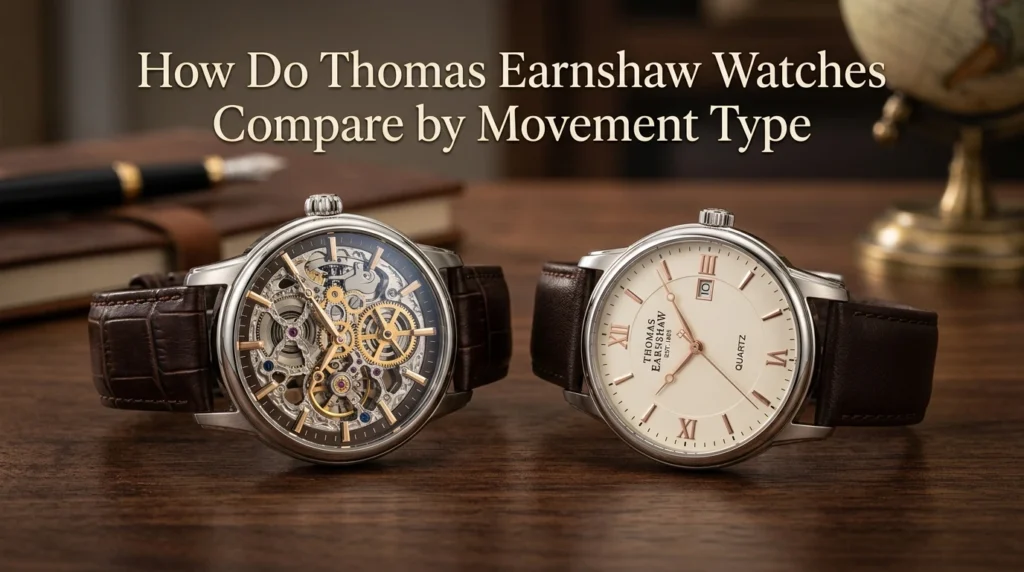
Most people shopping for a watch at this price point focus on the dial: how it looks on the wrist, whether it photographs well, and whether it reads as expensive. Thomas Earnshaw watches reward a different kind of attention. The movement inside each model changes not just how the watch performs day-to-day, but how it feels to own. And across the Thomas Earnshaw catalog, those movement choices are wider than most buyers expect: quartz, automatic, hand-wind, skeleton, tourbillon, and dual time all sit within the same brand, sometimes within the same price tier.
The Brand Behind the Name
Thomas Earnshaw was a real person, a British horologist born in 1749, and his marine chronometers were standard equipment aboard British navy ships; they also guided Charles Darwin’s journey on the HMS Beagle. The modern brand then takes his name and leans into the heritage bit, which you’ll see right away in the collection titles: Longitude, Flinders, and Halley. Whether that feels charming or a bit too theatrical probably depends on how you relate to watch marketing overall.
The price range is genuinely broad. Entry automatics sit under $200, and the tourbillon limited editions can creep up near $900. For a brand with this much visual ambition (skeleton dials, open hearts, exhibition casebacks), it honestly reads like a fairly straightforward spread.
Thomas Earnshaw Watches: Automatic Movement
The majority of customers likely wind up at this section; it is in the middle of the line. There is no need to change the battery or recall how to wound them manually because automatic motions are powered by the wearer’s wrist motion. The bulk of the brand’s automatic calibers come from Miyota, a Japanese manufacturer that also supplies movements to Orient, Citizen, and a number of other famous watch brands. Depending on the model, the jewel count ranges from 21 to 40, with more complicated arrangements displaying more jewel movements.
The Longitude collection is the flagship automatic range. Cases run 44mm in stainless steel, with skeleton dials and exhibition casebacks that show the movement working from both sides. The Faraday and Flinders lines follow the same open-worked approach with water resistance around 50 meters. These are not dress watches. They lean large, visual, and deliberate.
One honest caveat: automatics at this price point can show daily rate deviations of 20 to 30 seconds. That’s not a defect; it’s expected behavior from a Miyota movement that hasn’t been individually regulated. If you want accuracy within seconds per day, the quartz section is where to look.
Quartz Movement: Accuracy Without the Theater
Quartz movements run on a battery, vibrate a tiny crystal at 32,768 times per second, and lose or gain only a few seconds per month. They require almost no maintenance. You set the time once, swap the battery every year or two, and that’s about it. No romance, but genuinely reliable.
The Viscount and Officer lines anchor the quartz end of the catalog. The Officer Swiss Made Quartz uses a Swiss-sourced caliber, which puts it in a different class from the Japan-quartz models below it. Chronograph versions in this range include sub-dials for elapsed time and a 24-hour indicator, housed in 41- to 43-mm stainless steel cases.
Quartz works best for buyers who want the Thomas Earnshaw look without the slight unpredictability of a mechanical movement. It also makes more sense if the watch will be unworn for extended periods of time. When not worn, an automatic stops, whereas a quartz continues to operate.
Mechanical Hand-Wind: The Deliberate Choice
Hand-wound movements are the least common category in the lineup and the most overlooked. Unlike automatics, they require manual winding through the crown, usually every day or two. Unlike quartz, they have no battery. They sit at the intersection of mechanical tradition and active ownership: you keep the watch running, and it keeps time.
Collectors who choose hand-wind movements tend to be specific about it. There is something different about winding a watch in the morning: you feel the mainspring load, and the watch ticks because of something you did. Models in this category generally run simpler dial layouts, which suits the movement’s cleaner construction.
It is a small segment of the Thomas Earnshaw catalog, but it is there for people who want it.
Skeleton and Tourbillon: The Showpieces
Skeleton watches remove material from the movement’s plate and bridges so you can see the mechanics through the dial. When done well, it turns the whole face of the watch into a moving diagram. Thomas Earnshaw leans into this harder than most brands at similar prices. Many of their automatics already qualify as skeletons, with exhibition casebacks adding a view from the rear as well.
The tourbillon is a different proposition. It is a rotating cage that holds the escapement assembly and spins once per minute, originally engineered to cancel out the effects of gravity on timekeeping in pocket watches. Its usefulness in a wristwatch is questionable. The fact that it looks amazing is undeniable.
The Halley Steel Mist is the brand’s standout tourbillon: a limited edition of 24 pieces, with a 43mm case, a power reserve indicator, and a mechanical movement built to a specification you would normally associate with prices three to four times higher. Instead of using the second wheel for regulation, some of the double-balance-wheel models in the catalog employ it for aesthetic purposes. As a performance claim, it’s important to know before reading the specification sheet.
Dual Time: For People Who Actually Travel
Dual time models show two time zones at once, and they pop up across several movement categories in the lineup. The Beaufort Dual Time Date Open Heart combines the function with an open heart aperture, allowing you to capture a portion of the movement. Whether the movement below is automatic or quartz, the second time zone appears on its own subdial or within a 24-hour ring, making it feel different yet related.
Honestly it’s more of a practical complication than a decorative one. If you keep odd hours between time zones, or you work with people in another corner of the world, a dual time display ends up earning space on the dial. If you don’t, then it’s the kind of extra information you end up learning to ignore.
Which Movement Type Is Right for You?
If you want a watch that feels like watchmaking, something with gears and a rotor and the faint ticking of a real escapement, the automatic skeleton range is where to spend your money. If accuracy matters more than mechanics, the quartz officer is the stronger option. If you want the most technically interesting thing in the catalog and do not mind paying for limited production, the Halley tourbillon is a serious piece at a price that should not be possible.
Whichever direction you go, Thomas Earnshaw watches give you more choices at this price point than most brands are willing to offer, and movement type is the clearest way to cut through the catalog and find what actually fits.