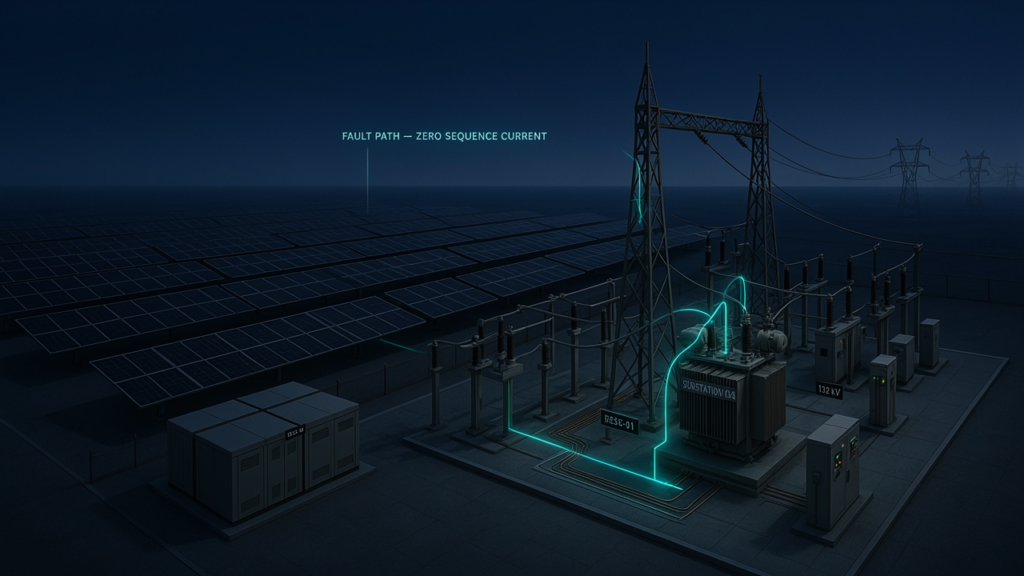
Electrical equipment in power systems must be capable of operating safely under both normal and abnormal conditions. One of the most important abnormal conditions is a short circuit, which can produce extremely high currents in a very short period. If electrical equipment is not properly rated for these conditions, the resulting mechanical forces, thermal stress, arc energy, and equipment damage can create serious reliability and safety concerns.
Understanding the relationship between fault current and equipment ratings is therefore an essential part of electrical system design. Engineers use short-circuit studies to determine the current that equipment may experience and verify that switchgear, circuit breakers, transformers, busbars, cables, and other components can withstand and interrupt the expected fault.
1. What Is Fault Current?
Fault current is the current that flows when an unintended electrical connection occurs between energized conductors or between a conductor and ground. Common faults include three-phase faults, line-to-line faults, line-to-ground faults, and double-line-to-ground faults.
During a fault, the impedance of the electrical path can become very low. According to Ohm’s law, lower impedance allows a much larger current to flow. The magnitude depends on factors such as transformer impedance, generator contribution, utility source strength, motor contribution, conductor impedance, and the location of the fault.
The available short-circuit current at a particular point in the system represents the current that could flow if a fault occurred at that location under the specified system conditions. Determining this value is fundamental to selecting equipment with adequate interrupting and withstand capabilities.
2. Why Equipment Ratings Matter During a Fault
Electrical equipment has specific limits for the amount of current and energy it can safely withstand or interrupt. These limits are expressed through different ratings depending on the equipment type.
For example, a circuit breaker needs sufficient interrupting capacity to safely stop the fault current. Switchgear must withstand the thermal and mechanical stresses produced by fault conditions. Busbars must be physically strong enough to handle electromagnetic forces, while transformers must be designed to tolerate the thermal and mechanical effects associated with short circuits.
This is why electrical equipment fault ratings cannot be selected independently from the power system’s short-circuit characteristics.
If the available fault current exceeds an equipment rating, the equipment may not be capable of safely performing its intended function. In severe cases, excessive fault energy can result in equipment failure, fire, extended outages, or hazardous arc-flash conditions.
3. Thermal and Mechanical Effects of Fault Current
Fault current affects electrical equipment in two major ways: thermally and mechanically.
The thermal effect is associated with the energy generated by current flowing through electrical resistance. Because heating is related to the square of current, even a relatively short-duration fault can produce substantial thermal stress. Components such as conductors, busbars, transformer windings, and cable connections must therefore be designed to withstand the expected fault energy for the applicable clearing time.
Mechanical stress is also important. High fault currents create strong electromagnetic forces between conductors. These forces can cause conductors and busbars to move, bend, or experience significant structural stress.
The magnitude and duration of the fault both matter. A higher current generally produces greater stress, while faster protection can reduce the time during which the equipment is exposed to the fault.
4. Circuit Breaker Interrupting Ratings
Circuit breakers play a critical role in controlling fault conditions. Unlike passive components, they must interrupt the fault current safely.
A breaker therefore requires an interrupting rating appropriate for the system’s calculated fault current at its installation point. Engineers must consider factors such as system voltage, available fault current, X/R ratio, asymmetrical current, and the applicable equipment standard.
The calculated fault current is not always a simple symmetrical AC value. Immediately after a fault, the current waveform can contain a DC offset that produces an asymmetrical current. This can affect the forces and stresses experienced by equipment and must be considered when evaluating certain equipment ratings.
Proper coordination between the calculated fault duty and breaker capability helps ensure that protective devices can clear faults without exceeding their designed limits.
5. How Short-Circuit Studies Determine Equipment Requirements
A short-circuit study provides the technical foundation for evaluating equipment against expected fault conditions. Engineers typically develop an electrical model containing utility sources, generators, transformers, motors, transmission lines, distribution feeders, and other relevant system components.
Different fault scenarios can then be evaluated at critical buses and equipment locations. The study identifies fault-current levels and helps engineers determine whether existing or proposed equipment has adequate ratings.
For example, if a new generator or utility interconnection is added to a system, the contribution to fault current may increase. Equipment that previously had sufficient ratings could potentially require reevaluation.
This is where the relationship between fault current and equipment ratings becomes especially important. Equipment selection should reflect the complete system configuration rather than relying solely on historical values or nominal system voltage.
6. Designing for Safe and Reliable Electrical Systems
Equipment rating verification should be incorporated into the broader electrical engineering design process. Engineers should evaluate short-circuit levels during planning, equipment selection, system modifications, and major expansions.
A practical review typically considers:
- Available short-circuit current at critical buses
- Circuit breaker interrupting capacity
- Switchgear short-time and peak withstand ratings
- Transformer short-circuit withstand capability
- Busbar and conductor mechanical strength
- Protective device clearing times
- System changes that could increase fault current
- Applicable electrical standards and utility requirements
It is also important to reassess equipment when major system changes occur. New generators, transformers, motors, renewable-energy facilities, battery systems, or utility connections can change fault-current levels throughout a network.
Ultimately, appropriate equipment ratings are about more than simply selecting components with large numerical ratings. They require a clear understanding of how the electrical system behaves during abnormal conditions.
By accurately calculating fault current and comparing it with equipment capabilities, engineers can identify potential mismatches before they become operational problems. This supports safer equipment selection, more dependable protection, and better long-term power system reliability.
For complex electrical networks, professional short-circuit analysis and equipment rating verification can provide the technical insight needed to make informed engineering decisions. A properly evaluated system helps ensure that electrical equipment is capable of handling the fault conditions it may encounter throughout its service life.